


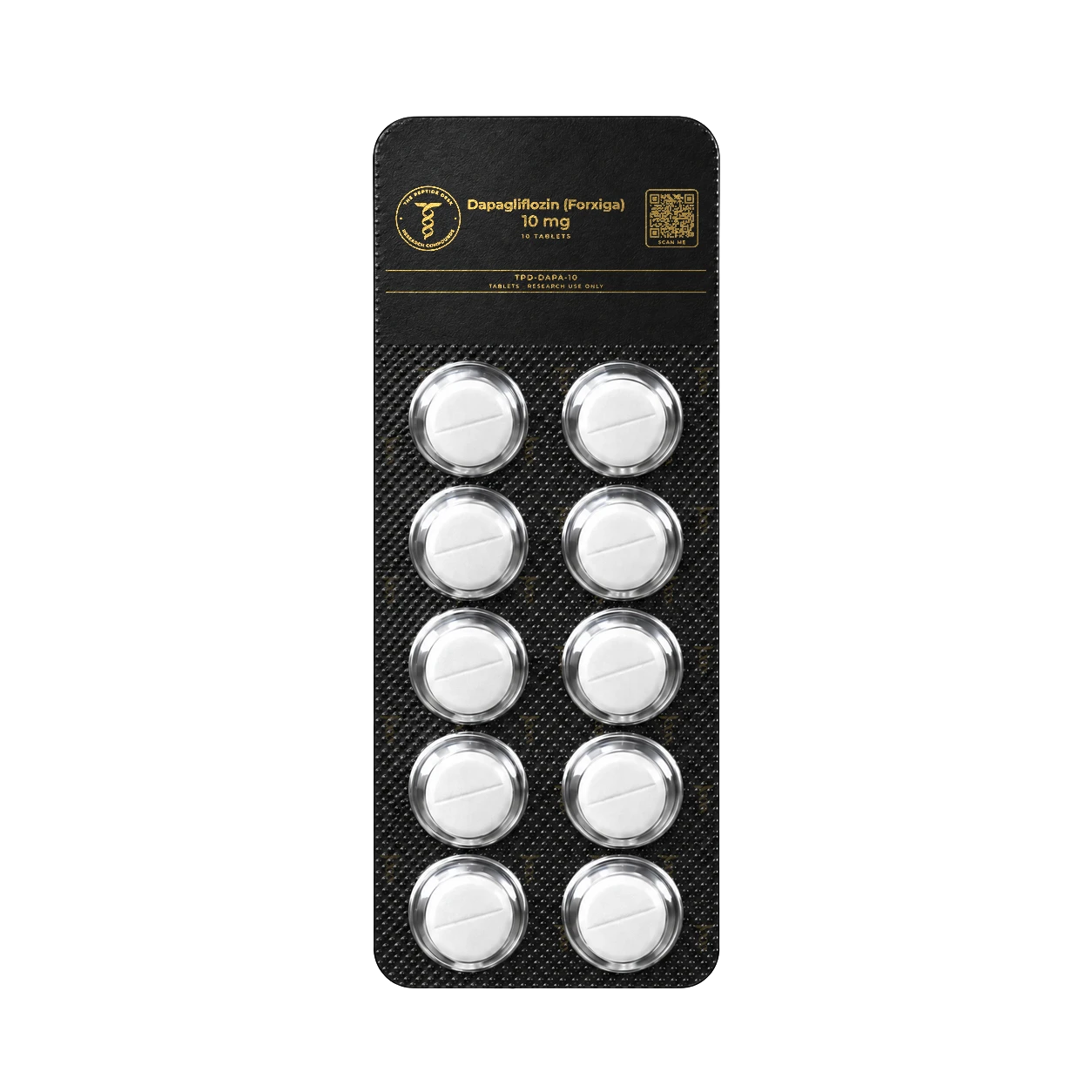
Pasirinkite etiketę
rodoma tiesiai ant flakonoDapagliflozin (Forxiga)
Medication
- Siunčiame iš Vokietijos
Užsakymas
- DHL su sekimu
- Diskreti pakuotė
Trumpai
Dapagliflozin (Forxiga) skaičiais
Pagrindiniai rodikliai iš mūsų žinyno. Vilkite tašką kreive, kad pamatytumėte, kiek lieka po vienos dozės, pagal skaičiavimą.
Visas žinyno įrašasHow long does it stay in the body?
Share left after one dose, calculated with a half-life of ~12.9 hours
Simplified model without an absorption phase, half-life from the TPD lexicon.
Half-life
about12.9hours
- Class
- SGLT2 inhibitorgliflozin, selective
- Use
- Oral1x daily
- Sizes
- 10 mg1 size in the shop
What studies show
All 6 sources in the lexicon- McMurray et al., NEJM, 2019
Dapagliflozin and cardiovascular outcomes in type 2 diabetes (DECLARE-TIMI 58) (opens in a new tab)
Wiviott et al., NEJM, 2019Euglycemic diabetic ketoacidosis as a complication of SGLT2 inhibition (opens in a new tab)
Peters et al., Diabetes Care, 2015
Atsiliepimai
Ką sako klientai
Tik tikri užsakymai, kuriuose buvo Dapagliflozin (Forxiga).
Visi atsiliepimaiProduktui Dapagliflozin (Forxiga) laboratorinės analizės dar nėra. Balsuoti už taiUžsakykite tyrimą, mes apmokame pusęVisos laboratorinės analizės
Žinios
Viskas apie Dapagliflozin (Forxiga)
Išsami informacija netrukus.
How does dapagliflozin work?
It blocks the transporter SGLT2 in the kidney, which brings filtered sugar back into the blood. The sugar then leaves with the urine without insulin being needed. Breakdown runs mainly via the enzyme UGT1A9 to an inactive metabolite.
Does it help without diabetes?
In the trials on heart failure and chronic kidney disease the effect was similar with and without diabetes. With reduced pumping the risk of worsening or cardiac death fell by 26 percent.
What did the kidney trial show?
Among 4,304 participants 9.2 percent on dapagliflozin and 14.5 percent on placebo had an event (halved kidney function, kidney failure or death). 19 had to be treated to prevent one. The trial was therefore stopped early.
What is euglycaemic ketoacidosis?
Acidosis from ketones with nearly normal blood sugar. Because sugar does not rise much, it was recognised late in a case series. The authors advise checking ketones in case of nausea, vomiting or malaise. In the large diabetes trial it occurred in 0.3 versus 0.1 percent.
Does it lower heart attacks and strokes?
Not clearly in the diabetes trial with 17,160 patients: 8.8 versus 9.4 percent major cardiovascular events. Hospital stays for heart failure and kidney events did fall clearly.
Which side effects are known?
Serious genital infections or those leading to a stop occurred in 0.9 versus 0.1 percent, ketoacidosis in 0.3 versus 0.1 percent. In the heart failure trials volume depletion, kidney problems and low blood sugar were not more common than on placebo.
Susiję
Susiję produktai

Telmisartan
Vaistai · Širdis ir kraujagyslės Širdis ir kraujagyslės
Dydžių: 2
Patikrinta laboratorijoje

Ivermectin
Vaistai · Skrandis ir kepenys Skrandis ir kepenys
1 dydis
Fenbendazol
Vaistai · Skrandis ir kepenys Skrandis ir kepenys
1 dydis

Prednisone
Vaistai · Skrandis ir kepenys Skrandis ir kepenys
1 dydis

Dapagliflozin (Forxiga)

