


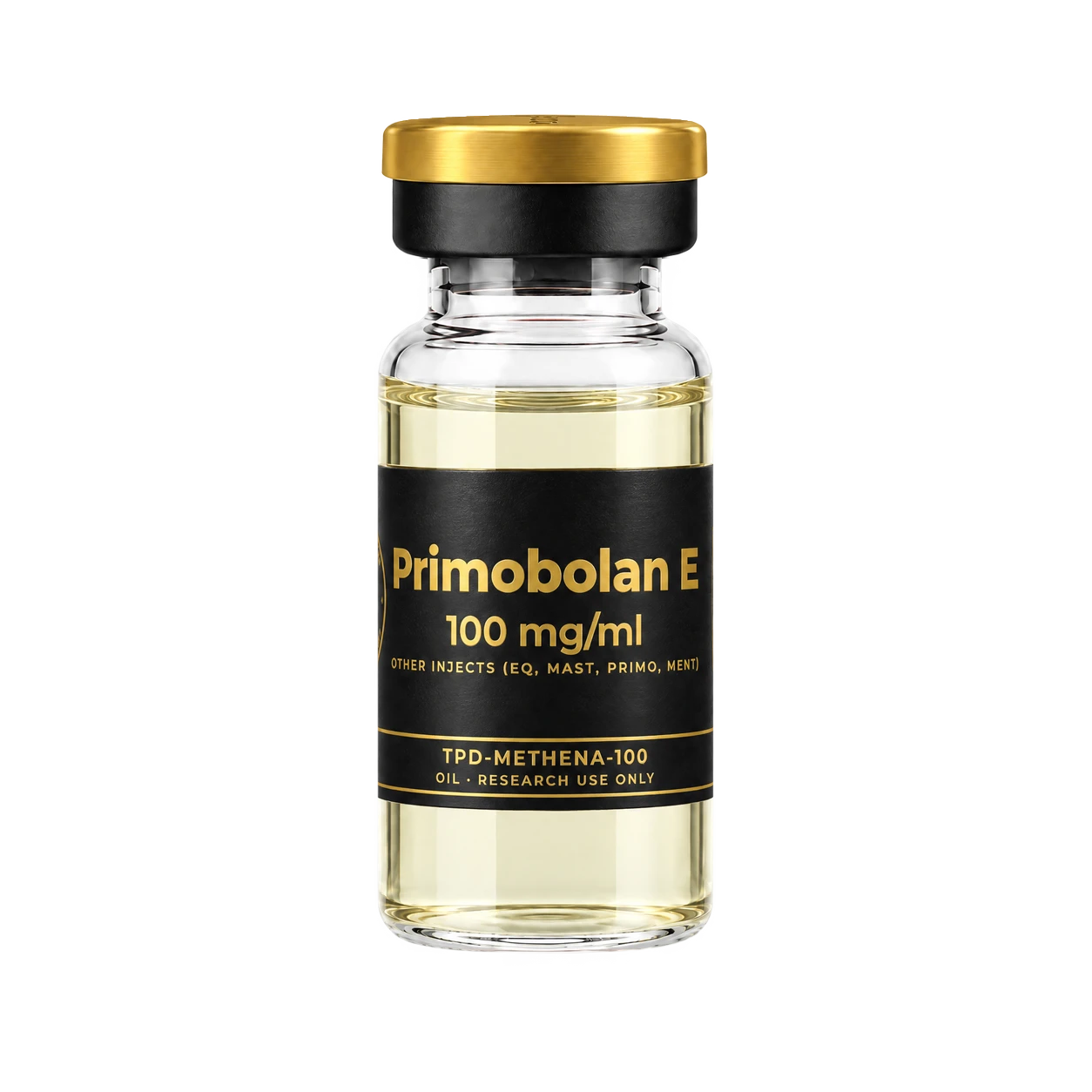
Pasirinkite etiketę
rodoma tiesiai ant flakonoLaboratorijos ataskaita
 PDF
- Ištirta
- Primobolan E 100mg/ml
- Laboratorija
- Analiza Białek
- Data
- August 2026
- Rezultatas
- 101.28 mg/ml measured (100 mg/ml label)
- Užsakymo nr.
- Slaptažodis
Ištirta nepriklausomai, su slaptažodžiu galima patikrinti tiesiogiai laboratorijoje.
Primobolan E
Other Inject
- Patikrinta laboratorijoje
- Siunčiame iš Vokietijos
Užsakymas
Dėmesio - gaunate VISĄ flakoną: šiame dydyje yra 100mg/ml · 10ml = 1000mg junginio - kur kas daugiau, nei rodo kiekis viename ml.
- DHL su sekimu
- Diskreti pakuotė
Trumpai
Primobolan E skaičiais
Pagrindiniai rodikliai iš mūsų žinyno. Vilkite tašką kreive, kad pamatytumėte, kiek lieka po vienos dozės, pagal skaičiavimą.
Visas žinyno įrašasHow long does it stay in the body?
Share left after one dose, calculated with a half-life of ~6 days
Simplified model without an absorption phase, half-life from the TPD lexicon. The lexicon gives 5 to 7 days, we calculate with the middle.
Half-life
about5-7days
- Class
- DHT derivativelong enanthate ester
- Use
- Intramuscular or subcutaneous2x per week
- Sizes
- 2 sizes100mg/ml, 200mg/ml
What studies show
All 2 sources in the lexiconPharmacology of anabolic steroids - comprehensive review (opens in a new tab)
Kicman, Br J Pharmacol, 2008Effects of androgenic-anabolic steroids in athletes (opens in a new tab)
Hartgens & Kuipers, Sports Med, 2004
Žinios
Viskas apie Primobolan E
Išsami informacija netrukus.
What is methenolone enanthate?
Methenolone is a steroid derived from DHT with a methyl group on the first carbon. The enanthate ester makes it oil-soluble and releases it slowly from the depot. In a comparison study methenolone bound to the androgen receptor in muscle and prostate more strongly than testosterone but less strongly than nandrolone.
Is methenolone enanthate approved or studied?
ClinicalTrials.gov lists no interventional trial with methenolone enanthate (as of 26 October 2026) and ChEMBL gives neither a phase nor an approval year. It was studied in humans mainly in the 1970s and 1980s, for example in breast cancer. Everything here is the state of research, not a recommendation.
What do the older human studies show?
In 43 patients with metastatic breast cancer metastases regressed for more than 3 months in 8 of 41 evaluable patients, best in soft tissue. According to the authors it worked similarly to testosterone propionate but was less virilising. In a study of 19 people with refractory anaemia 7 responded to methenolone, survival was not visibly prolonged.
What does GPR133 have to do with methenolone?
GPR133 is a receptor in the cell membrane. A 2025 paper found that DHT activates it in muscle cells, the messenger cAMP rises and muscle strength increases. Using cryo-electron microscopy the authors also showed methenolone bound to this receptor. This is basic research, consequences for use have not been studied.
How long is methenolone detectable?
In a study from a doping laboratory one healthy volunteer took methenolone orally. The researchers found 16 metabolites, one of which was detectable in urine for up to 40 days. There are no such data for the injection with the long ester.
Which side effects have been described?
In 28 women with breast cancer who additionally received methenolone enanthate blood lipids rose in 12, one had a heart attack. After stopping the values returned to normal in every case. Reviews of anabolic steroids also describe suppressed own hormone production, falling HDL cholesterol, rising blood pressure and acne.
Are there animal studies?
Yes, for example on the jaw bone. Rats received a bone medication (zoledronic acid), then a tooth was extracted. Without methenolone enanthate bone was exposed afterwards in 75 percent, with it in 10 percent. The authors see potential for prevention, this has not been tested in humans.
Susiję
Susiję produktai

Equipoise (BU)
Anabolikai · Kiti injekciniai Kiti injekciniai
Dydžių: 4
Patikrinta laboratorijoje
už buteliuką

Masteron P
Anabolikai · Kiti injekciniai Kiti injekciniai
1 dydis
už buteliuką

Masteron E
Anabolikai · Kiti injekciniai Kiti injekciniai
1 dydis
Patikrinta laboratorijoje
už buteliuką

MENT (Trestolone Acetate)
Anabolikai · Kiti injekciniai Kiti injekciniai
1 dydis
už buteliuką

Primobolan E

