
What is armodafinil?
Armodafinil is the R-enantiomer of modafinil. Modafinil is a racemate, a 1:1 mix of two mirror-image molecules that the body clears at different speeds: the S-enantiomer leaves plasma roughly three times faster than the R-enantiomer. Armodafinil keeps only the slower-clearing half, so it is not a new substance but one half of a familiar one.
Clinically, armodafinil (brand name Nuvigil, sold in India among others as Waklert) is approved for excessive daytime sleepiness in narcolepsy, obstructive sleep apnea and shift work disorder. Like modafinil it belongs to the eugeroics, the wakefulness promoters. It is not an amphetamine derivative. The pharmacokinetic rule of thumb: 150mg armodafinil corresponds roughly to 200mg modafinil in total exposure.
This information is for research and educational purposes only. No medical advice.
How it works
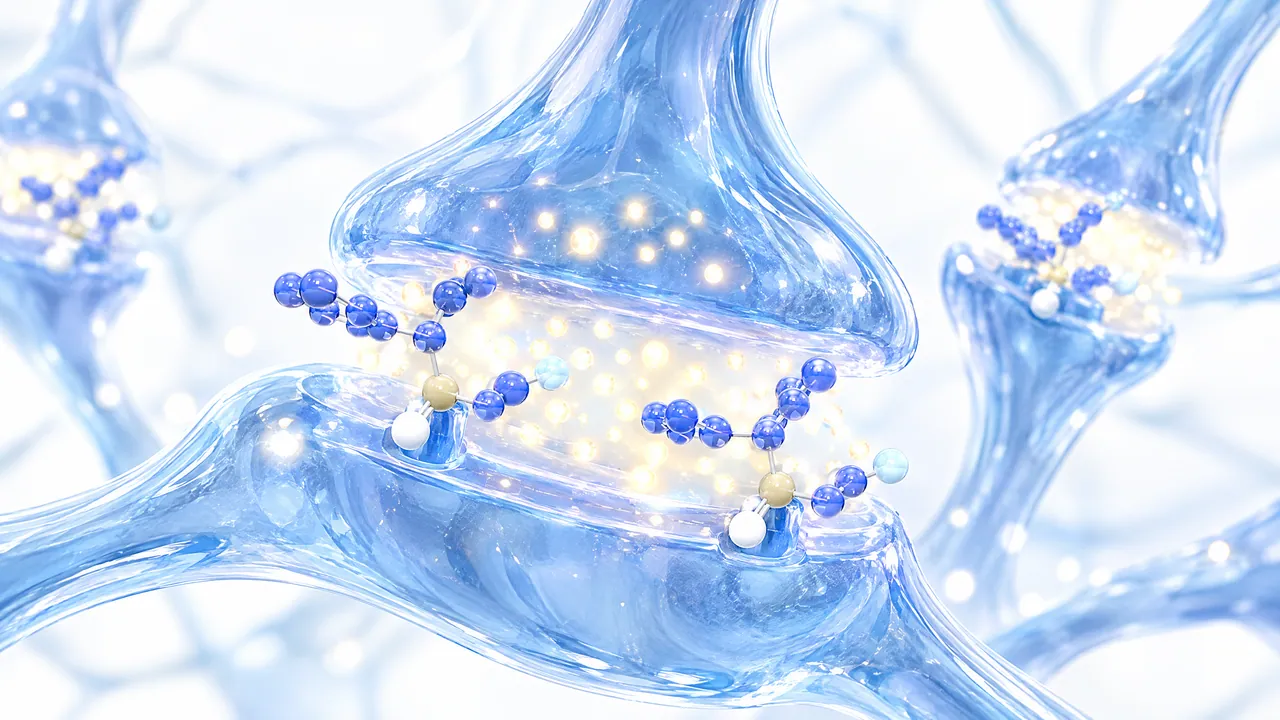
The mechanism is the same as for the racemate and still not resolved in every detail. At its core sits inhibition of the dopamine transporter (DAT): armodafinil blocks dopamine reuptake into the neuron and thereby raises extracellular dopamine. Unlike amphetamines it does not push dopamine out of the storage vesicles, which is what gives it the calmer character. In the transporter work by Loland and colleagues (Biological Psychiatry 2012) the R-enantiomer bound DAT with roughly three times the affinity of the S-enantiomer, inhibited dopamine uptake far less potently than cocaine and raised dopamine in the nucleus accumbens more modestly but for longer.
On top of that come indirect effects on the hypothalamic wake systems: orexinergic and histaminergic pathways are activated, cortical catecholamines rise, GABA falls. Those are the circuits that run the sleep-wake cycle rather than general drive. Subjectively the result is closer to "not tired" than to "wired".
Where it acts
Where armodafinil acted in studies
Tap a point or a card. Colour = dopamine transporter, grey = observed in studies.
- Brain
Inhibits dopamine reuptake, less potently than cocaine, dopamine rises for longer (mice)6
DAT - Heart and circulation
Blood pressure on average 3.6/2.3 mmHg and pulse 6.7 beats per minute higher (long-term study)5
Observed in trials - Liver
Induces CYP3A4 and inhibits CYP2C19, levels of other drugs change4
Observed in trials - Skin
Rash dose-dependent, severe skin reactions rarely described7
Observed in trials
Targets in the ChEMBL database9
Compound CHEMBL1201192 (Armodafinil): one recorded mechanism, Inhibitor, direct binding.
R-enantiomer versus racemate: the difference is in the curve
The most common misconception is that armodafinil is the stronger version of modafinil. It is not, at least not at the peak. Darwish and colleagues (Clinical Drug Investigation 2009) pooled three single-dose studies in healthy adults and normalized everything to 200mg. Both drugs had a single-dose terminal half-life of about 13 hours (the prescribing information puts armodafinil at about 15 hours), similar peak concentrations and a similar time to peak.
The difference appears after the peak. Modafinil declines in two phases because its S-enantiomer disappears quickly in the first hours. Armodafinil declines in a single, flatter phase. Milligram for milligram, exposure (AUC) was 33 to 40 percent higher with armodafinil. Plasma levels late in the day sat clearly above those of modafinil. In practice: same peak, longer afternoon. That is why armodafinil was the compound of choice in shift work research. It is also exactly where its risk to sleep comes from.
Comparison
Modafinil and armodafinil compared
The modafinil and armodafinil entries in the TPD lexicon, as described there. Tap a card to open its entry.
Simplified: all act on the dopamine transporter. The R-enantiomer bound about three times more tightly than the S-enantiomer and stays in the blood longer. 63
Pharmacokinetics: timing and food
Taken on an empty stomach, armodafinil peaks after about 2 hours. A high-fat meal pushes the peak back by 2 to 4 hours without changing total absorption. The mean elimination half-life is around 15 hours. Steady state is reached within about 7 days of daily dosing, with exposure then about 1.8 times above a single dose. Kinetics are linear from 50 to 400mg, so double the dose means double the exposure (prescribing information).
From this follows the single most important rule: dose early or not at all. A dose at noon still carries well over half its peak level at midnight. Unlike modafinil there is no fast-clearing half that eases the evening a little. Taking it with a meal shifts the peak further into the afternoon on top of that.
Exposure is higher in older adults, where the prescribing information advises lower doses. In severe hepatic impairment the dose should be reduced, because elimination runs through the liver.
Use and dosing
Dosing
Dosing, titration and syringe
Loading the dosing information …
- Getting started and stepping up, drawn as a staircase
- Units on the U-100 syringe for every step
- How long one vial lasts
What the research shows
The strongest evidence is in shift work. Czeisler and colleagues (Mayo Clinic Proceedings 2009) randomized 254 night shift workers with shift work disorder to 150mg armodafinil or placebo, taken 30 to 60 minutes before each shift for 12 weeks. Mean sleep latency during the night shift rose from 2.3 to 5.3 minutes on armodafinil versus 2.4 to 2.8 minutes on placebo. Standardized memory and attention tests improved. Daytime sleep was not disturbed on polysomnography.
In narcolepsy, Harsh and colleagues (Current Medical Research and Opinion 2006) compared 150mg, 250mg and placebo in 196 patients over 12 weeks. Both doses significantly lengthened sleep latency on the Maintenance of Wakefulness Test and improved memory, attention and fatigue. The gap between 150 and 250mg was small: plus 1.3 versus plus 2.6 minutes, against a drop of 1.9 minutes on placebo.
Long-term data come from the open-label extension by Black and colleagues (Journal of Clinical Sleep Medicine 2010): 743 patients for at least 12 months at 50 to 250mg per day, with the effect maintained, 13 percent discontinuing for adverse events and moderate rises in blood pressure and heart rate. What is missing is evidence for cognitive enhancement in rested healthy people. The healthy-volunteer studies of armodafinil were almost all run under sleep deprivation. For the racemate, meta-analyses show only a small effect, as described in the modafinil entry.
Study results
What the trials measured
Interactive: switch tabs, tap points, show or hide arms. Arms are named relative to each other, no dosing advice.
Sleep latency during the night shift1
Mean minutes until falling asleep in the sleep lab
254 night shift workers, taken 30 to 60 minutes before the shift. Memory and attention improved and daytime sleep in the sleep lab was not disturbed. Clinical condition improved in 79 versus 59 percent.
Time staying awake in the daytime test2
Change from baseline, in minutes
196 patients. At least minimally improved in overall clinical impression were 69 and 73 percent versus 33 percent with placebo. Memory, attention and fatigue improved.
Total exposure milligram for milligram3
Area under the curve, difference in percent (modafinil = 0)
Three single-dose studies in healthy adults, normalised to the same amount. Half-life of both about 13 hours, similar peak. Modafinil fell in two phases because its S part disappears quickly.
Levels of probe drugs with armodafinil4
Change in area under the curve, in percent
77 healthy adults in three studies. Armodafinil is a moderate inducer of CYP3A4 and a moderate inhibitor of CYP2C19, it had no effect on CYP1A2.

Research status
Where the research stands
Armodafinil has been approved since 2007. On ClinicalTrials.gov 62 trials list armodafinil among their interventions. Shown are the phase 3 trials in the three approved uses, the long-term study and later phase 3 trials in other areas. As of 26 Oct 2026. 10
- Preclinical Binding to the dopamine transporter, comparison of the enantiomers
- Phase 1 no registered trial
- Phase 2 no registered trial
- Phase 3 10 trials, 9 completed, 1 stopped early
- Approval in the USA since 2007
Show all 10 phase 3 trials on a timelineHide timeline
NCT00078325 · 395 participants, started Feb 2004, primary endpoint reached Nov 2004.
Registry entry ↗ · Results not yet in PubMed
NCT00079677 · 263 participants, started Mar 2004, primary endpoint reached Oct 2004.
Registry entry ↗ · Results not yet in PubMed
NCT00078377 · 196 participants, started Mar 2004, primary endpoint reached Jan 2005.
Registry entry ↗ · Results: Harsh et al., Current Medical Research and Opinion, 2006
NCT00080288 · 254 participants, started Mar 2004, primary endpoint reached Dec 2004.
Registry entry ↗ · Results: Czeisler et al., Mayo Clinic Proceedings, 2009
NCT00228553 · 743 participants, started May 2004, primary endpoint reached Jul 2006.
Registry entry ↗ · Results: Black et al., Journal of Clinical Sleep Medicine, 2010 (DOI 10.5664/jcsm.27935 laut Crossref)
NCT00758498 · 427 participants, started Sept 2008, primary endpoint reached Feb 2009.
Registry entry ↗ · Results not yet in PubMed
NCT01072929 · 433 participants, started Jan 2010, primary endpoint reached Mar 2012.
Registry entry ↗ · Results not yet in PubMed
NCT01072630 · 492 participants, started Mar 2010, primary endpoint reached Nov 2012.
Registry entry ↗ · Results not yet in PubMed
NCT01121536 · 867 participants, started Apr 2010, stopped early Oct 2013.
NCT01781468 · 328 participants, started Jun 2013, primary endpoint reached May 2019.
Registry entry ↗ · Results not yet in PubMed
Bar: start to primary endpoint (planned for running trials). Green = completed, blue = progress until 26 Oct 2026, grey = stopped early.
Interactions: CYP3A4 and hormonal contraception
Armodafinil induces CYP3A4 and inhibits CYP2C19. Darwish and colleagues (Clinical Pharmacokinetics 2008) measured this in three probe studies in 77 healthy adults: after at least 22 days on 250mg armodafinil, midazolam exposure fell by about 17 percent after intravenous and 32 percent after oral dosing, while caffeine (CYP1A2) was unchanged. Omeprazole was tested separately, with a single 400mg dose of armodafinil given 2 hours before the omeprazole. Omeprazole exposure rose by about 38 percent.
In practice: substances cleared through CYP3A4 become weaker. Hormonal contraceptives are among them. The prescribing information states that hormonal contraception is less reliable during use and for about one month afterwards. In the other direction, levels of CYP2C19 substrates such as omeprazole, diazepam or phenytoin rise. Anyone using such a substance should take that question to a doctor.
Side effects
- Serious skin reactions: rare but serious. Rash requiring hospitalization, up to Stevens-Johnson syndrome and toxic epidermal necrolysis, is documented for armodafinil and modafinil, along with multi-organ hypersensitivity (DRESS) and angioedema. Any new rash, any blistering and any involvement of mouth, eyes or mucous membranes is a reason to stop and a case for medical assessment. In the pooled registration trials rash occurred in 4 percent on 250mg and 1 percent on 150mg.
- Headache: by far the most common, 17 percent versus 9 on placebo. It is also dose-dependent (23 percent on 250mg, 14 on 150mg).
- Insomnia: 5 percent in the trials, almost always a question of timing. With armodafinil the flatter decline makes this weigh heavier than with modafinil.
- Nausea, dizziness, dry mouth, anxiety, diarrhea: regularly reported, mostly mild to moderate.
- Circulation: in the long-term study blood pressure rose by an average of 3.6/2.3 mmHg and heart rate by 6.7 beats per minute, mostly within the first three months. Anyone with blood pressure issues should keep measuring.
- Mental state: anxiety, agitation, nervousness and depressed mood led to discontinuation more often than on placebo. With a history of psychosis, depression or mania the prescribing information calls for particular caution.
- Abuse potential: lower than with amphetamines, but not zero. Armodafinil is a Schedule IV controlled substance in the US. Cases of abuse are documented.
Tolerability
Side effects in the approval trials
From the US label: pooled trials in sleep apnoea, narcolepsy and shift work. The study arms are named relative to each other.
| Event | Placebo | Lower study dose | Higher study dose |
|---|---|---|---|
| Headache7 | 9% | 14% | 23% |
| Nausea7 | 3% | 6% | 9% |
| Insomnia7 | 1% | 4% | 6% |
| Dizziness7 | 2% | 0% | 0% |
| Anxiety7 | 1% | 0% | 0% |
| Stopped because of side effects7 | 4% | 0% | 0% |
Armodafinil arm = both study doses combined (645 versus 445 with placebo). Rash occurred in 4 percent at the higher study dose and 1 percent at the lower one. Severe skin reactions are rare but described.7
Storage
Store dry, at room temperature and protected from light. Leave tablets in the blister until you need them and keep them out of reach of children. Use split tablets promptly rather than keeping halves around for weeks.