
What is tretinoin?
Tretinoin is all-trans retinoic acid, the biologically active acid form of vitamin A. Your body makes small amounts of it from retinol; as a cream it goes straight onto the skin. It is the sister molecule of isotretinoin (13-cis retinoic acid), which is taken by mouth, but applied as a cream its effect stays where you put it.
It came out of acne research in the 1960s and has been available as a cream since the 1970s. In the 1980s dermatologists noticed that fine lines and pigment spots were changing under the acne cream as well. Tretinoin became the reference compound against which every new agent for photoaged skin is measured.
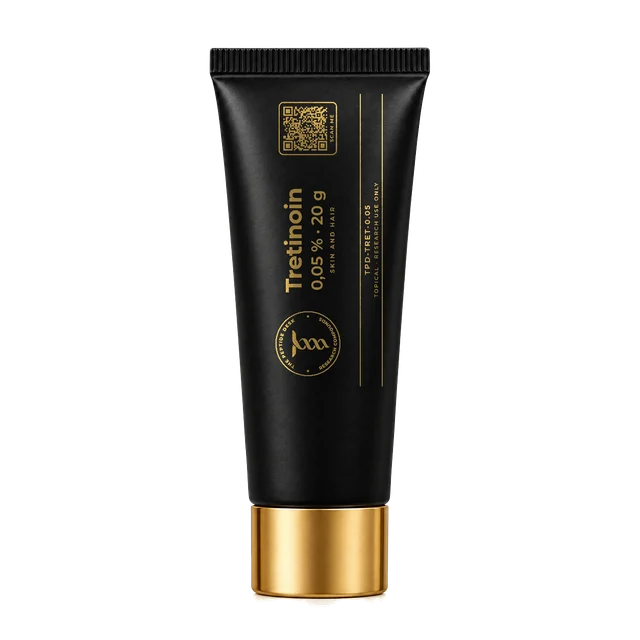
The catalogue lists tretinoin as a cream in a 20 g tube at 0.05% and 0.1%. Both strengths sit inside the range the trials used, which runs from 0.025% to 0.1%.
This information is for research and educational purposes only. No medical advice.
How it works
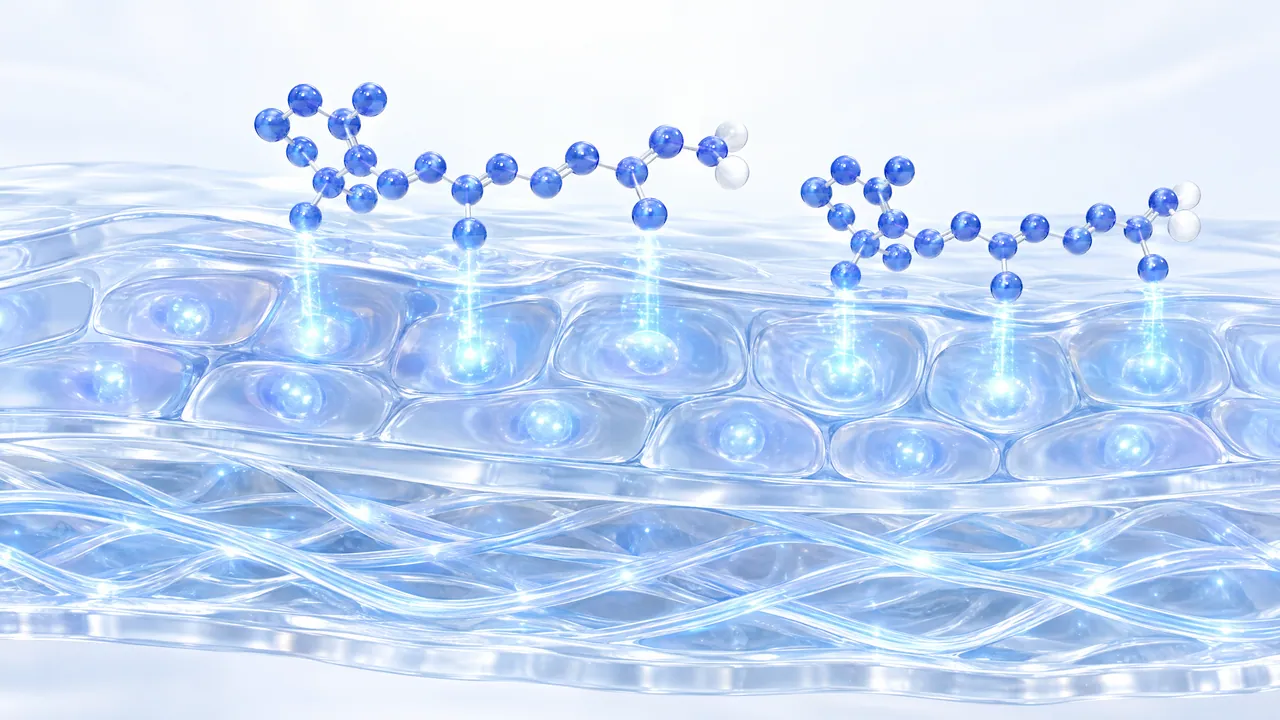
Once inside the skin cell, tretinoin binds to retinoic acid receptors (RAR) in the nucleus, mostly the gamma subtype in skin. The receptor then switches genes on and off. In the epidermis that means faster keratinocyte turnover, a thinner and more even stratum corneum and loosening of the keratin plugs that block sebaceous follicles. This is why comedones recede in the trials and fewer new ones form.
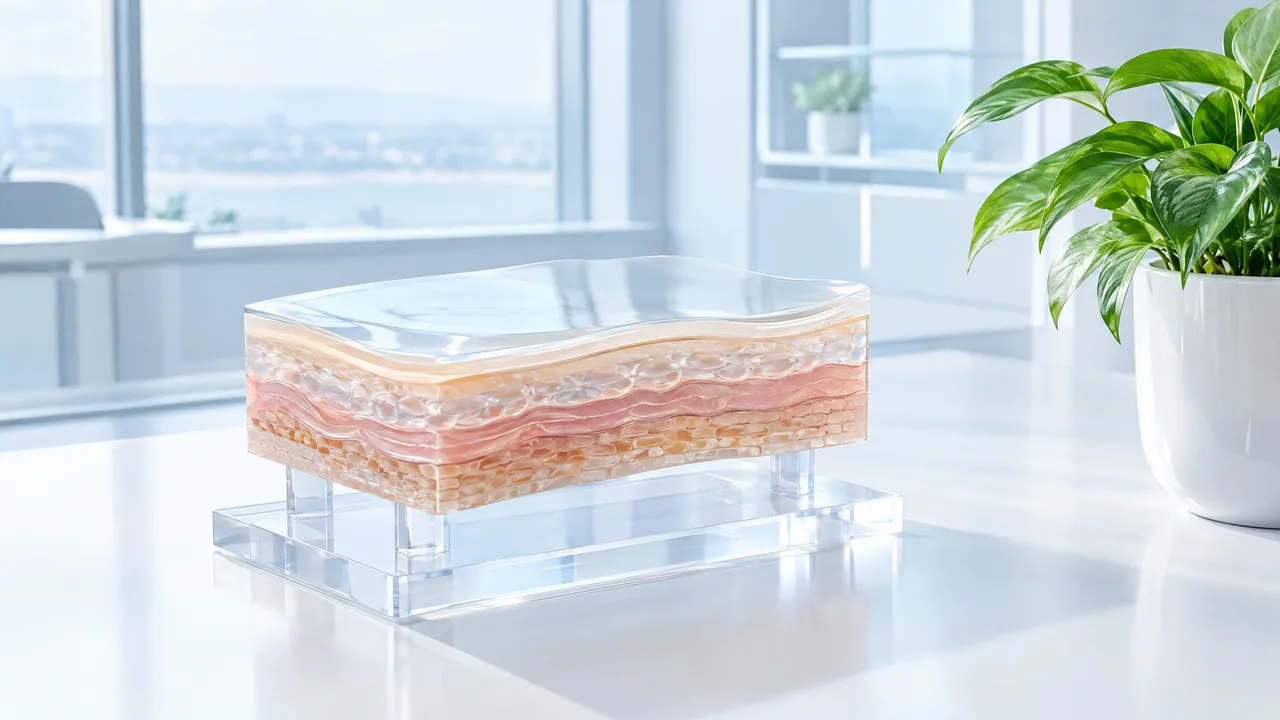
In the dermis a second mechanism runs. UV light activates the transcription factor AP-1, which drives matrix metalloproteinases, the enzymes that break down collagen. Tretinoin suppresses AP-1 and with it those enzymes. Fisher and colleagues showed this in irradiated human skin in the New England Journal of Medicine in 1997: pretreatment with tretinoin cut the enzyme induction by 70 to 80 percent. At the same time procollagen synthesis rises; in the two-year trial by Kang and colleagues the procollagen marker was significantly higher at month 12.
Almost none of it reaches the bloodstream. Latriano and colleagues measured about 2 percent percutaneous absorption after a single dose of radiolabelled tretinoin and 1.1 percent after more than a year of daily use, with plasma levels of tretinoin and its metabolites staying within the endogenous range. The action is local, which is why the side effect profile has little in common with oral isotretinoin.
Where it acts
Where tretinoin acts
Tap a point or a card. Colour = retinoic acid receptor, grey = observed in studies.
Targets in the ChEMBL database7
Compound CHEMBL38: one recorded mechanism, Agonist of the RAR family according to ChEMBL.
- Gene
- RARG
- UniProt
- P13631
- ChEMBL
- CHEMBL2003
- Action
- Agonist of the RAR family according to ChEMBL
Use and dosing
Dosing
Dosing, titration and syringe
Loading the dosing information …
- Getting started and stepping up, drawn as a staircase
- Units on the U-100 syringe for every step
- How long one vial lasts
What the research shows
Weiss and colleagues (JAMA 1988) made tretinoin known beyond acne. Thirty participants applied tretinoin to one forearm and the drug-free vehicle to the other for 16 weeks; half also applied tretinoin to the face. Every tretinoin forearm improved measurably, no vehicle forearm did. Fourteen of the 15 tretinoin faces improved, none of the vehicle faces. Under the microscope the changes were significant, but only in tretinoin-exposed skin.
Griffiths and colleagues (Archives of Dermatology 1995) settled the strength question: 99 participants, 0.1% and 0.025% cream against vehicle, double-blind, 48 weeks. Both strengths improved photoaging to the same degree and thickened the epidermis by about 30 percent, but 0.1% irritated the skin significantly more often. That is the single most useful data point for choosing a concentration.
Kang and colleagues (American Journal of Clinical Dermatology 2005) ran the longest placebo-controlled trial: 204 participants with moderate to severe facial photodamage applied 0.05% emollient cream or placebo for two years. Fine and coarse wrinkling, mottled pigmentation and sallowness improved significantly against placebo. Biopsies showed no increase in atypical cells and no damage to the stratum corneum, but a significant rise in the procollagen marker at month 12.
Fisher and colleagues (NEJM 1997) supplied the mechanism in 59 volunteers: a single UV exposure raised three collagen-degrading enzymes and increased collagen breakdown by 58 percent, while tretinoin applied beforehand blocked 70 to 80 percent of the enzyme induction. Latriano and colleagues (JAAD 1997) supplied the pharmacokinetics: roughly 2 percent absorption through the skin after a single dose and after 28 days, only 1.1 percent in participants with more than a year of use. Endogenous plasma levels did not change.
For acne the evidence base is even broader. Topical retinoids are a cornerstone of the American and European acne guidelines. Tretinoin is the oldest member of the group. For hair growth the data are thin: a small 1986 study tested tretinoin alone and together with minoxidil. Little has followed since.
Study results
What the trials measured
Interactive: switch tabs, tap points, show or hide arms. Arms are named relative to each other, no dosing advice.
Faces with improved photoaging1
15 participants each, double-blind, inactive cream as comparison
In addition all 30 participants applied tretinoin to one forearm and the inactive cream to the other. All tretinoin arms improved, no comparison arm did. The only side effect was irritation of the treated skin.
Changes in the skin2
99 participants with photoaging, double-blind, tissue samples
Clinically both concentrations improved photoaging equally. Redness and scaling were significantly more frequent with the higher concentration. The authors conclude that irritation is not the reason for the effect.
Collagen breakdown after UV light4
Healthy volunteers, irradiated versus non-irradiated skin
Tretinoin was applied 48 hours before irradiation. It did not change the body's own inhibitor of the enzymes.
Research status
Where the research stands
Tretinoin has been approved since 1971. On ClinicalTrials.gov 406 trials name tretinoin, 65 of them on acne or photoaging. The large photoaging studies ran before the registry. Shown is a selection of later skin trials. As of 26 Oct 2026. 6
- Preclinical Principle: retinoic acid receptors in the cell nucleus, inhibition of collagen-degrading enzymes
- Phase 1 no registered trial
- Phase 2 no registered trial
- Phase 3 3 trials, 3 completed
- Approval since 1971
Show all 6 phase 3 and 4 trials on a timelineHide timeline
NCT01243450 · 958 participants, started Oct 2009, primary endpoint reached Oct 2010.
Registry entry ↗ · Results not yet in PubMed
FOTEN · NCT01406080 · 128 participants, started Jan 2013, primary endpoint reached Nov 2015. Tests several agents.
Registry entry ↗ · Results not yet in PubMed
NCT02249767 · 574 participants, started Nov 2013, primary endpoint reached Jun 2014.
Registry entry ↗ · Results not yet in PubMed
NCT00835198 · 163 participants, started Dec 2008, primary endpoint reached Aug 2009. Tests several agents.
Registry entry ↗ · Results not yet in PubMed
NCT01522456 · 73 participants, started Apr 2012, primary endpoint reached May 2012. Tests several agents.
Registry entry ↗ · Results not yet in PubMed
NCT04548349 · 25 participants, started Apr 2021, primary endpoint reached Aug 2022.
Registry entry ↗ · Results not yet in PubMed
Bar: start to primary endpoint (planned for running trials). Green = completed, blue = progress until 26 Oct 2026.
Tretinoin versus isotretinoin
Both are retinoic acids and both descend from vitamin A. Still, they are two different tools. Tretinoin works where it is applied: in the epidermis and the upper dermis. Isotretinoin is swallowed, spreads through the whole body, shrinks the sebaceous glands and brings a strict safety profile with it, above all harm to a fetus.
That gives the division of labour in research: tretinoin for mild to moderate acne, comedones, pigment spots and photoaging, isotretinoin for severe, scarring acne. Used together on the skin the two add up dryness and irritation, which is why the literature advises against continuing topical retinoids during an isotretinoin course.
Adapalene, a synthetic third-generation retinoid, binds the receptors more selectively and is stable in light. It irritates less, but has far fewer data in photoaging than tretinoin.
Comparison
Skin compounds in the lexicon
Tretinoin next to its swallowed sister and two peptides for the skin, as stated in the TPD lexicon. Tap a card to open its entry.
Simplified: tretinoin acts where it is applied. Isotretinoin is swallowed and acts throughout the body. 75
Side effects
- Retinoid dermatitis: redness, flaking, burning, dryness and tightness, mainly in the first 2 to 4 weeks. It is the most common effect by far and the reason for the slow start. In Griffiths and colleagues, irritation was significantly more frequent at 0.1% than at 0.025% with no difference in effect. If it gets too much: skip a night, moisturise, do not increase the amount.
- Initial acne flare: more spots can appear in the first weeks as blocked follicles empty out. It usually settles by week 6 to 8.
- Photosensitivity: skin under tretinoin burns faster. Sunscreen is not optional, it is part of the application.
- Pigment changes: occasionally lighter or darker patches, mostly temporary, more often in darker skin types and where the skin is irritated.
- Pregnancy: retinoids are regarded as off limits in pregnancy. A meta-analysis in the British Journal of Dermatology (2015) found no significant rise in malformations across 654 exposed pregnancies, but stated itself that it was too small to prove safety. The rule therefore stands: not in pregnancy, not when trying to conceive.
- Interactions on the skin: benzoyl peroxide can oxidise tretinoin; alcohol-based toners, exfoliants and scrubs amplify irritation. Avoid waxing and laser on the areas you apply tretinoin to in the days before and after.
Storage
Keep the tube tightly closed at room temperature, 15 to 25 °C, protected from light and heat. Tretinoin is sensitive to light and oxidation, so the tube does not belong on a windowsill or next to the bathroom radiator. Do not freeze. After opening, use within the period printed on the pack. Keep out of reach of children.