Description
AOD-9604 is a synthetic peptide fragment derived from amino acids 177-191 of human growth hormone (HGH). In contrast to the complete growth hormone molecule, AOD-9604 in research models exhibits the lipolysis-stimulating properties of the C-terminal HGH end without the growth or insulin sensitivity modulating properties of the full hormone.
The central research mechanism lies in fat metabolism. Preclinical studies have documented that AOD-9604 stimulates hormone-sensitive lipase activity in adipocytes and thereby increases the release of free fatty acids from adipose tissue. At the same time, the compound shows reduced lipogenesis rates in animal models. Beta-3 adrenoreceptor activity is also under discussion, although the mechanisms are not conclusively resolved.
Earlier clinical studies investigated AOD-9604 as a compound in adiposity models. Phase 2 data in human settings were mixed, which prevented the transition into phase 3 trials. AOD-9604 nevertheless remains an established compound in the community for studies on the HGH fragment mechanism.
Per study reports, AOD-9604 is typically applied daily subcutaneously in preclinical setups. The half-life is relatively short, which requires frequent application intervals.
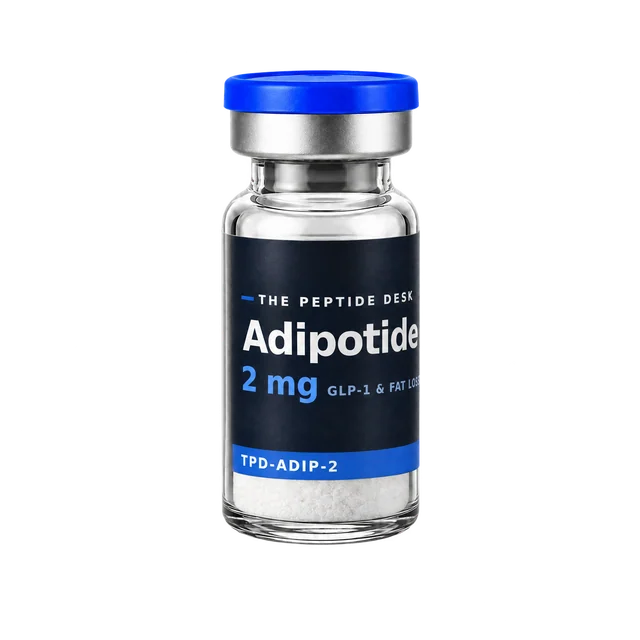
AOD-9604 is available in 5mg vials as 10-vial packs.
This information is for research and educational purposes only. No medical recommendations.
Risks & Safety
AOD-9604 is considered well tolerated per study reports. Because it represents only the C-terminal HGH fragment, it lacks the growth and insulin sensitivity modulating properties of the full growth hormone, which keeps the risk profile comparatively narrow.
Observed in studies and user reports:
- Injection site: mild redness, pressure or transient irritation at the injection site is the most common observation, particularly with frequent subcutaneous use.
- Circulation: isolated reports of brief warmth, mild dizziness or fatigue shortly after application.
- Mixed efficacy data: the human Phase 2 data were mixed, which prevented the transition into Phase 3 trials. This concerns efficacy rather than primarily the safety profile.
- No long-term data: robust long-term human studies do not exist. The classification rests primarily on animal models and short-term anecdotal experience.
This classification does not replace medical advice. Risk and responsibility for any actual use lie entirely with the buyer.
Studies
- Metabolic studies of a synthetic lipolytic domain (AOD9604) of human growth hormone - Hormone Research 2000: In obese Zucker rats, daily oral AOD9604 for 19 days reduced body weight gain by more than half and increased lipolytic activity in adipose tissue without impairing insulin sensitivity.
- Increase of fat oxidation and weight loss in obese mice caused by chronic treatment with human growth hormone or a modified C-terminal fragment - International Journal of Obesity 2001: In obese mice, hGH and AOD9604 reduced body weight gain and increased fat oxidation over 14 days, while AOD9604 did not bind the hGH receptor and induced neither hyperglycemia nor cell proliferation.
- The effects of human GH and its lipolytic fragment (AOD9604) on lipid metabolism following chronic treatment in obese mice and beta(3)-AR knock-out mice - Endocrinology 2001: hGH and AOD9604 increased beta-3 adrenergic receptor expression in obese mice. In knockout mice lacking this receptor the weight effect of chronic dosing was absent.
- Detection and in vitro metabolism of AOD9604 - Drug Testing and Analysis 2015: Analytical study: describes AOD9604 as the hGH fragment 177-191 with an added N-terminal tyrosine, validates a urine detection method, identifies a stable metabolite in serum and notes that the substance is banned by WADA.
- Safety and Efficacy of Approved and Unapproved Peptide Therapies for Musculoskeletal Injuries and Athletic Performance - Sports Medicine 2026: Narrative review of approved and unapproved peptides including AOD-9604: favorable findings mostly come from animal models. Rigorous human safety data are scarce.