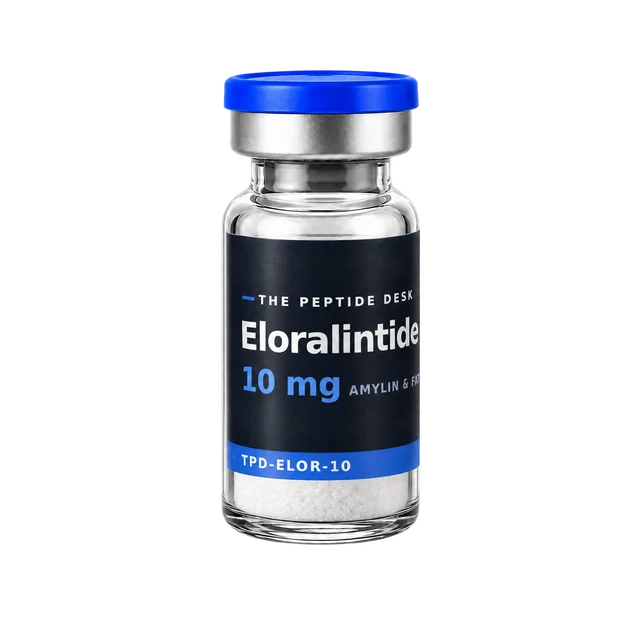
Description
Cagrilintide is an amylin analog with extended half-life that, in research models, modulates satiety and gastric emptying through the amylin-calcitonin receptor. Structurally it is a modified variant of natural amylin, the pancreatic hormone co-secreted with insulin by beta cells. Modifications extend the half-life into a range that supports weekly application intervals.
In research settings, the central property of cagrilintide is activation of the amylin pathway, which operates independently of the GLP-1 axis. While GLP-1 agonists act primarily through the GLP-1 receptor, cagrilintide addresses calcitonin and amylin receptors in the brainstem and hypothalamus. The result in preclinical studies: prolonged satiety, reduced food intake and slowed gastric emptying.
The particular research value of cagrilintide lies in combination with semaglutide. The stack variant CagriSema combines both compounds in a single vial and exploits the additive effects of amylin and GLP-1 pathways. In phase 2 trials (Lau et al.), the combination showed reduction values exceeding semaglutide monotherapy.
Cagrilintide alone is used in research settings to study the amylin pathway in isolation. In practice, the compound is more frequently investigated in the combination context (CagriSema).
Cagrilintide is available in 5mg vials as 10-vial packs.
This information is for research and educational purposes only. No medical recommendations.
Risks & Safety
Cagrilintide is considered generally well tolerated per study reports. As an amylin analog the documented profile is likewise shaped by gastrointestinal effects, although in studies these tend to be milder than with the GLP-1 agonists.
Observed in studies and user reports:
- Gastrointestinal effects: nausea, vomiting, diarrhea and constipation are the most commonly documented observations, particularly at the start and with overly rapid dose escalation. Slow titration reduces the incidence.
- Appetite and fluids: the prolonged satiety lowers food and fluid intake in studies. The literature describes an elevated risk of dehydration.
- Muscle mass and injection site: weight loss involves a portion of muscle mass alongside fat mass. Mild irritation at the injection site is documented.
- No long-term data: cagrilintide is more frequently studied in the combination context (CagriSema). Robust human data on isolated long-term use are limited.
This classification does not replace medical advice. Risk and responsibility for any actual use lie entirely with the buyer.
Studies
- Once-weekly cagrilintide for weight management in people with overweight and obesity - The Lancet 2021: Phase 2 trial with 706 participants over 26 weeks, mono application.
- Safety, tolerability, pharmacokinetics, and pharmacodynamics of concomitant administration of multiple doses of cagrilintide with semaglutide 2·4 mg for weight management: a randomised, controlled, phase 1b trial - The Lancet 2021: Phase 1b trial with 95 participants: cagrilintide plus semaglutide 2.4 mg showed mostly mild to moderate, often gastrointestinal adverse events, a half-life of 159 to 195 hours and, after 20 weeks, 17.1% weight loss versus 9.8% with semaglutide plus placebo.
- Development of Cagrilintide, a Long-Acting Amylin Analogue - Journal of Medicinal Chemistry 2021: Development paper: describes cagrilintide as a stable, lipidated, long-acting amylin analogue and the structure-activity work that led to its selection for clinical development.
- Amylin: Pharmacology, Physiology, and Clinical Potential - Pharmacological Reviews 2015: Review of amylin: a 37-amino-acid beta-cell hormone that regulates glucose and energy metabolism. It acts via receptors formed by a core receptor protein and receptor activity-modifying proteins, principally in the circumventricular organs.