Description
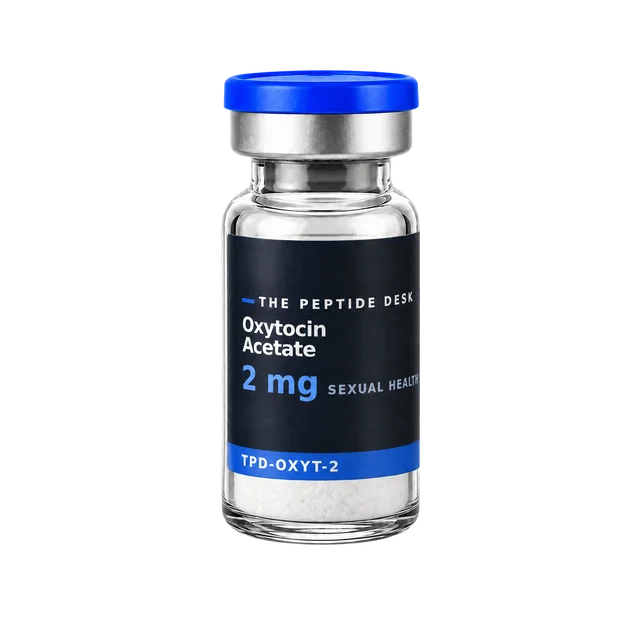
Oxytocin is a nonapeptide naturally produced in the hypothalamus and secreted via the posterior pituitary. Structurally it is one of the oldest and best-characterized neuropeptides, with a documented research history reaching back into the 1950s (Vincent du Vigneaud, Nobel Prize 1955 for structural elucidation). Oxytocin is closely related to vasopressin; both differ by only two amino acids.
In research context, the two classical activity areas are peripheral (uterine contraction, milk ejection) and central (social behavior, bonding, trust, stress reduction). The central research renaissance of recent decades has established oxytocin as a modulator of social cognition and emotional processing. In preclinical studies, intranasal application has been associated with altered behavioral endpoints in trust games, social recognition and emotional empathy tasks.
Mechanistically, oxytocin acts through the oxytocin receptor (OXTR), a G-protein-coupled receptor expressed in multiple brain regions including the amygdala, hypothalamus and prefrontal cortex. With a half-life of approximately 3-5 minutes, it is short, requiring frequent application intervals in research setups. With intranasal application, there is evidence for direct CNS penetration through the olfactory route.
In research setups, oxytocin is frequently used intranasally to investigate central effects. For peripherally focused research questions it is used subcutaneously.
This variant is a ready-to-use nasal spray: 10mg of Oxytocin dissolved in 5 ml saline and 0.4 ml bacteriostatic water (5.4 ml in total), nothing to mix yourself. One spray (0.1 ml) delivers about 185 mcg (roughly 111 IU). A bottle lasts for about 50 sprays. It is made fresh once you place your order and ships as an express item. As a powder for reconstitution, Oxytocin remains available in vials.
This information is for research and educational purposes only. No medical recommendations.
Risks & Safety
Oxytocin is one of the longest-researched neuropeptides and is considered predominantly mild in tolerability per study reports, particularly with intranasal application.
Observed in research and user reports:
- Intranasal irritation: with the intranasal route, mild irritation of the nasal mucosa or headache is occasionally reported.
- Peripheral activity: through the OXTR, oxytocin also acts peripherally, including on smooth muscle. The literature describes circulatory changes at higher dosages as a result.
- Mood effects: preclinical studies documented altered emotional processing and occasionally opposite social effects depending on context; the profile is not consistently uniform.
- No long-term data: robust human studies on longer-term use do not exist. The short half-life limits acute exposure but says little about repeated application.
This classification does not replace medical advice. Risk and responsibility for any actual use lie entirely with the buyer.
Studies
- Oxytocin increases trust in humans - Nature 2005: Kosfeld et al., landmark study on trust and social cognition.
- Oxytocin, vasopressin, and human social behavior - Frontiers in Neuroendocrinology 2009: Review of the behavioral, endocrine, genetic and neural effects of oxytocin and vasopressin in humans, building on the findings from animal research.
- The neurobiology of attachment - Nature Reviews Neuroscience 2001: Review of the neural basis of attachment at the molecular, cellular and systems level, drawing on studies in a range of vertebrates including humans.
- Does Oxytocin Increase Trust in Humans? A Critical Review of Research - Perspectives on Psychological Science 2015: Critical review: the finding that intranasal oxytocin increases trust has not replicated well. Plasma measurements and genetic associations do not provide robust evidence either.