Description
Trazodone (Trittico, Desyrel, Oleptro) is a triazolopyridine derivative and the prototype of the SARI class (serotonin antagonist and reuptake inhibitor). The compound has been clinically approved since the 1970s and engages several receptors at once: strong blockade of 5-HT2A and 5-HT2C, antagonism at the histamine H1 receptor, antagonism at the alpha-1 adrenoceptor and comparatively weak inhibition of the serotonin transporter (SERT).
These differing binding strengths produce the central pharmacological point of trazodone: the effect flips with the dose. Affinity for 5-HT2A and H1 is many times higher than affinity for SERT. In the low range of roughly 25 to 100mg, practically only the 5-HT2A and H1 blockade is occupied, which explains the pronounced sedating profile, while the serotonin transporter is barely engaged. Only at doses from about 150mg upward does SERT inhibition reach a level that studies link to antidepressant action. Stahl described this dose-receptor model in detail in 2009. In practice this means a low dose is not a weaker version of a high dose but a pharmacologically different effect profile.
Pharmacokinetically, trazodone is well absorbed orally, with bioavailability reported in the literature at roughly 65 to 80 percent. Peak concentration is reached about one hour after a fasted dose, delayed to around two hours with food and with a flatter peak. Elimination is biphasic: a first phase of about 3 to 6 hours and a terminal phase of roughly 5 to 9 hours. Breakdown runs primarily through CYP3A4 and generates the active metabolite mCPP (meta-chlorophenylpiperazine), which is itself serotonergically active and can accumulate when CYP3A4 is inhibited.
The study literature separates the two application fields clearly. Fagiolini et al. in 2012 classified trazodone as an antidepressant with efficacy comparable to SSRIs, SNRIs and tricyclics, with a different tolerability profile that lacks the typical SSRI-related sleep disruption. For the low-dose use, the randomized, placebo-controlled crossover investigation by Roth et al. in 2011 with 50mg over seven days showed fewer nighttime awakenings, less stage 1 sleep and more slow wave sleep on day seven, but at the same time measurable decrements in short-term memory, verbal learning and equilibrium the following morning. Mendelson reached a deliberately critical assessment in his 2005 review: the data basis for sleep use is thin, most work is small and was collected in depressed populations. The Lancet network meta-analysis by De Crescenzo et al. in 2022 confirms this classification and lists trazodone among the substances that can be effective in acute use but whose tolerability or long-term data are limited.
In a research context trazodone is mainly interesting as a comparison and reference substance for dose-dependent receptor selectivity, because it cleanly demonstrates how different binding affinities on the same molecule lead to two distinct effect profiles. In the community the compound is additionally discussed in connection with disturbed sleep architecture, where the data situation carries exactly the limitations Mendelson names.
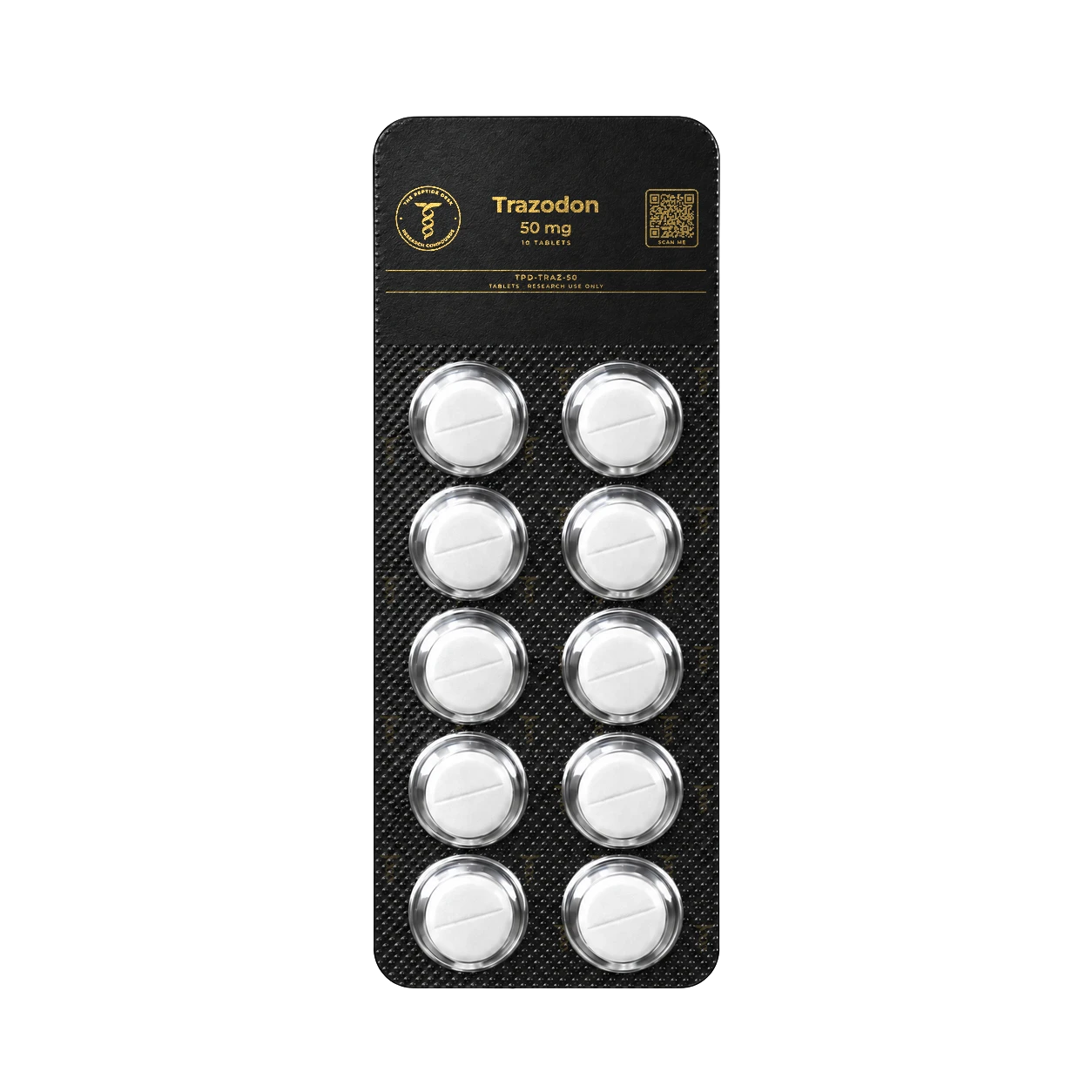
You can order Trazodone as oral tablets in two strengths: 50mg and 100mg per tablet.
This information is for research and educational purposes only. No medical advice.
Risks & Safety
Trazodone is a compound approved for decades with a well documented effect profile. It has no relevant anticholinergic activity, which sets it apart from the tricyclics, but through alpha-1 and H1 blockade it carries its own risk profile that includes a rare but serious urological component.
Documented in clinical studies and case series:
- Priapism: the classic rare but serious adverse effect of trazodone and the reason the compound is known in urology. The cause is alpha-1 adrenergic blockade in the corpus cavernosum, which disrupts the outflow mechanism. A painful erection lasting several hours without sexual stimulus is a urological emergency, because delayed treatment is linked in the literature to permanent erectile impairment. The effect is described as dose-independent and also occurs in the low range. A rare female counterpart (clitoral priapism) has also been reported.
- Serotonin syndrome: documented on combination with other serotonergic substances, particularly MAO inhibitors, SSRIs, SNRIs, triptans, linezolid, tramadol or St John’s wort. The active metabolite mCPP adds to the serotonergic load. Described signs are agitation, tremor, muscle twitching, hyperreflexia, sweating, diarrhea and rising temperature.
- Orthostatic hypotension and syncope: follows directly from alpha-1 blockade and is the most common circulation-related effect. Described in the literature especially at the start and in older individuals, with corresponding fall risk when getting up at night.
- Sedation with next-day carryover: Roth et al. documented measurable decrements in short-term memory, verbal learning, equilibrium and arm muscle endurance the following morning under 50mg. Mendelson likewise describes sedation, dizziness and psychomotor impairment as relevant reasons for discontinuation.
- QT prolongation: prolongation of the corrected QT interval and, in isolated cases, torsade de pointes are documented. Relevant mainly with pre-existing heart disease, electrolyte disturbance or combination with other QT-prolonging substances.
- CYP3A4 interaction: strong CYP3A4 inhibitors such as ketoconazole, itraconazole, ritonavir or clarithromycin markedly raise trazodone levels, while CYP3A4 inducers such as carbamazepine lower them. Via the metabolite mCPP, inhibition can additionally favor dysphoric and anxiety-amplifying effects.
- Discontinuation effects and tolerance: Mendelson describes evidence of tolerance development with longer use. Abrupt discontinuation after prolonged use is linked in the literature to rebound insomnia and irritability.
This classification does not replace medical advice. Risk and responsibility for any actual use lie entirely with the buyer.
Studies
- Mechanism of action of trazodone: a multifunctional drug - CNS Spectrums 2009, Stahl: describes the dose-receptor model under which 5-HT2A and H1 blockade dominate at low doses and SERT inhibition only becomes relevant at high doses.
- Rediscovering trazodone for the treatment of major depressive disorder - CNS Drugs 2012, Fagiolini et al: review of the SARI class with antidepressant efficacy comparable to SSRIs, SNRIs and tricyclics, including classification of low-dose use and the rare priapism cases.
- Cognitive, psychomotor and polysomnographic effects of trazodone in primary insomniacs - Journal of Sleep Research 2011, Roth et al: randomized, double-blind, placebo-controlled with 50mg over seven days, showing fewer nighttime awakenings and more slow wave sleep, but measurable decrements in memory, equilibrium and muscle endurance the following morning.
- A review of the evidence for the efficacy and safety of trazodone in insomnia - Journal of Clinical Psychiatry 2005, Mendelson: critical review of 18 studies concluding that evidence for sleep use is limited and that side effects such as sedation, dizziness and psychomotor impairment are not inconsequential.
- Comparative effects of pharmacological interventions for the acute and long-term management of insomnia disorder in adults - The Lancet 2022, De Crescenzo et al: network meta-analysis across 170 trials and nearly 48,000 participants, placing trazodone among the substances effective in acute use but with limited tolerability or long-term data.