

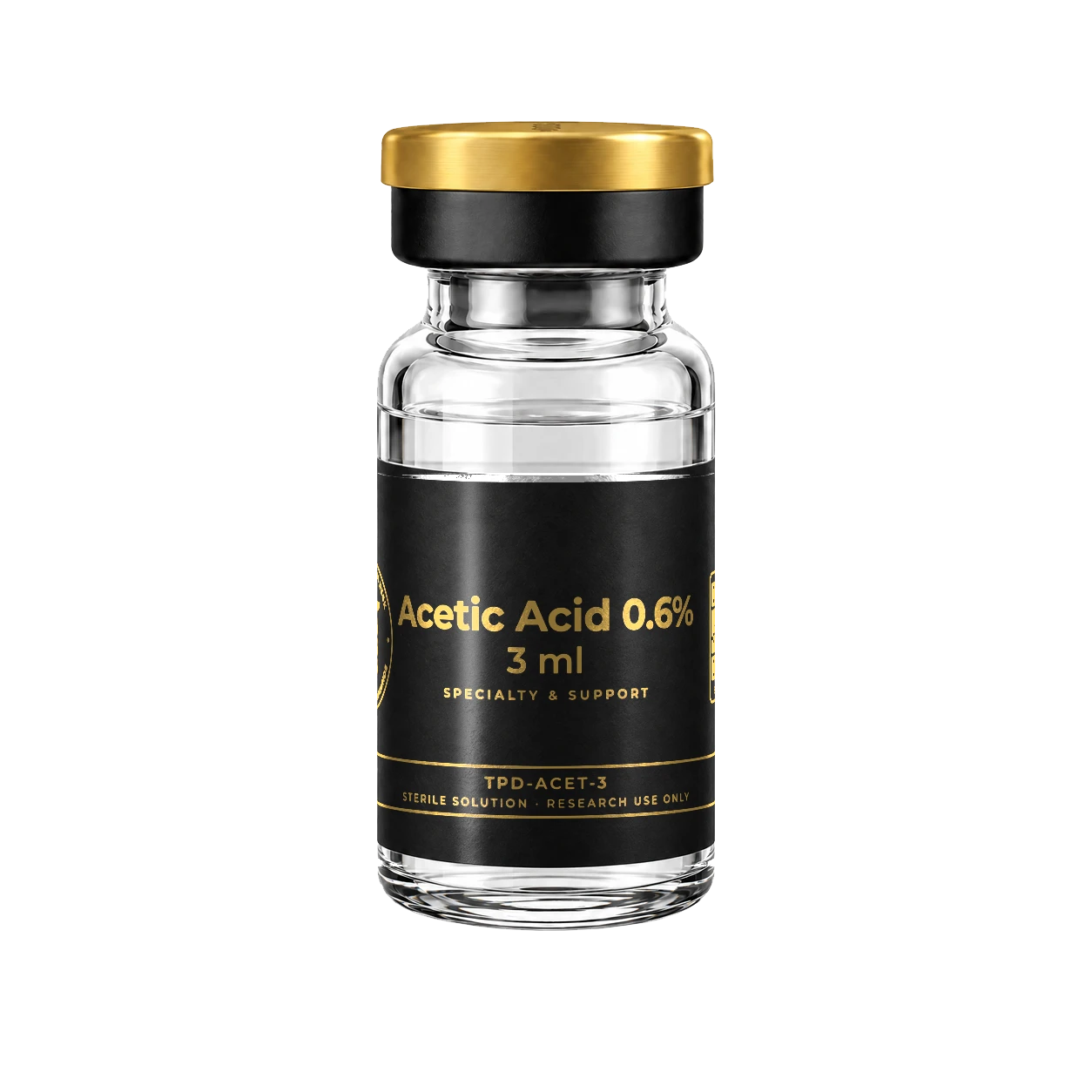
Acetic Acid 0.6%
Accessories & Special
- Lähetetään Saksasta
Tilaus
- DHL seurannalla
- Huomaamaton pakkaus
Yhdellä silmäyksellä
Acetic Acid 0.6% lukuina
Tietopankkimme keskeiset luvut.
Koko tietopankkiartikkeli- Class
- Solvent / reconstitution agent
- Use
- Dissolving lyophilized peptides
- Sizes
- 3 to 10 ml2 sizes in the shop
Arvostelut
Mitä asiakkaat sanovat
Vain todelliset tilaukset, joissa oli Acetic Acid 0.6%.
Kaikki arvostelutTuotteelle Acetic Acid 0.6% ei ole vielä laboratorioanalyysia. Äänestä sitäTestauta itse, me maksamme puoletKaikki laboratorioanalyysit
Tietoa
Kaikki aiheesta Acetic Acid 0.6%
Tarkemmat tiedot tulossa pian.
Tilaa samalla
Mitä tarvitset sen kanssa
Bakteriostaattinen vesi lisätään ostoskoriisi automaattisesti. Ruiskut ja pyyhkeet yhdellä napsautuksella.

Insuliiniruiskut
10 kpl · 5.50 €

Alkoholipyyhkeet
50 kpl · 10 €
Is acetic acid 0.6% an active compound?
No. It is a solvent. Its job is purely chemical: getting a peptide into solution and keeping it stable there. It has no biological effect in this context.
Why do some peptides dissolve better in acid?
A peptide's charge depends on pH. It is least soluble and most prone to clumping where its net charge is close to zero. In acid many peptides carry a clearly positive charge, the molecules repel each other and tend to stay separate in solution.
Does a peptide always last longer in acid?
Not always. With oxytocin as an example the half-life at 40 degrees was 115.5 days at pH 4.5 and 8.7 days at pH 7. At pH 2 it was only 21 days, because the peptide lost amide groups there. The best pH window differs from peptide to peptide.
Which peptides need acetic acid?
Only a few. According to the entry these are for example certain IGF-1 or fragment variants that dissolve poorly in bacteriostatic water. Which solvent a peptide needs is noted in its own entry. For everything else bacteriostatic water remains the standard.
How safe is acetic acid?
Acetic acid occurs naturally in plants and animals and in the US is generally recognised as safe as a food additive, among other things as a pH regulator and solvent. In the diluted form here, direct skin contact may mildly irritate. There are no studies on its use as a solvent for research peptides.
Liittyvät
Samankaltaiset tuotteet

Acetic Acid 0.6%

