

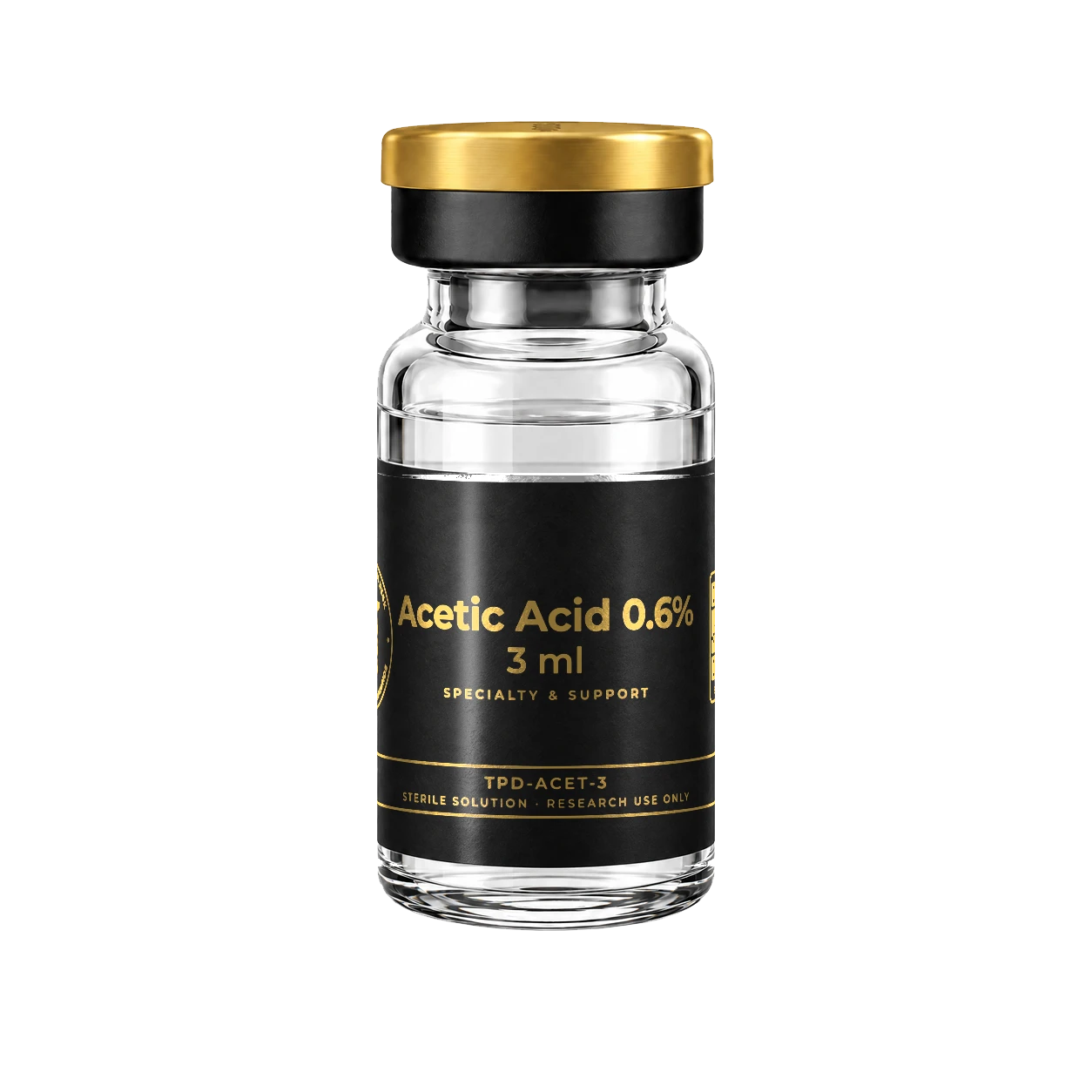
Acetic Acid 0.6%
Accessories & Special
- Verzonden vanuit Duitsland
Bestelling
- DHL met tracking
- Discrete verpakking
In één oogopslag
Acetic Acid 0.6% in cijfers
De kerncijfers uit ons lexicon.
Volledig lexiconartikel- Class
- Solvent / reconstitution agent
- Use
- Dissolving lyophilized peptides
- Sizes
- 3 to 10 ml2 sizes in the shop
Er is nog geen labanalyse voor Acetic Acid 0.6%. Stem eropLaat het zelf testen, wij betalen de helftAlle labanalyses
Kennis
Alles over Acetic Acid 0.6%
Uitgebreide informatie volgt binnenkort.
Handig om erbij te hebben
Wat je erbij nodig hebt
Bacteriostatisch water wordt automatisch aan je winkelwagen toegevoegd. Spuiten en doekjes met één klik.

Insulinespuiten
10 stuks · 5.50 €

Alcoholdoekjes
50 stuks · 10 €
Is acetic acid 0.6% an active compound?
No. It is a solvent. Its job is purely chemical: getting a peptide into solution and keeping it stable there. It has no biological effect in this context.
Why do some peptides dissolve better in acid?
A peptide's charge depends on pH. It is least soluble and most prone to clumping where its net charge is close to zero. In acid many peptides carry a clearly positive charge, the molecules repel each other and tend to stay separate in solution.
Does a peptide always last longer in acid?
Not always. With oxytocin as an example the half-life at 40 degrees was 115.5 days at pH 4.5 and 8.7 days at pH 7. At pH 2 it was only 21 days, because the peptide lost amide groups there. The best pH window differs from peptide to peptide.
Which peptides need acetic acid?
Only a few. According to the entry these are for example certain IGF-1 or fragment variants that dissolve poorly in bacteriostatic water. Which solvent a peptide needs is noted in its own entry. For everything else bacteriostatic water remains the standard.
How safe is acetic acid?
Acetic acid occurs naturally in plants and animals and in the US is generally recognised as safe as a food additive, among other things as a pH regulator and solvent. In the diluted form here, direct skin contact may mildly irritate. There are no studies on its use as a solvent for research peptides.
Gerelateerd
Gerelateerde producten

Acetic Acid 0.6%

