This information is for research and educational purposes only. No medical recommendations. Products are not approved for human use. For health questions, consult a doctor.

Lexicon

Acetic Acid 0.6%

A mild acidic reconstitution solvent for peptides that are more stable at low pH.

1 min read 5 sources

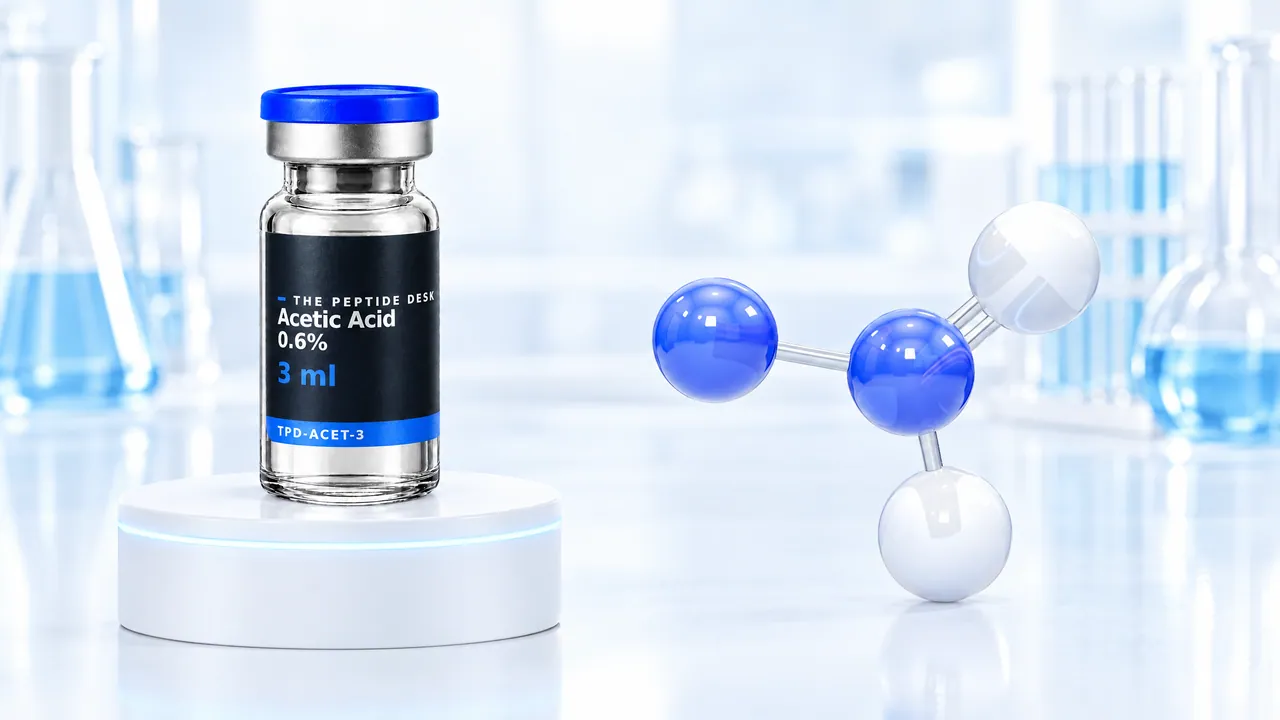
Vial with the black TPD label for acetic acid 0.6% on a white podium, next to it a model of two blue and two white spheres in a bright lab
Lab aid, not an active compound · not approved

Summary

At a glance

Sources checked on 26 Oct 2026

Acetic acid in water
0.6 %

highly diluted, substance data of acetic acid from PubChem4

Acid strength
4.76 pKa

weak acid, value at 25 degrees4

Half-life of a peptide at pH 4.5
115.5 days

oxytocin at 40 degrees, at pH 7 only 8.7 days1

  • Acetic acid 0.6% is highly diluted acetic acid in water. It is not an active compound but a solvent for peptides that dissolve poorly in neutral bacteriostatic water.4
  • In acid peptides carry a different charge than at neutral pH. If their net charge is far from zero, the molecules repel each other and clump less.2
  • According to reviews pH is the most important lever for the shelf life of peptides in solution. One example: oxytocin lasted much longer at pH 4.5 than at pH 7.31
  • More acidic is not automatically better: at pH 2 the same peptide broke down faster than at pH 4.5, via a different route.1
  • In the US acetic acid is generally recognised as safe as a food additive, among other things as a pH regulator. Everything here is research and educational information.5
Profile

Updated June 2026

Class
Solvent / reconstitution agent
Use
Dissolving lyophilized peptides
pH
about 3.0 to 4.0
Status
Lab aid

not an active compound

Sizes
3 to 10 ml

2 sizes in the shop

Contents 12 sections
  1. At a glance
  2. What is Acetic Acid 0.6%?
  3. What it is for
  4. How it works
  5. Research status
  6. How to use it
  7. Side effects
  8. Storage
  9. Related compounds
  10. FAQ
  11. Glossary
  12. Sources

What is Acetic Acid 0.6%?

Acetic Acid 0.6% is not an active compound but a mild acidic solvent for dissolving (reconstituting) certain lyophilized research peptides. Some peptides dissolve poorly or are unstable at neutral pH - a slightly acidic environment then helps them dissolve and stay stable.

This information is for research and educational purposes only. No medical advice.

What it is for

Some peptides (for example certain IGF-1 or fragment variants) dissolve poorly in bacteriostatic water. Acetic Acid 0.6% is used to dissolve them first, then you can dilute further with water. Which solvent a peptide needs is noted in its compound entry.

Comparison

Solvents in the lexicon

Which solvent a peptide needs is noted in its entry. Here are the three at a glance, as stated in the TPD lexicon. Tap a card to open its entry.

Simplified: bacteriostatic water is the standard, the two acidic solvents only for peptides that do not dissolve cleanly in it.
Beaker with clear liquid and a glass rod, a white powder dissolving in it, surrounded by bright light trails
A poorly soluble peptide goes into solution in slightly acidic conditions. Symbolic image.

How it works

The slightly acidic environment (pH 3 to 4) improves the solubility of pH-sensitive peptides and slows two decay pathways - hydrolysis and oxidation. The effect is purely chemical-stabilizing, not biologically active.

Study results

What the trials measured

Interactive: switch tabs, tap points, show or hide arms. Arms are named relative to each other, no dosing advice.

How long a peptide lasts in solution1

Half-life of oxytocin at 40 degrees by pH, in days

Oxytocin, 40 degrees1 accelerated degradation in the lab
pH 2.0 (strongly acidic) 21.0 d
pH 4.5 (slightly acidic) 115.5 d
pH 7.0 (neutral) 8.7 d
pH 9.0 (alkaline) 7.2 d

Values from Table I of the study. Oxytocin was dissolved in phosphate buffer, not in acetic acid. The chart only shows how strongly pH changes the shelf life of a peptide. At pH 2 the peptide mainly lost amide groups (deamidation), at pH 4.5 to 9 mainly linked forms appeared.
White powder sinking into a clear liquid, blue bead chains unfurling from it, next to them two small molecules of blue and white spheres
Peptide chains dissolve and stay intact. Symbolic image.

Research status

Where the research stands

There are no clinical trials for a solvent, which is to be expected. The basics come from pharmaceutics: how pH and charge change the solubility and shelf life of peptides. As of 26 Oct 2026.

  1. Preclinical Lab studies on peptide solubility and shelf life
  2. Phase 1 no registered trial
  3. Phase 2 no registered trial
  4. Phase 3 no registered trial
  5. Approval not yet
Not a drug and not an active compound. In the US acetic acid is generally recognised as safe as a food additive (GRAS), among other things as a pH regulator and solvent.5

So far there is no registered trial in humans.

How to use it

Dosing

Dosing, titration and syringe

Loading the dosing information …

  • Getting started and stepping up, drawn as a staircase
  • Units on the U-100 syringe for every step
  • How long one vial lasts

Side effects

As a pure lab aid, Acetic Acid 0.6% has no therapeutic side effect profile. In the tiny amounts used for reconstitution it is uncritical. Direct skin contact may mildly irritate.

Storage

Store at room temperature, protected from light, in a tightly closed bottle - no fridge needed. Out of reach of children.

Related

Related compounds

A different path: all in the TPD lexicon.

FAQ

Common questions about Acetic Acid 0.6%

Short answers, each backed by the sources below.

Is acetic acid 0.6% an active compound?

No. It is a solvent. Its job is purely chemical: getting a peptide into solution and keeping it stable there. It has no biological effect in this context.3

Why do some peptides dissolve better in acid?

A peptide's charge depends on pH. It is least soluble and most prone to clumping where its net charge is close to zero. In acid many peptides carry a clearly positive charge, the molecules repel each other and tend to stay separate in solution.2

Does a peptide always last longer in acid?

Not always. With oxytocin as an example the half-life at 40 degrees was 115.5 days at pH 4.5 and 8.7 days at pH 7. At pH 2 it was only 21 days, because the peptide lost amide groups there. The best pH window differs from peptide to peptide.1

Which peptides need acetic acid?

Only a few. According to the entry these are for example certain IGF-1 or fragment variants that dissolve poorly in bacteriostatic water. Which solvent a peptide needs is noted in its own entry. For everything else bacteriostatic water remains the standard.

How safe is acetic acid?

Acetic acid occurs naturally in plants and animals and in the US is generally recognised as safe as a food additive, among other things as a pH regulator and solvent. In the diluted form here, direct skin contact may mildly irritate. There are no studies on its use as a solvent for research peptides.5

Glossary

Terms explained briefly

Dotted words in the text open these explanations directly.

Bacteriostatic water
Sterile water with benzyl alcohol as a preservative. The standard solvent for most peptides.
Deamidation
Loss of an amide group on building blocks such as asparagine or glutamine. A common way peptides break down in solution.
Hydrolysis
Splitting of a molecule by water. In peptides this can break the chain.
Lyophilisate
Freeze-dried powder. Without water a peptide keeps much longer.
Net charge
Sum of all positive and negative charges of a molecule. It changes with pH.
Oxidation
Reaction with oxygen. It changes sensitive building blocks of a peptide such as methionine or cysteine.
pH
Measure of how acidic or alkaline a solution is. 7 is neutral, below is acidic, above is alkaline.
pKa
Measure of the strength of an acid. The higher the value, the weaker the acid. Acetic acid is at 4.76.
Reconstitution
Dissolving a freeze-dried powder in a liquid so that it can be used.

Evidence

Sources

Show all 5 sourcesHide sources 3 Studies2 Database checked 26 Oct 2026

Studies

  1. Degradation of oxytocin by pH and temperature

    Hawe et al., Pharmaceutical Research, 2009

    Checked 26 Oct 2026 via doi.org, Crossref, PubMed, PMC (Volltext)
  2. Review: what makes peptides aggregate, including pH and charge

    Zapadka et al., Interface Focus, 2017

    Checked 26 Oct 2026 via doi.org, Crossref, PubMed
  3. Review: keeping peptides stable in solution

    Nugrahadi et al., Pharmaceutics, 2023

    Checked 26 Oct 2026 via doi.org, Crossref, PubMed

Database

  1. Acetic acid in PubChem (structure, pKa)

    PubChem, U.S. National Library of Medicine (CID 176)

    Checked 26 Oct 2026 via PubChem
  2. Acetic acid as a generally recognised safe food additive (GRAS)

    eCFR, 21 CFR 184.1005, U.S. Food and Drug Administration

    Checked 26 Oct 2026 via eCFR

In the shop

Acetic Acid 0.6% in the catalog

Sizes, prices and shipping times are on the product page.

To the product

