

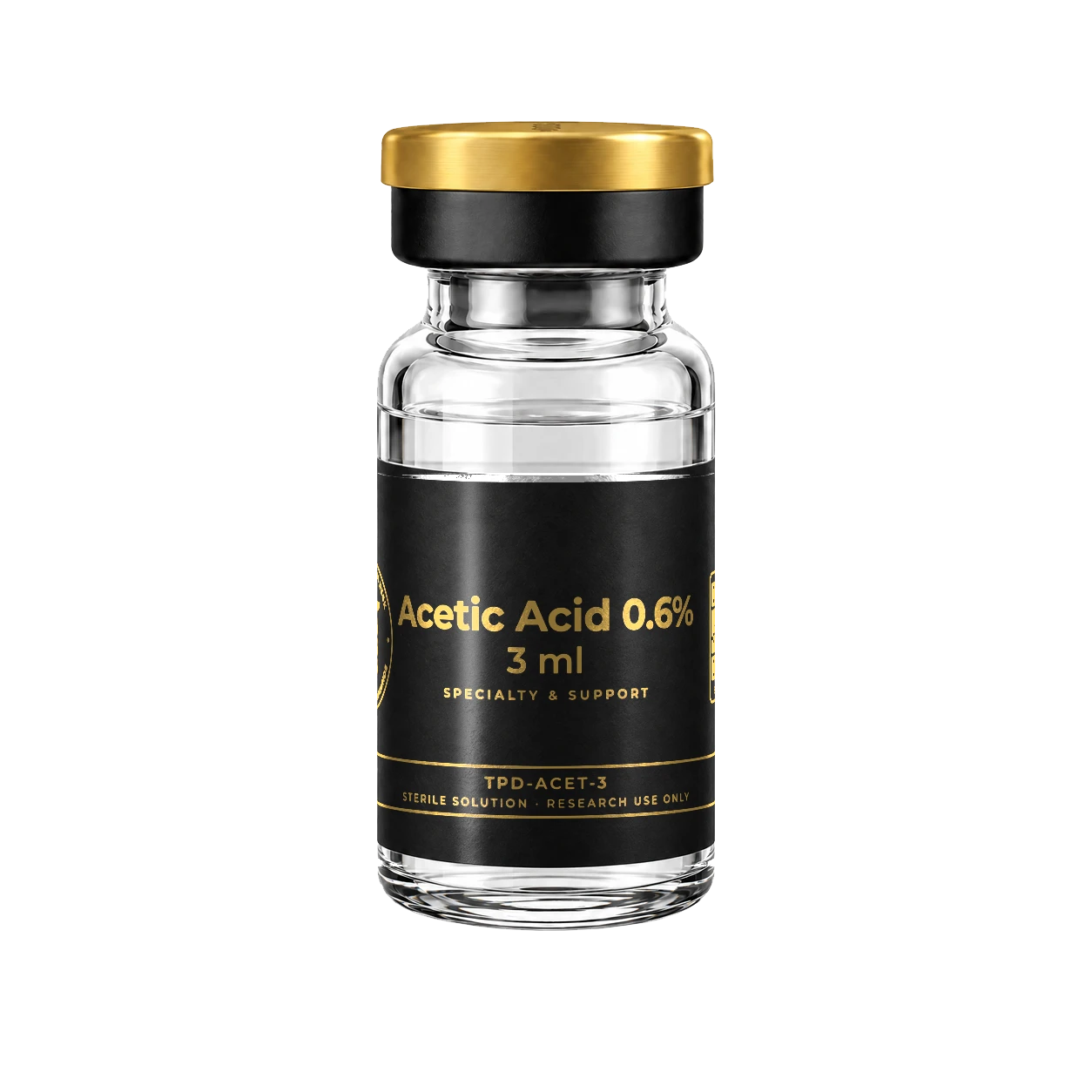
Acetic Acid 0.6%
Accessories & Special
- Siunčiame iš Vokietijos
Užsakymas
- DHL su sekimu
- Diskreti pakuotė
Trumpai
Acetic Acid 0.6% skaičiais
Pagrindiniai rodikliai iš mūsų žinyno.
Visas žinyno įrašas- Class
- Solvent / reconstitution agent
- Use
- Dissolving lyophilized peptides
- Sizes
- 3 to 10 ml2 sizes in the shop
Atsiliepimai
Ką sako klientai
Tik tikri užsakymai, kuriuose buvo Acetic Acid 0.6%.
Visi atsiliepimaiProduktui Acetic Acid 0.6% laboratorinės analizės dar nėra. Balsuoti už taiUžsakykite tyrimą, mes apmokame pusęVisos laboratorinės analizės
Žinios
Viskas apie Acetic Acid 0.6%
Išsami informacija netrukus.
Pravers
Ko dar jums reikės
Bakteriostatinis vanduo į krepšelį pridedamas automatiškai. Švirkštai ir servetėlės - vienu paspaudimu.

Insulino švirkštai
10 vnt. · 5.50 €

Spiritinės servetėlės
50 vnt. · 10 €
Is acetic acid 0.6% an active compound?
No. It is a solvent. Its job is purely chemical: getting a peptide into solution and keeping it stable there. It has no biological effect in this context.
Why do some peptides dissolve better in acid?
A peptide's charge depends on pH. It is least soluble and most prone to clumping where its net charge is close to zero. In acid many peptides carry a clearly positive charge, the molecules repel each other and tend to stay separate in solution.
Does a peptide always last longer in acid?
Not always. With oxytocin as an example the half-life at 40 degrees was 115.5 days at pH 4.5 and 8.7 days at pH 7. At pH 2 it was only 21 days, because the peptide lost amide groups there. The best pH window differs from peptide to peptide.
Which peptides need acetic acid?
Only a few. According to the entry these are for example certain IGF-1 or fragment variants that dissolve poorly in bacteriostatic water. Which solvent a peptide needs is noted in its own entry. For everything else bacteriostatic water remains the standard.
How safe is acetic acid?
Acetic acid occurs naturally in plants and animals and in the US is generally recognised as safe as a food additive, among other things as a pH regulator and solvent. In the diluted form here, direct skin contact may mildly irritate. There are no studies on its use as a solvent for research peptides.
Susiję
Susiję produktai

Acetic Acid 0.6%

