Description
Armodafinil is the R-enantiomer of modafinil. Modafinil itself is a racemate, an equal mixture of two mirror-image molecules. Of the two, the R-enantiomer has the markedly longer half-life; the S-enantiomer clears from plasma roughly three times faster. Armodafinil isolates exactly the slower-clearing half, which is why 150mg armodafinil corresponds to around 200mg modafinil.
The practical difference is not peak effect, it is the curve. Because the fast-clearing half is missing, plasma levels fall more gently across the afternoon and concentrations in the second half of the day sit higher than with an equivalent modafinil dose. That is precisely why armodafinil was the compound of choice in work on shift schedules and shifted rhythms.
The mechanism is the same as for the racemate and still not fully resolved. Inhibition of the dopamine transporter is central, with additional effects on the orexinergic, histaminergic, noradrenergic and glutamatergic systems of the hypothalamus. The review by Sousa and Dinis-Oliveira places armodafinil explicitly in the same pharmacological class as modafinil and adrafinil. As with the racemate, dopamine is not actively released from vesicles, only reuptake is blocked, which separates the profile clearly from amphetamine derivatives.
The evidence base is thinner than for modafinil, but very solid in one place. In the randomized, placebo-controlled multicenter study by Czeisler and colleagues in 254 night shift workers with shift work disorder, armodafinil 150mg lengthened mean sleep latency from 2.3 to 5.3 minutes, while it stayed essentially unchanged on placebo. Standardized memory and attention tests improved as well. Daytime sleep was not disturbed on polysomnography. For interactions and adverse effects the modafinil literature largely applies, for example the evidence-based review by Kumar.
In a research context armodafinil is therefore a wakefulness compound with a longer profile, not a stronger version of modafinil. Anyone who wants a shorter effect is better served by the racemate.
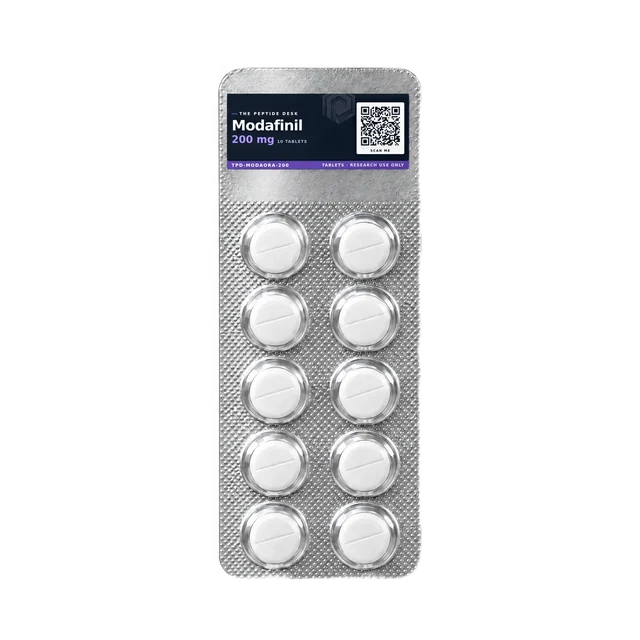
You can order Armodafinil as oral tablets with 150mg or 250mg per tablet, 10 tablets per blister.
This information is for research and educational purposes only. No medical advice.
Risks & Safety
Armodafinil shares the safety profile of modafinil. Two points are routinely overlooked. Both belong on the table before any engagement with the substance.
- Severe skin reactions: Severe skin reactions up to Stevens-Johnson syndrome are documented for the modafinil class. The review by Sousa and Dinis-Oliveira lists them explicitly. They are very rare, usually appear within the first weeks and are potentially life-threatening. Any new rash, any blistering and any involvement of mouth, eyes or mucous membranes is a reason to stop and a case for medical assessment.
- Interaction with hormonal contraceptives: The class induces CYP3A4. Prescribing information therefore notes reduced reliability of hormonal contraception during use and for roughly one month afterwards. This is the single most overlooked point of the entire class.
- A longer effect means a longer sleep shift: The advantage of armodafinil is also its risk. Dosing in the afternoon pushes sleep further into the night than modafinil would. Timing matters more than quantity with this substance.
- Further CYP interactions: Via CYP3A4 induction, substrates with high first-pass metabolism are affected; CYP2C19 is additionally inhibited, which concerns diazepam, omeprazole and phenytoin among others.
- Common adverse effects: Headache is by far the most frequent effect in the trials, followed by nausea, nervousness, reduced appetite and dry mouth. Slight increases in blood pressure and heart rate are described.
- Abuse and dependence potential: Lower than with amphetamines, but not zero. Class reviews derive this from the dopaminergic action and do not rule out potential in vulnerable groups.
This classification does not replace medical advice. Risk and responsibility for any actual use lie entirely with the buyer.
Studies
- Armodafinil for treatment of excessive sleepiness associated with shift work disorder: a randomized controlled study - Mayo Clinic Proceedings 2009, Czeisler et al: 254 night shift workers, 150mg lengthened mean sleep latency from 2.3 to 5.3 minutes and improved memory and attention testing without disturbing daytime sleep.
- Pharmacokinetic and pharmacodynamic of the cognitive enhancer modafinil: relevant clinical and forensic aspects - Substance Abuse 2020, Sousa & Dinis-Oliveira: review of modafinil, adrafinil and armodafinil covering mechanism, metabolism, adverse effects and the documented severe skin reactions.
- Approved and investigational uses of modafinil: an evidence-based review - Drugs 2008, Kumar: evidence-based review of the approved indications, the CYP interaction profile and the common adverse effects of the class.
- A systematic review of modafinil: potential clinical uses and mechanisms of action - Journal of Clinical Psychiatry 2006, Ballon & Feifel: systematic review across 33 double-blind, placebo-controlled trials and the neurotransmitter systems involved.