Description
DNP (2,4-Dinitrophenol) is the historical prototype of mitochondrial uncouplers. In the 1930s DNP was briefly marketed as an obesity therapeutic, until high incidence of fatal hyperthermia led to market withdrawal. Since then DNP has remained a standard tool in pharmacological research for investigating oxidative phosphorylation.
In research contexts DNP acts as a protonophoric uncoupler: the lipophilic molecule diffuses into the inner mitochondrial membrane and transports protons along their gradient back to the matrix. This bypasses ATP synthase - the energy from nutrient oxidation is released as heat instead of ATP.
Uncoupling is a real, long-known effect and the reason the substance looked so attractive historically. The problem is the extremely narrow safety window: the desired and the toxic effect lie close together. Serious adverse effects occur at an unacceptably high rate (Grundlingh 2011). Poisoning shows as uncontrollable hyperthermia; body temperature rises faster than the body can dissipate it via sweating.
Described signs are fever, heavy sweating, a racing heart, rapid breathing or shortness of breath. Yellowing of the skin and urine is described as well. They are not something you get used to; they can be the start of poisoning. Medical use in the 1930s also documented cataracts and peripheral nerve inflammation.
Because of its adverse effects, DNP has been banned for human consumption in many countries since 1938 (Sousa 2020). The current toxicology literature reaches the same conclusion.
How long DNP stays in the body has barely been studied in humans; the data come almost entirely from poisoning cases. There, elimination stretched over several days (Zhao 2015, Silvester 2025), so repeated intake can add up.
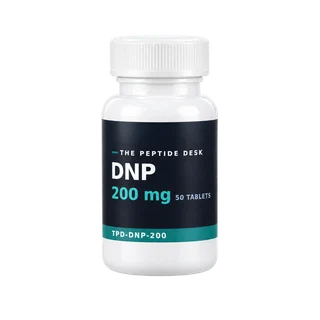
You can order DNP as oral tablets with 200mg per tablet, 50 tablets per bottle. We deliberately give no dose for DNP: there is no defensible human protocol.
This information is for research and educational purposes only. No medical recommendations.
Risks & Safety
DNP has the narrowest safety margin of any compound in the entire catalog. The substance was pulled from the market for good reason - the toxicology literature is unambiguous and serious.
Documented in the literature:
- Fatal hyperthermia: the central danger mechanism. The desired and the toxic effect sit extremely close together. Body temperature rises faster than the body can shed it. Documented cases end in death. There is no antidote.
- Heat and exertion: sauna, intense cardio and warm environments raise the hyperthermia risk massively, because they block the exact route by which the body sheds the extra heat.
- Fluids and electrolytes: not an add-on but part of the risk. DNP-related hyperthermia is life-threatening without adequate fluid.
- Accumulation: in poisoning cases elimination stretched over several days, so repeated intake can add up. In the UK case series, repeated intake over days to weeks was more common than a single overdose (Kamour 2014).
- Warning signs: fever, heavy sweating, a racing heart, shortness of breath and yellowing of the skin and urine are not something you get used to; they can be the start of poisoning.
- From medical use in the 1930s: cataracts and peripheral nerve inflammation.
- Emergency: fever, feeling hot, a racing heart or confusion after taking DNP are an emergency. Call emergency services immediately (112 in the EU) and say that DNP is involved.
Risk-Tier 3, top end of the scale. There is no defensible human protocol for DNP, so we give no dose. This classification does not replace medical advice. Risk and responsibility for any actual use lie entirely with the buyer.
Studies
- 2,4-Dinitrophenol (DNP): A Weight Loss Agent with Significant Acute Toxicity and Risk of Death - Journal of Medical Toxicology 2011, Grundlingh et al: review of the acute toxicity and lethality of DNP, today a standard reference for risk classification.
- International trends in systemic human exposures to 2,4 dinitrophenol reported to poisons centres - Clinical Toxicology 2021, Gziut et al: international analysis of 456 documented DNP exposure cases reported to poison centres.
- Mitochondrial Uncoupling Proteins (UCP1-UCP3) and Adenine Nucleotide Translocase (ANT1) Enhance the Protonophoric Action of 2,4-Dinitrophenol in Mitochondria and Planar Bilayer Membranes - Biomolecules 2021, Žuna et al: mechanism study on the protonophoric uncoupling action of DNP.
- Survival of Acute-on-Chronic 2,4-Dinitrophenol Overdose with Associated Pharmacokinetics - Journal of Medical Toxicology 2025, Silvester et al: case report tracking DNP blood levels over time. The authors stress that human pharmacokinetic data on DNP are rare.
- Molecular mechanisms of mitochondrial uncoupling: focus on 2,4-dinitrophenol - European Biophysics Journal 2026, Pohl & Jovanovic: recent review of the molecular mechanisms of mitochondrial uncoupling by DNP.