Description
Liothyronine (T3, Triiodothyronine, Cytomel) is the active form of thyroid hormone. In physiological metabolism the storage hormone T4 is converted to T3 by deiodinases - only T3 binds effectively to thyroid hormone receptors of target cells. Direct T3 administration bypasses this conversion.
Per study reports T3 increases basal metabolic rate, mitochondrial activity and protein synthesis. In cutting research T3 is used for its strong thermogenic action. Studies document BMR increases of 15-30% at supraphysiologic doses, with corresponding acceleration of fat loss in caloric deficit.
The main disadvantage in research practice is the catabolic action on muscle tissue. T3 increases not only lipolysis but also proteolysis. In anabolic research T3 is therefore rarely used without accompanying anabolics - muscle losses would otherwise be significant.
Pharmacokinetically T3 is orally bioavailable with high bioavailability. Half-life about 2.5 days. Steady-state established after 7-10 days. Known effects in studies: tachycardia, palpitations, tremor, sweating, at high doses elevated atrial fibrillation risk.
Suppression of the endogenous thyroid axis is an important point: longer than 4-6 weeks above physiologic doses, exogenous T3 suppresses TSH production and thereby endogenous hormone synthesis. Recovery after discontinuation takes 4-8 weeks in studies.
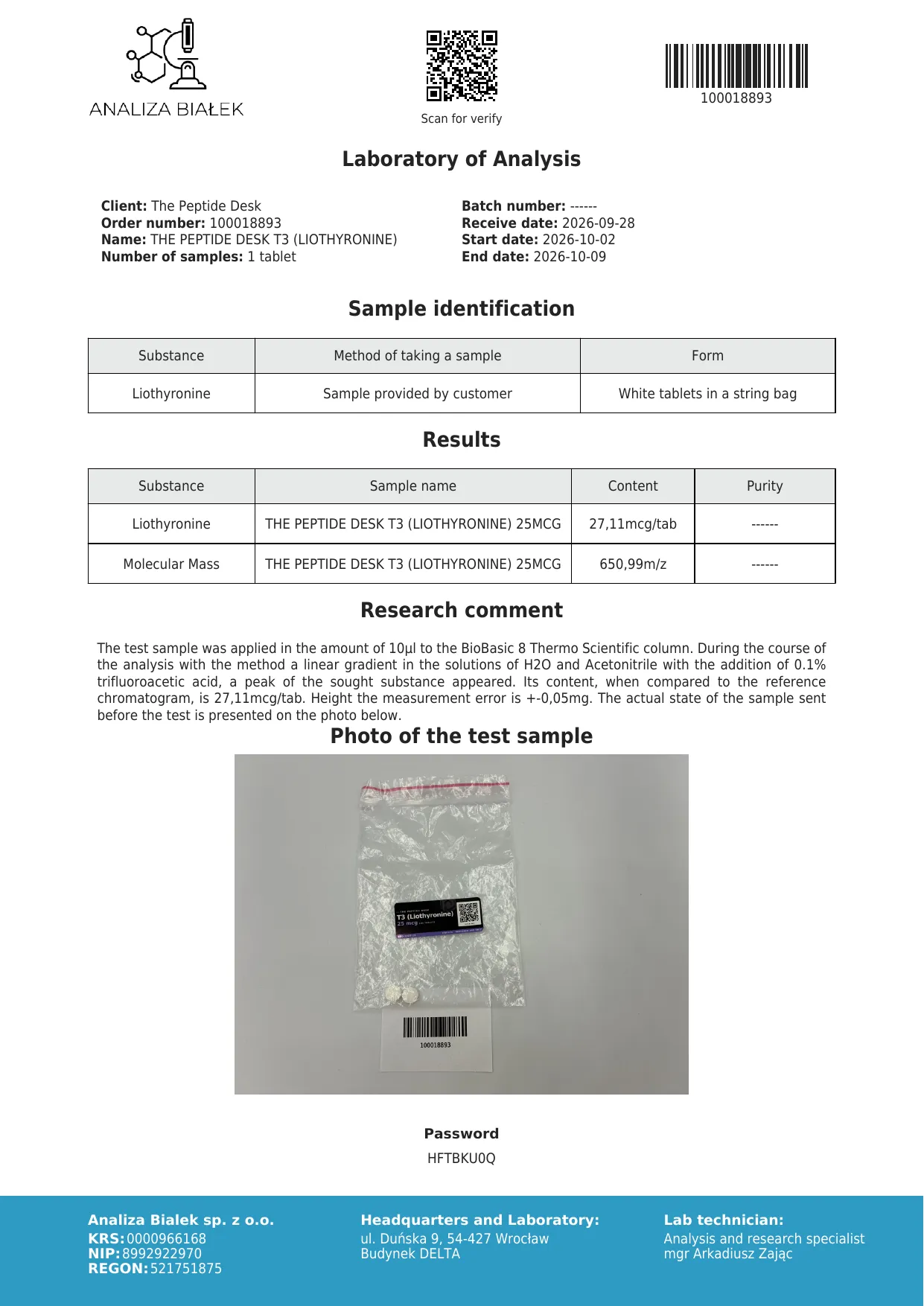
You can order T3 as oral tablets in one bottle with 25mcg per tablet.
This information is for research and educational purposes only. No medical recommendations.
Risks & Safety
T3 sits at the high end of the risk scale. As an active thyroid hormone the compound intervenes directly in a central endocrine axis. Its effects are clearly documented in the literature.
Documented in studies and the literature:
- Cardiac effects: tachycardia and palpitations are documented dose-dependently. At high doses the risk of atrial fibrillation is elevated.
- Axis suppression: given above physiological doses for longer than 4-6 weeks, exogenous T3 suppresses TSH production and thereby endogenous hormone synthesis.
- Muscle loss: T3 raises not only lipolysis but also proteolysis - the catabolic effect on muscle tissue is consistently described in the research literature.
- Anxiety and tremor: inner restlessness, shaking and sweating are documented accompanying effects of the metabolic acceleration.
- Discontinuation issue: abrupt discontinuation from higher doses can produce a transient hypothyroid picture. Axis recovery takes 4-8 weeks in studies.
Monitoring via bloodwork is recommended. This classification does not replace medical advice. Risk and responsibility for any actual use lie entirely with the buyer.
Studies
- Pharmacokinetics of L-Triiodothyronine in Patients Undergoing Thyroid Hormone Therapy Withdrawal - Thyroid 2019, Van Tassell et al: open-label pharmacokinetic study, documents a two-compartment model with a slow elimination half-life of around 30 hours.
- Thyroid Hormone Regulation of Metabolism - Physiological Reviews 2014, Mullur et al: comprehensive review of the mechanisms by which thyroid hormones govern basal metabolic rate and thermogenesis.
- Thyroid Hormone and the Cardiovascular System - New England Journal of Medicine 2001, Klein & Ojamaa: standard reference on the cardiac pharmacology of thyroid hormones.
- Thyroid hormones and changes in body weight and metabolic parameters in response to weight loss diets: the POUNDS LOST trial - International Journal of Obesity 2017, Liu et al: clinical study on the relationship between thyroid hormone levels, body weight and metabolic parameters under dieting.