Description
DSIP (Delta Sleep Inducing Peptide) is a nonapeptide with the sequence Trp-Ala-Gly-Gly-Asp-Ala-Ser-Gly-Glu, originally isolated in 1977 from cerebral venous blood of rabbits during sleep phases. The research history of DSIP is therefore one of the oldest in sleep peptide literature. The name derives from the original observation that the peptide was associated with increased delta wave activity in EEG in animal models.
Despite the name, DSIP in current research literature is characterized as a pleiotropic neuropeptide that modulates not only sleep architecture but a broad range of neuroendocrine pathways. In preclinical studies, DSIP has been associated with effects on stress resilience, pain modulation, hormone secretion patterns and circadian rhythmicity. The original sleep hypothesis is one of many activity axes in the modern data, not the dominant mechanism.
Mechanistically, DSIP is unusual: despite decades of research, no clear primary receptor has been identified. The activity hypotheses include indirect modulation of GABA, glutamate and endorphin systems. In some studies, DSIP binding to albumin has been characterized, which influences pharmacokinetics.
In research setups, DSIP is typically used in evening protocols in preclinical models, with endpoints such as EEG patterns, hormone secretion profiles and behavioral markers.
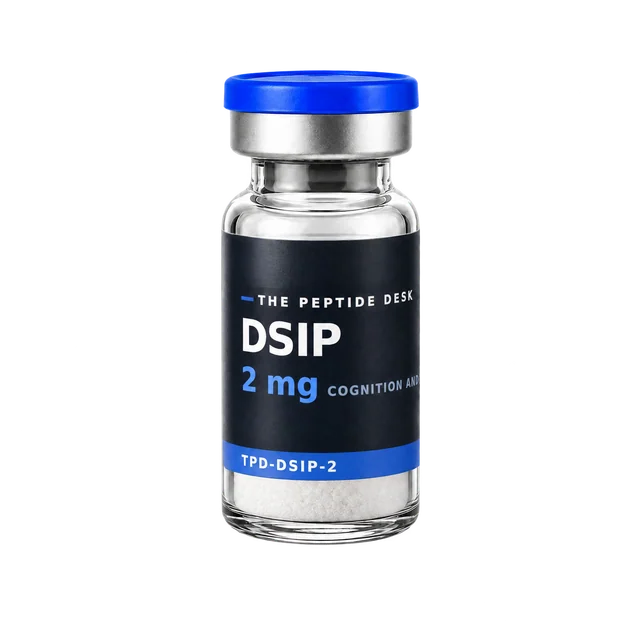
This variant is a ready-to-use nasal spray: 10mg of DSIP dissolved in 5 ml saline and 0.4 ml bacteriostatic water (5.4 ml in total), nothing to mix yourself. One spray (0.1 ml) delivers about 185 mcg. A bottle lasts for about 50 sprays. It is made fresh once you place your order and ships as an express item. As a powder for reconstitution, DSIP remains available in vials.
This information is for research and educational purposes only. No medical recommendations.
Risks & Safety
DSIP is described as well tolerated per study reports and is among the longest-studied sleep peptides of all.
Observed in research and user reports:
- Nasal lining: the spray adds local effects: brief burning or tingling, an urge to sneeze, a runny nose and a bitter taste in the throat when solution runs down the back. With frequent use a dry lining or slight nosebleeds are possible.
- Grogginess: occasional reports of fatigue, a groggy feeling or prolonged drowsiness the next day, as the compound is used in evening sleep research setups.
- Unclear mechanism: despite decades of research, no clear primary receptor has been identified, which complicates mechanistic assessment of the effects.
- Pleiotropic action: in studies, DSIP modulates not only sleep architecture but also stress, pain and hormone pathways, so the effects are not confined to sleep.
- No long-term data: robust long-term human studies do not exist.
This classification does not replace medical advice. Risk and responsibility for any actual use lie entirely with the buyer.
Studies
- Characterization of a delta-electroencephalogram (-sleep)-inducing peptide - PNAS 1977: First description: isolation of the nonapeptide from rabbits and sequencing, with only synthetic DSIP enhancing delta and spindle EEG activity after intraventricular infusion.
- Delta-sleep-inducing peptide (DSIP): a review - Neuroscience & Biobehavioral Reviews 1984: Early review: summarizes the findings on delta sleep induction in several species and in humans and describes effects on circadian patterns, hormone levels and neurotransmitters.
- Effects of DSIP in man - Neuropsychobiology 1983: Five double-blind human studies with intravenous DSIP, not nasal administration: good tolerability, sleep induction with a latency of about one hour and indications of chronobiological effects.
- Effects of delta sleep-inducing peptide on sleep of chronic insomniac patients. A double-blind study - Neuropsychobiology 1992: Double-blind study in 16 participants with chronic insomnia using intravenous dosing: higher sleep efficiency and shorter sleep latency with DSIP, but the effects were weak and a major benefit of short-term dosing was considered unlikely.
- Delta sleep-inducing peptide (DSIP): a still unresolved riddle - Journal of Neurochemistry 2006: Critical mini-review: neither the gene nor a receptor for DSIP has been identified, its role as a sleep factor is considered poorly documented. The authors suspect a DSIP-like peptide behind the observed effects.