Description
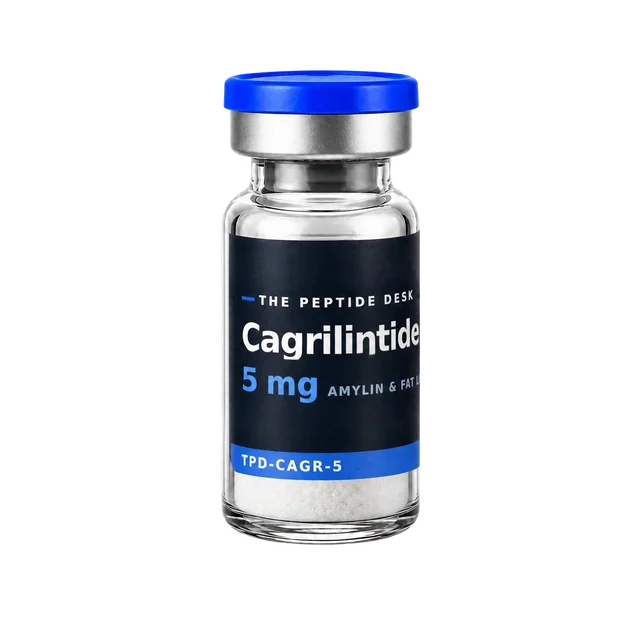
Eloralintide (development name LY3841136) is a long-acting analogue of amylin, the hormone the pancreas releases together with insulin and that signals satiety to the brain. It comes from the Eli Lilly pipeline and, like cagrilintide, belongs to the amylin analogues with a weekly rhythm.
The difference lies in the receptor profile: eloralintide prefers the amylin 1 receptor and in cell assays acts roughly twelve times more weakly on the calcitonin receptor, while cagrilintide is not selective. The developers’ working hypothesis: less activation at the calcitonin receptor, less nausea for the same satiety. A C20 fatty acid binds the peptide to albumin, which results in a half-life of around 13 to 15 days.
According to studies, satiety sets in earlier and lasts longer. Amylin also slows glucagon release after meals and slows gastric emptying. GLP-1 compounds use a different pathway, which is why research regards the amylin route as a complement. In the 48-week phase 2 trial, weight fell by 9 to 20 percent depending on dose, versus 0.4 percent under placebo. One finding stands out: pulse rate fell instead of rising as it does under GLP-1 agonists.
Eloralintide is not approved. The first phase 3 trials have been running since late 2025. There are no long-term data beyond 48 weeks yet.
You can order Eloralintide as lyophilized peptide in 10-vial packs with 10mg per vial.
This information is for research and educational purposes only. No medical recommendations.
Risks & Safety
Eloralintide is a young amylin analogue. The data come from phase 1 and phase 2 trials with a few hundred participants in total. Long-term data are missing.
Observed in studies:
- Nausea, strongly dose-dependent: in phase 2 at 1 and 3mg at placebo level (11 and 13 percent versus 14 percent), at 6mg in 64 percent. Vomiting and diarrhoea were rare in phase 1.
- Fatigue: rose with dose, at 9mg in 43 percent of participants, under placebo in 12 percent.
- Injection site: reactions, mostly pain, occurred more often than under placebo from 3mg in phase 1.
- Mood: in phase 1 four participants reported low mood, three of them at 12mg. These three stopped. The complaints resolved within two to four days.
- Long half-life: around two weeks. Side effects fade over weeks after stopping, not over days.
- Open questions: no data on pregnancy, children or pre-existing conditions, no cardiovascular outcomes trial.
This classification does not replace medical advice. Risk and responsibility for any actual use lie entirely with the buyer.
Studies
- Eloralintide, a selective amylin receptor agonist for the treatment of obesity: a 48-week phase 2, multicentre, double-blind, randomised, placebo-controlled trial - The Lancet 2025, Billings et al: phase 2 trial in 263 adults, 9 to 20 percent weight reduction depending on dose versus 0.4 percent under placebo.
- Eloralintide, a selective, long-acting amylin receptor agonist for treatment of obesity: Phase 1 proof of concept - Diabetes, Obesity and Metabolism 2026, Bhattachar et al: 12 weeks of multiple dosing in 100 participants, 2.6 to 11.3 percent weight reduction and a falling pulse rate.
- Eloralintide (LY3841136), a novel amylin receptor agonist for the treatment of obesity: From discovery to clinical proof of concept - Molecular Metabolism 2025, Briere et al: receptor selectivity, animal data and a single-dose study with a half-life of 13 to 15 days.
- Cardiometabolic Risk Reduction Through Selective Amylin Receptor Agonism - Cardiology in Review 2026, Sigalov and Frishman: review of the cardiovascular data, the authors explicitly rate the findings as preliminary.