Description
Exemestane (Aromasin) is a steroidal, irreversible third-generation aromatase inhibitor. Unlike the non-steroidal AIs Anastrozole and Letrozole, Exemestane binds covalently and therefore permanently to the active site of aromatase. The enzyme is inactivated and must be newly synthesized - hence the term “suicide inhibitor”.
Per study reports Exemestane lowers circulating estradiol levels by 65-80% with daily dosing. Due to the irreversible binding the effect persists for several days after discontinuation until enough new aromatase molecules are synthesized. Steady-state is established after about 7 days.
In anabolic research Exemestane has an important distinction from non-steroidal AIs: the steroid scaffold provides weak anabolic and androgenic residual action. This makes Exemestane attractive in PCT setups because, unlike Anastrozole, it impacts the lipid profile less negatively and doesn’t cause estrogen rebound after discontinuation.
Another property: Exemestane has an IGF-1 preserving effect, while Anastrozole and Letrozole slightly lower IGF-1 in some studies. For recreational research protocols paralleling GH axis performance, this is a practical bonus.
Known effects in studies are similar to other AIs: at too-strong E2 lowering, joint pain and libido loss. Pharmacokinetically orally bioavailable, half-life about 24 hours, dosed with meal (fatty meal substantially increases bioavailability).
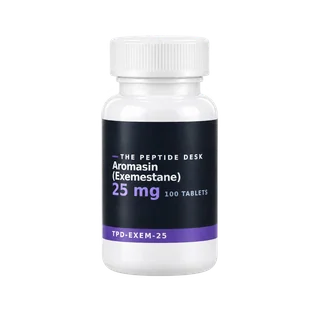
You can order Exemestane as oral tablets with 25mg per tablet, as a blister of 10 or a bottle of 100.
This information is for research and educational purposes only. No medical recommendations.
Risks & Safety
Exemestane sits in the mid range of the risk scale. As an aromatase inhibitor the central risk lies not in the compound itself but in lowering estradiol too far.
Documented in studies and the literature:
- Estradiol crash: at too-strong E2 lowering, joint pain and libido loss are documented - the lead problem of all aromatase inhibitors.
- Bone density: sustained low estradiol is associated with bone density loss in the literature.
- Irreversible binding: Exemestane binds covalently to aromatase. The effect persists for several days after discontinuation until enough new enzyme is synthesized.
- Fatigue and low mood: described in the studies as accompanying effects of an over-deep E2 reduction.
Monitoring via bloodwork is recommended. This classification does not replace medical advice. Risk and responsibility for any actual use lie entirely with the buyer.
Studies
- A Randomized Trial of Exemestane after Two to Three Years of Tamoxifen Therapy in Postmenopausal Women with Primary Breast Cancer - New England Journal of Medicine 2004, Coombes et al: Intergroup Exemestane Study - gold standard efficacy and safety data for the steroidal AI.
- Pharmacokinetics and Dose Finding of a Potent Aromatase Inhibitor, Aromasin (Exemestane), in Young Males - Journal of Clinical Endocrinology & Metabolism 2003, Mauras et al: Pharmacokinetics and dose finding of Exemestane in young males, including estradiol suppression rates.
- An overview of the pharmacology and pharmacokinetics of the newer generation aromatase inhibitors anastrozole, letrozole, and exemestane - Cancer 2002, Buzdar et al: Pharmacology overview and comparison of the third AI generation, including the irreversible binding mechanism of Exemestane.
- Aromatase inhibitors and selective estrogen receptor modulators: Unconventional therapies for functional hypogonadism? - Andrology 2019, Awouters et al: Review of AI action on the male gonadal axis.