This information is for research and educational purposes only. No medical recommendations. Products are not approved for human use. For health questions, consult a doctor.

Lexicon

Aromasin (Exemestane)

The steroidal, irreversible aromatase inhibitor - no estrogen rebound after stopping.

1 min read 10 sources

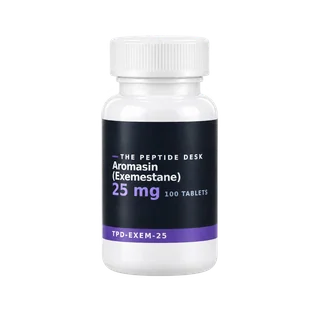
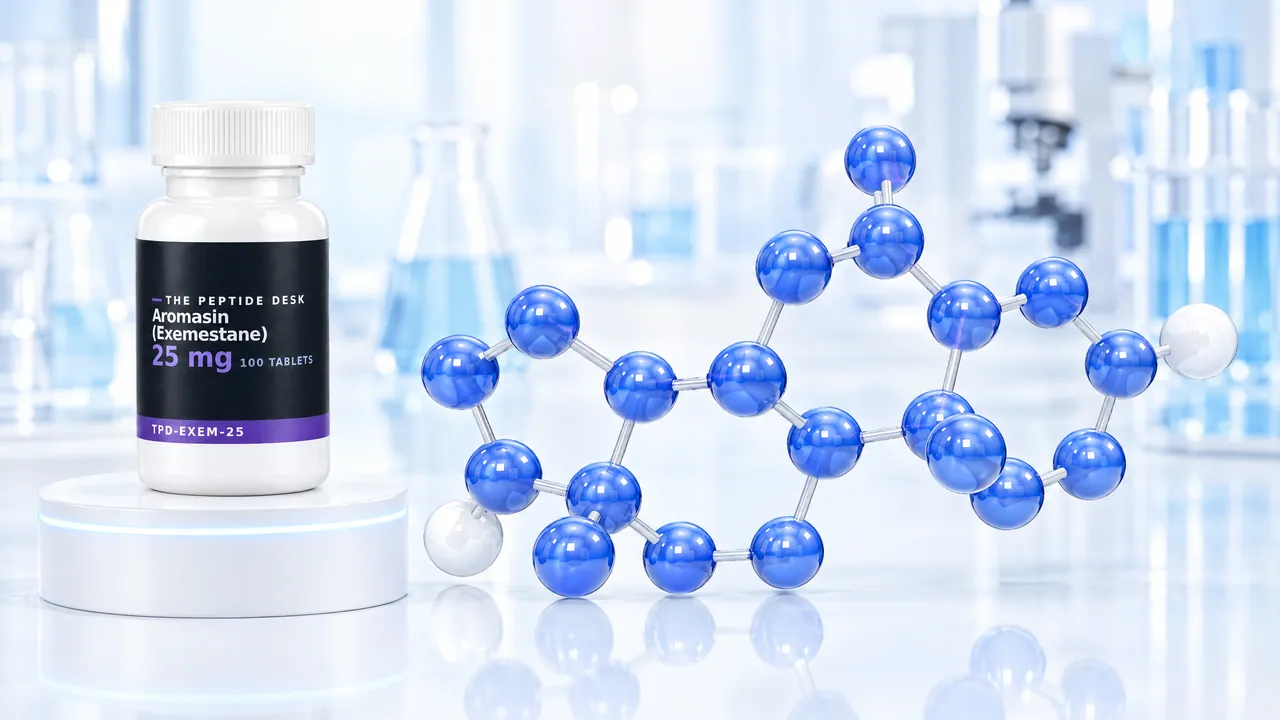
White tablet bottle with a black TPD label on a white podium, next to it a large glossy blue 3D steroid molecule in a bright lab, symbolic image for exemestane
Compound approved · in the USA since 1999 (breast cancer)

Summary

At a glance

Sources checked on 26 Oct 2026

Estradiol in men
-62 %

strongest reduction 12 hours after intake, young healthy men5

Testosterone in men
+60 %

after 10 days, lower study dose, blood lipids and IGF-1 unchanged5

Invasive breast cancer
-65 %

4,560 women at increased risk, against placebo, median 35 months4

Half-life in men
8.9 hours

Peak 1 hour after intake, rapid absorption5

  • Exemestane is a steroidal aromatase inhibitor. Aromatase converts androgens into estrogen, exemestane shuts the enzyme down.85
  • In young healthy men estradiol fell by up to 62 percent 12 hours after intake and testosterone rose by 60 percent. Blood lipids and IGF-1 stayed unchanged.5
  • In breast cancer after menopause switching from tamoxifen to exemestane improved disease-free survival, the risk fell by 32 percent.1
  • In women at increased risk invasive breast cancer fell by 65 percent. Bone density decreased in the first six months and fractures were somewhat more common than on tamoxifen.43
  • In the USA exemestane has been approved for breast cancer since 1999. Everything here is the state of research, not a recommendation.7
Profile

Updated June 2026

How long does it stay in the body?

Share left after one dose, calculated with a half-life of ~24 hours

Half-life ~24 hours
After 48 hours: 25 %
Hour 24 · 50 %Hour 48 · 25 %Hour 72 · 12.5 %Hour 120 · 3.1 %

Simplified model without an absorption phase, half-life from the TPD lexicon.

Class
Aromatase inhibitor

steroidal, irreversible

Use
Oral

every other day to daily

Half-life
about 24 hours

prescribing information, postmenopausal women; 8.9 hours in young men

Status
Clinically approved

breast cancer

Sizes
20 to 25 mg

3 sizes in the shop

Contents 13 sections
  1. At a glance
  2. What is Exemestane?
  3. How it works
  4. Exemestane vs anastrozole
  5. Dosing
  6. What the research shows
  7. Research status
  8. Side effects
  9. Storage
  10. Related compounds
  11. FAQ
  12. Glossary
  13. Sources

What is Exemestane?

Exemestane (brand name Aromasin) is a steroidal, irreversible aromatase inhibitor - a so-called suicide inhibitor. Unlike reversible anastrozole, exemestane binds aromatase permanently and shuts the enzyme molecule down completely. The body has to make new aromatase to restore activity.

This information is for research and educational purposes only. No medical advice.

How it works

As a suicide inhibitor, exemestane binds aromatase irreversibly and deactivates it for good. That has a practical advantage: after stopping there is no estrogen rebound (no sudden estradiol spike) as can occur with reversible AIs. Exemestane also has a mildly androgenic structure itself and tends to affect lipids more favorably than non-steroidal AIs.

Where it acts

Where exemestane acts

Tap a point or a card. Colour = enzyme, grey = observed in trials.

  1. Fat tissue and other tissues

    Less conversion of androgens into estrogen, estradiol down to -62%5

    Aromatase
  2. Testes

    Testosterone +60% in young men5

    Observed in trials
  3. Bone

    Bone density -2.7% in the first six months, fractures 7% against 5%3

    Observed in trials

Targets in the ChEMBL database8

Compound CHEMBL1200374: one recorded mechanism, Inhibitor.

Aromatase
Gene
CYP19A1
UniProt
P11511
ChEMBL
CHEMBL1978
Action
Inhibitor
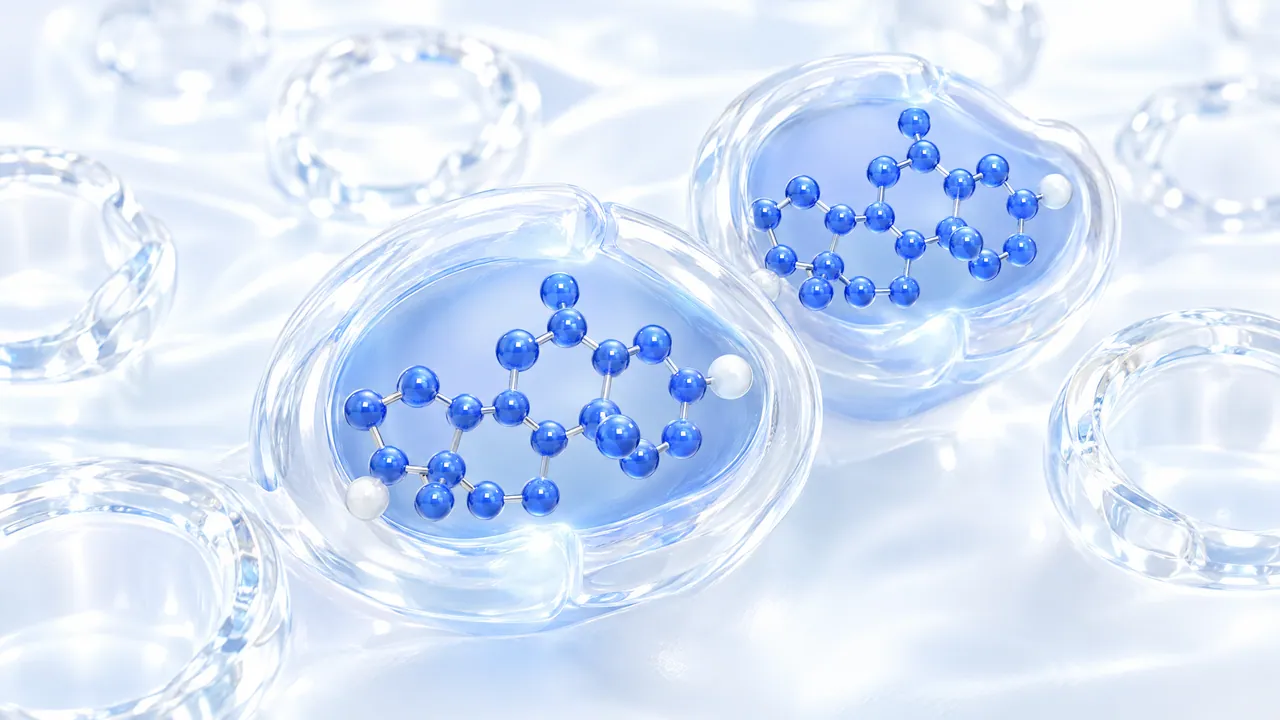
Two blue 3D steroid molecules sit tightly in transparent glass enzyme shells, empty glass rings around them on a light surface
Exemestane binds tightly to aromatase and shuts it down. Symbolic image.

Exemestane vs anastrozole

  • Exemestane (steroidal, irreversible): no rebound after stopping, tends to be more lipid-friendly.
  • Anastrozole (non-steroidal, reversible): finer control in small steps, larger experience base in AAS research.

Comparison

Lower or block estrogen

Compounds around estrogen, as described in the TPD lexicon. Tap a card to open its entry.

Simplified: aromatase inhibitors lower estrogen production, receptor modulators block its effect at the receptor. 8

Dosing

Dosing

Dosing, titration and syringe

Loading the dosing information …

  • Getting started and stepping up, drawn as a staircase
  • Units on the U-100 syringe for every step
  • How long one vial lasts

What the research shows

The Intergroup Exemestane Study (Coombes et al., NEJM 2004) showed that switching to exemestane after 2-3 years of tamoxifen improved disease-free survival in postmenopausal breast cancer. That confirms the strong and reliable estrogen lowering.

On half-life: according to the US prescribing information it is about 24 hours in healthy postmenopausal women. In young healthy men a study measured 8.9 hours, yet the drop in estradiol still lasted beyond 24 hours there (Mauras et al., 2003).

Study results

What the trials measured

Interactive: switch tabs, tap points, show or hide arms. Arms are named relative to each other, no dosing advice.

Hormones in young healthy men5

Change after 10 days in percent, 24 hours after the last intake, 12 men

Estradiol5
Exemestane, lower study dose -38%
Exemestane, higher study dose -32%
Testosterone5
Exemestane, lower study dose +60%
Exemestane, higher study dose +56%

Both doses lowered estradiol to a similar degree, the higher one brought no advantage. The strongest reduction was 62 percent 12 hours after intake.

Switch after 2 to 3 years of tamoxifen1

Share with a first event (recurrence, contralateral breast cancer, death) in percent, 4,742 women, median 30.6 months

First events1 266 of 2,380 against 183 of 2,362
Continued tamoxifen 11.2%
Exemestane 7.7%
Contralateral breast cancer1 20 against 9 women
Continued tamoxifen 0.8%
Exemestane 0.4%

Shares calculated from the case numbers in the abstract. Risk 32 percent lower. After a median of 55.7 months the advantage persisted (hazard ratio 0.76) and overall mortality fell slightly.

New breast cancer per year4

Annual rate in percent, 4,560 women at increased risk, median 35 months

Invasive breast cancer4
Placebo 0.55%
Exemestane 0.19%
Invasive and precursors4
Placebo 0.77%
Exemestane 0.35%

11 against 32 invasive breast cancers. Fractures, cardiovascular events and other cancers did not differ significantly.
Row of test tubes with clear liquid in a white rack, a translucent spongy bone structure behind them
Large breast cancer trials plus data on bone. Symbolic image.

Research status

Where the research stands

Exemestane has been approved for breast cancer since 1999. The registry lists 398 trials, 100 of them in phase 3. The list shows large trials on prevention and adjuvant treatment. As of 26 Oct 2026. 9

  1. Preclinical Inhibits aromatase
  2. Phase 1 no registered trial
  3. Phase 2 no registered trial
  4. Phase 3 3 trials, 3 completed
  5. Approval in the USA since 1999 (breast cancer)
4,560 participants in phase 3 Approved: in the USA exemestane has been marketed as a prescription drug since 21 October 1999 (Drugs@FDA). ChEMBL lists phase 4 as the highest phase. The switch trial after tamoxifen is registered with ISRCTN, not with ClinicalTrials.gov.7
Show all 3 phase 3 trials on a timelineHide timeline 3 completed 0 running 1 with results
Phase 3

Bar: start to primary endpoint (planned for running trials). Green = completed, blue = progress until 26 Oct 2026.

Side effects

  • Too-low estradiol: joint pain, libido loss, fatigue.
  • Watch bone density with long-term use.
  • Tends to be more lipid-friendly than non-steroidal AIs.

Tolerability

Side effects and bone

Data from breast cancer trials in women after menopause. For men there is only the short 10-day trial.

85 of 100 Placebo
88 of 100 Exemestane
Event PlaceboExemestane
Any adverse event4 85%88%
Fractures3 0%7%

Bone density of the lumbar spine fell by 2.7 percent in the first six months and by only 1.0 percent in the second year. No woman with normal bone density developed osteoporosis.3

Storage

Store dry and protected from light. Out of reach of children.

Three white tablet bottles and a folded light blue towel on a white shelf
Store dry and protected from light. Symbolic image.

Related

Related compounds

Same targets or a different path: all in the TPD lexicon.

FAQ

Common questions about Aromasin (Exemestane)

Short answers, each backed by the sources below.

Is exemestane approved?

Yes. In the USA it has been marketed as a prescription drug for breast cancer since 21 October 1999, ChEMBL lists phase 4 as the highest phase. It is not approved for men, there is only one short trial in men.785

What does the trial in men show?

12 young healthy men took two doses in random order for 10 days each. Estradiol fell by 38 and 32 percent, testosterone rose by 60 and 56 percent. So the higher dose brought no advantage. Blood lipids and IGF-1 stayed unchanged, the strongest reduction was 62 percent 12 hours after intake.5

How long does exemestane act?

In young men the peak level came 1 hour after intake and the half-life was 8.9 hours. Estradiol was lowered most after 12 hours and was still clearly lower than at baseline after 24 hours.5

What do the breast cancer trials show?

In the Intergroup Exemestane Study 4,742 women switched to exemestane after 2 to 3 years of tamoxifen or stayed on tamoxifen. With exemestane there were 183 instead of 266 first events, the risk fell by 32 percent. In MAP.3 invasive breast cancer fell by 65 percent against placebo in 4,560 women at increased risk.124

What happens to bone?

After switching from tamoxifen bone density of the lumbar spine fell by 2.7 percent in the first six months and at the hip by 1.4 percent. In the second year the loss slowed. Fractures occurred in 7 percent against 5 percent on tamoxifen. In the prevention trial against placebo fractures did not differ significantly.34

Which side effects have been described?

In the prevention trial 88 percent on exemestane and 85 percent on placebo had any adverse event, quality of life barely changed. Serious toxic effects were rare in the switch trial. In men it was well tolerated over 10 days.415

Glossary

Terms explained briefly

Dotted words in the text open these explanations directly.

Aromatase
Enzyme that converts androgens such as testosterone into estrogen, mainly in fat tissue.
Bone density
Mineral content of bone, measured by X-ray. Low values raise the fracture risk.
Disease-free survival
Time without recurrence, new cancer or death.
Estradiol
The body's main estrogen, needed in small amounts in men as well.
Postmenopausal
After menopause, when the ovaries hardly make any estrogen.
Rebound
Counter-reaction after stopping, here a renewed rise of estradiol.
Steroidal
Built on the skeleton of a steroid, like hormones made from cholesterol.
Suicide inhibitor
Inhibitor that binds tightly to the enzyme and switches it off permanently. The body has to make new enzyme.
Tamoxifen
Estrogen receptor modulator, long the standard after breast cancer.

Evidence

Sources

Show all 10 sourcesHide sources 5 Studies1 Trial registry4 Database checked 26 Oct 2026

Studies

  1. Intergroup Exemestane Study: switch after tamoxifen

    Coombes et al., New England Journal of Medicine, 2004

    Checked 26 Oct 2026 via doi.org, Crossref, PubMed
  2. Intergroup Exemestane Study: survival after 55.7 months

    Coombes et al., Lancet, 2007

    Checked 26 Oct 2026 via doi.org, Crossref, PubMed
  3. Bone density and fractures in the switch trial

    Coleman et al., Lancet Oncology, 2007

    Checked 26 Oct 2026 via doi.org, Crossref, PubMed
  4. MAP.3: prevention in women at increased risk

    Goss et al., New England Journal of Medicine, 2011

    Checked 26 Oct 2026 via doi.org, Crossref, PubMed, ClinicalTrials.gov
  5. Effect and elimination in young healthy men

    Mauras et al., Journal of Clinical Endocrinology and Metabolism, 2003

    Checked 26 Oct 2026 via doi.org, Crossref, PubMed

Trial registry

  1. Trials on ClinicalTrials.gov

    ClinicalTrials.gov, U.S. National Library of Medicine

    Checked 26 Oct 2026 via ClinicalTrials.gov API v2

Database

  1. US prescribing information for exemestane (half-life about 24 hours in postmenopausal women)

    DailyMed, U.S. National Library of Medicine (Stand 12/2025)

    Checked 26 Oct 2026 via openFDA Label API, DailyMed
  2. US approval (NDA 020753), prescription

    Drugs@FDA, U.S. Food and Drug Administration

    Checked 26 Oct 2026 via openFDA-API
  3. Mechanism and approval in ChEMBL

    ChEMBL, EMBL-EBI (CHEMBL1200374)

    Checked 26 Oct 2026 via ChEMBL
  4. Structure of exemestane in PubChem

    PubChem, U.S. National Library of Medicine (CID 60198)

    Checked 26 Oct 2026 via PubChem

In the shop

Aromasin (Exemestane) in the catalog

Sizes, prices and shipping times are on the product page.

To the product