Description
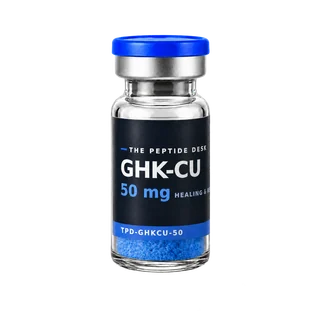
GHK-Cu is a naturally occurring tripeptide composed of glycine, histidine and lysine, forming a complex with copper ions. The substance was originally isolated from human plasma in the early 1970s. Its concentration in the body declines with age, which is why GHK-Cu is established as a central compound in the field of anti-aging and skin regeneration.
Across more than five decades of research, GHK-Cu has demonstrated effects in preclinical and in vitro studies on a wide range of pathways: stimulation of collagen and glycosaminoglycan synthesis, modulation of metalloproteinases and their inhibitors, promotion of angiogenesis (formation of new blood vessels), antioxidant and anti-inflammatory activity as well as activation of genes involved in tissue repair.
In research models, measurable effects are observed at very low concentrations (1 to 10 nanomolar). GHK-Cu acts in vitro on dermal fibroblasts, keratinocytes and endothelial cells. In studies with topical application, improvements in skin density, elasticity and collagen I production were observed. Effects are also documented in research on lung tissue, bone, liver and gastric mucosa.
In recovery and anti-aging research, GHK-Cu is among the most intensively studied compounds. Due to sensitivity to carboxypeptidases, the substance is often used in stabilized formulations or in stack combinations.
You can order GHK-Cu in 10-vial packs at 50mg per vial.
This information is for research and educational purposes only. No medical recommendations.
Risks & Safety
GHK-Cu is considered well tolerated per study reports. Across more than five decades of research, a mild profile has been documented, particularly with topical and low-dose subcutaneous use.
Observed in research and user reports:
- Injection site: mild redness, pressure or transient irritation at the injection site is the most common observation with subcutaneous use.
- Copper component: as a copper-containing tripeptide, GHK-Cu can cause somewhat more pronounced local irritation at the injection site than pure peptide solutions. Very high or frequent dosing is associated in the literature with a theoretical concern of copper accumulation.
- Circulation: isolated reports of brief fatigue or a feeling of warmth shortly after application.
- No long-term data: robust long-term human studies and data on systemic use do not exist. The favorable safety profile rests primarily on in vitro models, topical studies and short-term anecdotal experience.
This classification does not replace medical advice. Risk and responsibility for any actual use lie entirely with the buyer.
Studies
- GHK Peptide as a Natural Modulator of Multiple Cellular Pathways in Skin Regeneration - BioMed Research International 2015: Comprehensive review of mechanisms in skin regeneration.
- Regenerative and Protective Actions of GHK-Cu in the Light of New Gene Data - International Journal of Molecular Sciences 2018: Gene profiling data on regenerative and protective effects.
- Nanoengineered Self-Assembling Peptides Promote Wound Healing - ACS Applied Materials 2025: Current research on stabilized GHK formulations.
- GHK and DNA: Resetting the Human Genome to Health - BioMed Research International 2014, Pickart et al: Gene expression study of GHK effects on over 4000 genes.