Description
Melanotan 2 (MT-2) is a synthetic cyclic heptapeptide developed as an analog of the naturally occurring alpha-melanocyte-stimulating hormone (alpha-MSH). The original synthesis took place in the 1980s at the University of Arizona with the goal of stimulating melanogenesis without UV exposure, enabling research on pigmentation-mediated UV protection.
Structurally, MT-2 is a non-selective agonist at multiple melanocortin receptors: MC1R, MC3R, MC4R and MC5R. Binding to MC1R in melanocytes triggers an upregulation of tyrosinase activity via cAMP signaling pathways, stimulating eumelanin synthesis and consequently skin pigmentation in research models. In the first human pilot study, pigmentation was measurably stronger in two of three subjects after only five low subcutaneous doses (Dorr 1996).
Through the central receptors MC3R and MC4R, MT-2 addresses additional research fields: modulation of the hypothalamic axis, influence on appetite and energy homeostasis pathways and melanocortinergic effects on the sexual response system. The multi-receptor activity distinguishes MT-2 from related compounds such as Afamelanotide (MT-1, MC1R-selective) or PT-141 (MC4R-focused).
In research settings, MT-2 is typically used in a loading phase with low doses, followed by a maintenance phase. Bioavailability following subcutaneous application is high.
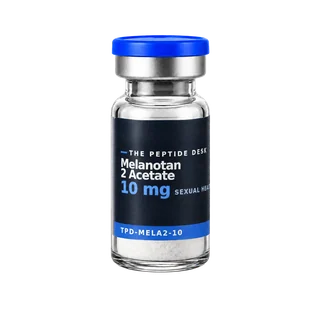
You can order Melanotan 2 in 10-vial packs at 10mg per vial. The compound appears in our catalog in both the Sexual Health category and the Tanning category.
This information is for research and educational purposes only. No medical recommendations.
Risks & Safety
Melanotan 2 is, as a non-selective melanocortin agonist, more broadly active than melanotan 1 and also addresses central pathways via MC3R and MC4R, which makes the side-effect profile correspondingly broader.
Observed in research and user reports:
- Nausea: nausea, particularly in the loading phase, is among the most commonly documented observations.
- Pigment changes: through strong MC1R activation, marked darkening of the skin as well as of moles and freckles is documented. Changes in moles are considered observation-relevant.
- Spontaneous erections: via central MC4R activation, spontaneous erections are described in user reports, a direct effect of the melanocortinergic system.
- Appetite changes: MC4R is involved in appetite regulation; altered appetite patterns are described in the literature.
- Flushing and injection site: facial flushing as well as redness or pressure at the injection site are among the common observations.
This classification does not replace medical advice. Risk and responsibility for any actual use lie entirely with the buyer.
Studies
- Evaluation of melanotan-II, a superpotent cyclic melanotropic peptide in a pilot phase-I clinical study - Life Sciences 1996: First human pilot study; five low subcutaneous doses increased pigmentation in two of three subjects, along with mild nausea and spontaneous erections.
- The alpha-MSH/MC1R interaction: A driver of pleiotropic effects beyond pigmentation - Pigment Cell & Melanoma Research 2021: Review on mechanisms beyond pigmentation.
- Localization of MC4-R in neuroendocrine and autonomic control circuits - Molecular Endocrinology 1994: Classical study on the distribution of the central MC4 receptor.