Description
Ostarine (MK-2866, Enobosarm) is a non-steroidal, oral selective androgen receptor modulator and the best-investigated compound in its class. The substance was originally developed by GTx, Inc. and went through multiple Phase II and Phase III clinical trials in sarcopenia, cancer cachexia and stress incontinence.
Per study reports Ostarine binds selectively to the androgen receptor with tissue-specific activity - anabolic in muscle and bone tissue, with lower activity at the prostate and sebaceous glands. In the Dalton 2011 study (Journal of Cachexia, Sarcopenia and Muscle) Ostarine showed significant lean mass increase and functional improvement (stair-climb speed) in older adults and cancer cachexia patients over 4 months.
Pharmacokinetically Ostarine is orally bioavailable with good bioavailability and a half-life of about 24 hours. Once-daily dosing is standard. Compared to other SARMs Ostarine shows the lowest HPG axis suppression profile - in Phase II studies testicular function was substantially better preserved at the doses tested than under LGD-4033 or RAD-140.
A known property in studies: slight elevation of liver markers (ALT/AST) that is reversible after discontinuation. Hepatotoxicity in the classical sense is not documented for Ostarine in available literature.
Ostarine is on the WADA banned list for sport. Per study reports the compound is still widely used because the safety data package is the most comprehensive in the entire SARM class.
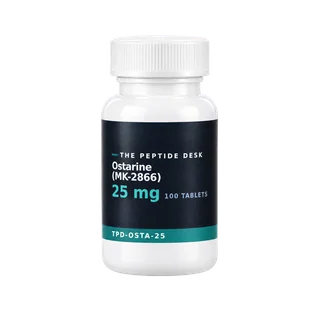
You can order Ostarine as oral tablets in one bottle with 25mg per tablet.
This information is for research and educational purposes only. No medical recommendations.
Risks & Safety
Ostarine sits in the mid range of the risk scale. As the best-researched SARM its safety data package is the most comprehensive in the class. Its suppression values are the lowest in the SARM range - but the class effects remain.
Documented in studies and the literature:
- HPG suppression: Ostarine suppresses the HPG axis, but in the Phase II studies testicular function was better preserved than under LGD-4033 or RAD-140.
- HDL suppression: a lowering of HDL cholesterol is documented as a class effect of SARMs.
- Liver markers: a slight elevation of ALT/AST is documented, reversible after discontinuation.
- PCT requirement: even if lower than with other SARMs, a SERM PCT after the cycle is customary in the literature.
Monitoring via bloodwork is recommended. This classification does not replace medical advice. Risk and responsibility for any actual use lie entirely with the buyer.
Studies
- The selective androgen receptor modulator GTx-024 (enobosarm) improves lean body mass and physical function in healthy elderly men and postmenopausal women: results of a double-blind, placebo-controlled phase II trial - Journal of Cachexia, Sarcopenia and Muscle 2011, Dalton et al: Phase II trial, significant gains in lean mass and stair-climb function over 12 weeks.
- Effects of enobosarm on muscle wasting and physical function in patients with cancer: a double-blind, randomised controlled phase 2 trial - The Lancet Oncology 2013, Dobs et al: randomised Phase II trial on muscle wasting in lung cancer.
- Selective Androgen Receptor Modulators: Current Knowledge and Clinical Applications - Sexual Medicine Reviews 2019, Solomon et al: review of the SARM class including enobosarm.
- Pharmacodynamics of Selective Androgen Receptor Modulators - The Journal of Pharmacology and Experimental Therapeutics 2003, Yin et al: preclinical characterization of the tissue-selective anabolic activity of non-steroidal SARMs.