Description
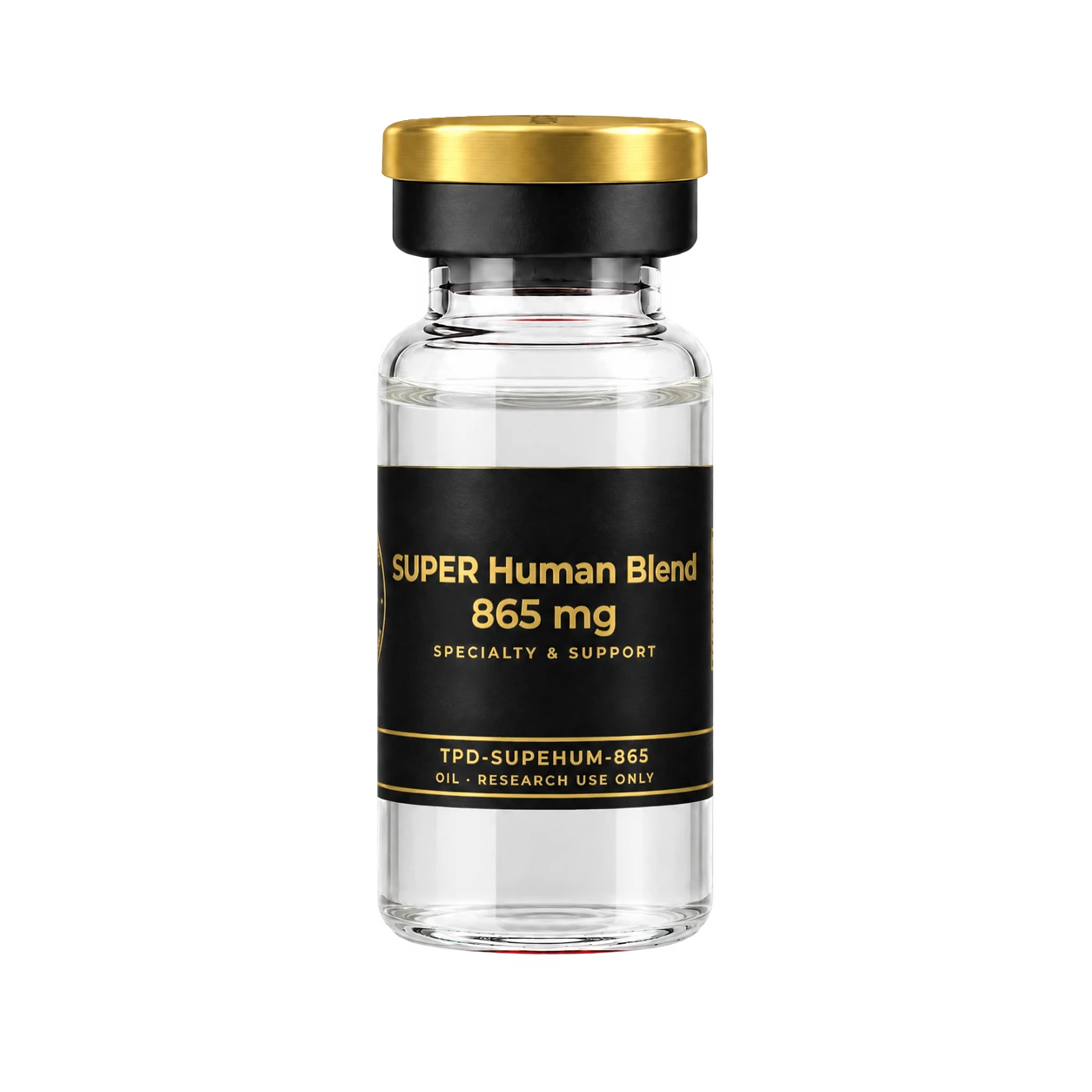
Super Human Blend is a pre-mixed research formulation combining multiple compounds from the areas of growth, repair and performance in one vial. Typical configurations include components of the GH secretagogue family (CJC, ipamorelin), repair peptides (BPC-157, TB-500) and partially additional compounds for broader coverage. The exact composition varies by vendor and research batch.
In research context, Super Human Blend addresses multiple complementary pathways simultaneously: GH axis (via secretagogues), tissue repair (via BPC-157), stem cell mobilization (via TB-500) and depending on configuration additional axes. This multi-pathway coverage makes the blend an efficient tool for comprehensive performance research setups.
The practical advantage of a pre-mixed blend lies in reduced operational complexity: one vial, one reconstitution step, one application routine. In multi-week research setups, this reduces the error rate and simplifies study logistics.
Compared to mechanistically focused mono-compounds, multi-component blends provide broader coverage but reduced mechanism clarity. For isolated pathway studies, solo compounds are the better choice; for comprehensive research overviews, blends are efficient.
Super Human Blend is primarily established in recovery- and performance-oriented research setups. The exact component configuration is vendor-specific and should be verified with the supplier before research application.
Super Human Blend is available in 16mg vials as 10-vial packs.
This information is for research and educational purposes only. No medical recommendations.
Risks & Safety
Super Human Blend combines several already well tolerated peptides in one vial and is considered mild per study reports, but the multi-component character brings its own classification points.
Observed in research and reports:
- Injection site: mild redness, pressure or transient irritation at the injection site is the most common observation, as with the individual components.
- Combined profile: because the blend unites components such as GH secretagogues, BPC-157 and TB-500, their individually mild effect profiles add up. The individual constituents are considered well tolerated, but the behavior of the exact combination is less studied in isolation.
- Vendor-dependent composition: the exact component configuration varies by vendor and batch. The safety profile is therefore not identical for every batch and should be verified before research application.
- Limited data on the mixture: robust studies on exactly this pre-mixed formulation are absent. The classification rests on the data of the individual compounds.
This classification does not replace medical advice. Risk and responsibility for any actual use lie entirely with the buyer.
Studies
- Injectable Peptide Therapy: A Primer for Orthopaedic and Sports Medicine Physicians - American Journal of Sports Medicine 2026: Narrative review of several typical components named in the text (BPC-157, TB-500, CJC-1295 with ipamorelin): the findings come largely from preclinical models, while clinical data on dosing, duration and safety are lacking. The finished blend itself is not covered.
- Prolonged stimulation of growth hormone (GH) and insulin-like growth factor I secretion by CJC-1295, a long-acting analog of GH-releasing hormone, in healthy adults - Journal of Clinical Endocrinology & Metabolism 2006: Work on CJC-1295, one of the typical components named in the text: in healthy adults, GH stayed elevated for at least 6 days and IGF-1 for 9 to 11 days after a single injection.
- Ipamorelin, the first selective growth hormone secretagogue - European Journal of Endocrinology 1998: Work on ipamorelin, one of the typical components named in the text: the pentapeptide released GH in rats and swine with a potency similar to GHRP-6 without significantly raising ACTH or cortisol.
- Gastric pentadecapeptide body protection compound BPC 157 and its role in accelerating musculoskeletal soft tissue healing - Cell and Tissue Research 2019: Work on BPC-157, one of the typical components named in the text: critical review of tendon, ligament and muscle models with consistently positive findings that come almost exclusively from rodent studies.