Description
Tamoxifen (Tamoxifen citrate, Nolvadex) is a selective estrogen receptor modulator and one of the best-researched substances in oncology. The substance has been established as breast cancer therapeutic since the 1970s and is on the WHO list of essential medicines.
Per study reports Tamoxifen binds competitively to estrogen receptors with tissue-specific action: antagonistic in breast tissue and hypothalamus, agonistic in bone, liver and uterus. This tissue specificity yields the classic SERM profile. In the hypothalamus, Tamoxifen blocks negative estradiol feedback and thereby increases GnRH, LH and FSH pulses - the mechanism that makes Tamoxifen relevant in PCT research.
In the anabolic community Tamoxifen is used for two reasons: first as PCT compound to stimulate the HPG axis after cycle. Second to treat gynecomastia research during active cycles - here Tamoxifen blocks estrogen action directly at breast tissue without lowering estradiol levels (unlike aromatase inhibitors).
Pharmacokinetically Tamoxifen is orally bioavailable with good bioavailability. Half-life is long at about 5-7 days; the main active metabolite Endoxifen has an even longer half-life (about 14 days). Steady-state is established after 3-4 weeks.
Known effects in studies: hot flushes, in longer use elevated thromboembolism risk. Hepatic effects are moderate and rarely clinically relevant in typical 4-6 week PCT durations.
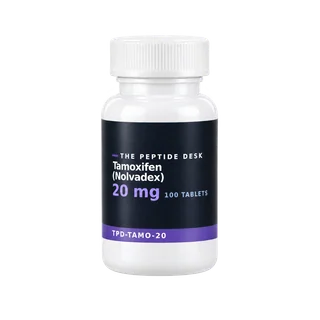
You can order Tamoxifen as oral tablets in one bottle with 20mg per tablet.
This information is for research and educational purposes only. No medical recommendations.
Risks & Safety
Tamoxifen sits in the mid range of the risk scale. As one of the best-researched substances in oncology its safety data package is extensive. The most relevant risk is clearly named in the literature.
Documented in studies and the literature:
- Thromboembolism risk: with longer use an elevated risk of thromboembolic events is documented - the most serious of the known effects.
- Hot flashes: hot flushes are a consistently documented accompanying effect in the studies.
- Hepatic effects: moderate effects on the liver are described, but rarely clinically relevant in the typical 4-6 week PCT duration.
- Long half-life: the active metabolite Endoxifen accumulates over weeks, which makes the action linger long after discontinuation.
Monitoring via bloodwork is recommended. This classification does not replace medical advice. Risk and responsibility for any actual use lie entirely with the buyer.
Studies
- Tamoxifen for Prevention of Breast Cancer: Report of the National Surgical Adjuvant Breast and Bowel Project P-1 Study - Journal of the National Cancer Institute 1998, Fisher et al: Classic prevention study - one of the most-cited oncology trials, broad safety dataset including the thromboembolism signal.
- Treatment of idiopathic oligozoospermia with tamoxifen - a randomized controlled study - International Journal of Andrology 1992, Krause et al: Randomized controlled study on the SERM effect on the gonadal axis in men.
- Tamoxifen in men: a review of adverse events - Andrology 2016, Wibowo et al: Systematic review of documented adverse events in male use.
- Comparison of Tamoxifen with Danazol in the Management of Idiopathic Gynecomastia - The American Surgeon 2000, Ting et al: Comparative study on the tamoxifen effect at breast tissue.