What is Tamoxifen?
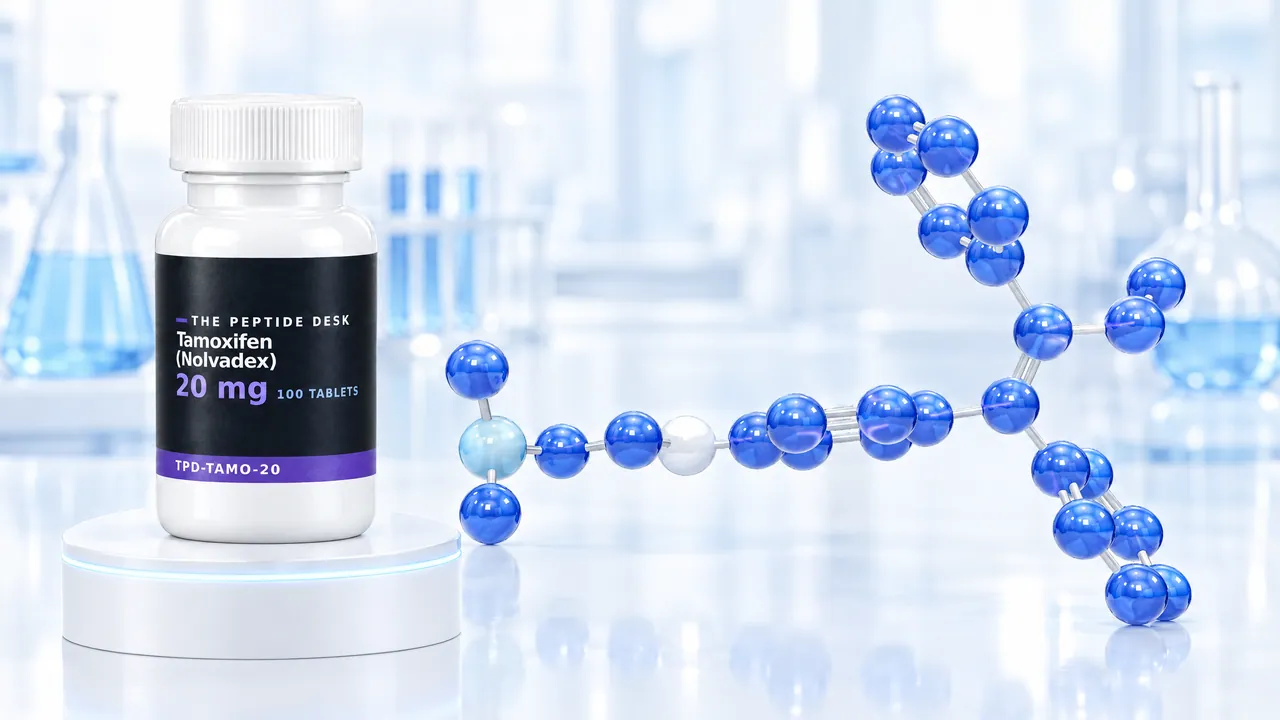
Tamoxifen, known as Nolvadex, is a selective estrogen receptor modulator (SERM). In medicine it is best known from breast cancer therapy. In the performance corner it is used for PCT and especially against gynecomastia.
The difference from aromatase inhibitors: Tamoxifen does not lower the estrogen level but blocks the estrogen effect where it causes trouble, mainly at breast tissue.
Comparison
Blocking or lowering estrogen
Tamoxifen and clomiphene act at the receptor, aromatase inhibitors lower the production of estrogen. Tap a card to open its entry.
According to ChEMBL: tamoxifen and clomiphene modulate estrogen receptor alpha, anastrozole, letrozole and exemestane inhibit aromatase (CYP19A1). 5
How it works
Tamoxifen acts differently depending on the tissue. At breast tissue it blocks the estrogen receptor, which is exactly what stops or slows the formation of breast gland tissue (gyno). At the hypothalamus it acts similarly to Clomifene and drives the body's own testosterone production via more LH and FSH.
So Tamoxifen covers two uses: gyno control and PCT support.
Where it acts
Where tamoxifen acted in studies
Tap a point or a card. Colour = estrogen receptor ERα, grey = observed in studies.
- Breast gland
Gynecomastia in 10 instead of 73 percent, breast pain in 6 instead of 39 percent1
ERα - Hormones in the blood
Testosterone rose, free testosterone stayed the same because SHBG rose1
Observed in trials - Prostate
PSA drop on the antiandrogen in 97 percent, as without tamoxifen1
Observed in trials
Targets in the ChEMBL database5
Compound CHEMBL83: one recorded mechanism, Modulator.

How to take it
Oral, once daily.
- One dose per day is enough given the long half-life.
- With some water, with or without food.
- For acute gyno it is dosed higher and shorter, for PCT lower over several weeks.
Dosing
Dosing
Dosing, titration and syringe
Loading the dosing information …
- Getting started and stepping up, drawn as a staircase
- Units on the U-100 syringe for every step
- How long one vial lasts
What the research shows
A controlled study (Boccardo, 2005) examined the prevention of gynecomastia under an estrogen-driving therapy. Result: in the placebo group 73 percent developed gyno, with Tamoxifen 20mg only 10 percent. The aromatase inhibitor anastrozole was clearly weaker in this study (51 percent).
That is a strong argument for why Tamoxifen is the first choice for acute gyno and not an aromatase inhibitor.
Study results
What the trials measured
Interactive: switch tabs, tap points, show or hide arms. Arms are named relative to each other, no dosing advice.
Breast changes on an antiandrogen1
Share of men in percent, 114 men with prostate cancer, all received bicalutamide
Values from the abstract. Bicalutamide is an antiandrogen that often triggers gynecomastia through more estrogen action. Sexual function showed no major differences up to month 6.
Relative risk versus no prevention2
1.0 means as common as without prevention, lower is better
Values from the abstract, 9 randomised trials with bicalutamide. Anastrozole showed no significant benefit and therefore has no bar.
Gynecomastia of unknown cause3
Share with complete resolution, 81 men over 10 years in a breast clinic
Observational study without a control group. 73 of 81 men responded completely, 2 of the other 8 had surgery.

Research status
Where the research stands
Tamoxifen has been approved since 1977. On ClinicalTrials.gov 685 trials list tamoxifen among their interventions, almost all on breast cancer. Shown are the registered phase 3 trial on gynecomastia and three large breast cancer trials. As of 26 Oct 2026. 4
- Preclinical Basis: modulator of the estrogen receptor ERα
- Phase 1 no registered trial
- Phase 2 no registered trial
- Phase 3 4 trials, 4 completed
- Approval since 1977 according to ChEMBL
Show all 4 phase 3 trials on a timelineHide timeline
IBIS-1 · NCT00002644 · 7,154 participants, started Jan 1994, primary endpoint reached Jan 2001.
Registry entry ↗ · Results not yet in PubMed
BIG 1-98 · NCT00004205 · 8,028 participants, started Mar 1998, primary endpoint reached Dec 2008. Tests several agents.
Registry entry ↗ · Results not yet in PubMed
STAR · NCT00003906 · 19,747 participants, started May 1999, primary endpoint reached Dec 2005. Tests several agents.
Registry entry ↗ · Results not yet in PubMed
NCT00233610 · 180 participants, started Dec 2003, primary endpoint reached Oct 2007.
Registry entry ↗ · Results not yet in PubMed
Bar: start to primary endpoint (planned for running trials). Green = completed, blue = progress until 26 Oct 2026.
Side effects
- Possible negative shift in blood lipids and IGF-1 values.
- Gastrointestinal complaints, rarely visual disturbances.
- Very rarely an increased thrombosis risk, especially with pre-existing risk.
Tolerability
Adverse events over 48 weeks
Out of 100 participants per group, how many had the event over 48 weeks.
| Event | No protection (placebo) | Tamoxifen | Anastrozole (comparator) |
|---|---|---|---|
| Adverse events1 | 37% | 35% | 69% |
Values from the abstract. Not more common with tamoxifen than without, almost twice as common with anastrozole.1
Practice
-
At the first signs of gyno (lump, tenderness behind the nipple) Tamoxifen is the standard.
-
20mg is usually enough, higher only briefly for acute gyno.
-
Banned in official competition (WADA S4).

Storage
Store dry, cool and protected from light, out of reach of children. Keep the original container closed and mind the expiry date.