Description
Testosterone Enanthate is a long-chain ester of endogenous testosterone, formed by esterification at the 17β-hydroxyl with heptanoic (enanthic) acid. The seven-carbon side chain makes the compound lipophilic and therefore slowly released from the intramuscular oil depot.
Per study reports the elimination half-life is about 4-5 days; the plateau typically lasts 10-14 days. Direct comparison studies show nearly identical pharmacokinetics to Cypionate - the two esters are clinically virtually indistinguishable. After esterase cleavage, free testosterone acts via the androgen receptor.
Outside the United States, Enanthate is the dominant test ester in research literature. The substance is administered as an oily injection solution and is on the WHO list of essential medicines.
The Bhasin research group used Enanthate in their landmark 1996 study as the basis for the testosterone dose-response relationship on muscle mass and strength. This data remains the most-cited reference in anabolic research literature.
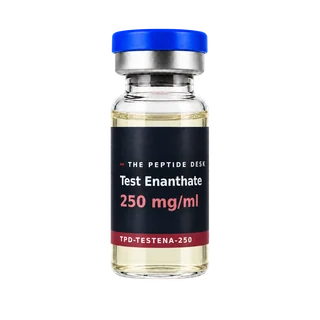
You can order Testosterone Enanthate as an oily injection solution in 10-vial packs at 250mg/ml or 300mg/ml and as a single 30 ml vial at 250 mg/ml.
This information is for research and educational purposes only. No medical recommendations.
Risks & Safety
Testosterone Enanthate has one of the best-documented effect and risk profiles of any anabolic. Supraphysiologic dosages intervene broadly in the hormonal system - the effects described in the literature are well established and predictable.
Documented in studies and the application literature:
- Estrogen conversion: testosterone aromatizes to estradiol. Water retention, raised blood pressure and, at higher doses, gynecomastia risk are documented - the reason research protocols often run an aromatase inhibitor alongside.
- Suppression of natural production: exogenous testosterone throttles the body’s own production via the HPTA axis. Testicular atrophy and reduced fertility are documented; recovery after discontinuation is not guaranteed.
- Cardiovascular: the literature describes unfavorable shifts in the lipid profile (HDL drops), elevated hematocrit and an associated thrombosis risk.
- Other: acne, accelerated hair loss in genetically predisposed individuals, mood swings and strain on liver and kidneys with long-term use.
Baseline bloodwork before, during and after a research protocol is strongly advised. This classification does not replace medical advice. Risk and responsibility for any actual use lie entirely with the buyer.
Studies
- The Effects of Supraphysiologic Doses of Testosterone on Muscle Size and Strength in Normal Men - New England Journal of Medicine 1996, Bhasin et al: Classic dose-response study, conducted with Testosterone Enanthate as the study compound.
- Testosterone dose-response relationships in healthy young men - American Journal of Physiology 2001, Bhasin et al: 61 young men received weekly 25 to 600 mg Testosterone Enanthate over 20 weeks - shows dose-dependent gains in lean mass and strength alongside a fall in HDL.
- Pharmacokinetics of Testosterone Enanthate After Intramuscular Injection for Transgender Men - Androgens: Clinical Research and Therapeutics 2020, Ichihara et al: Tracks the serum testosterone profile after intramuscular Enanthate injection - the peak occurs at a mean of 1.7 days.
- Pharmacokinetics of testosterone therapies in relation to diurnal variation of serum testosterone levels as men age - Andrology 2021, Pastuszak et al: Review of the pharmacokinetics of common testosterone delivery forms.
- Pharmacology of testosterone replacement therapy preparations - Translational Andrology and Urology 2016, Shoskes et al: Comparative pharmacokinetics and adverse-effect profile of the common esters.