


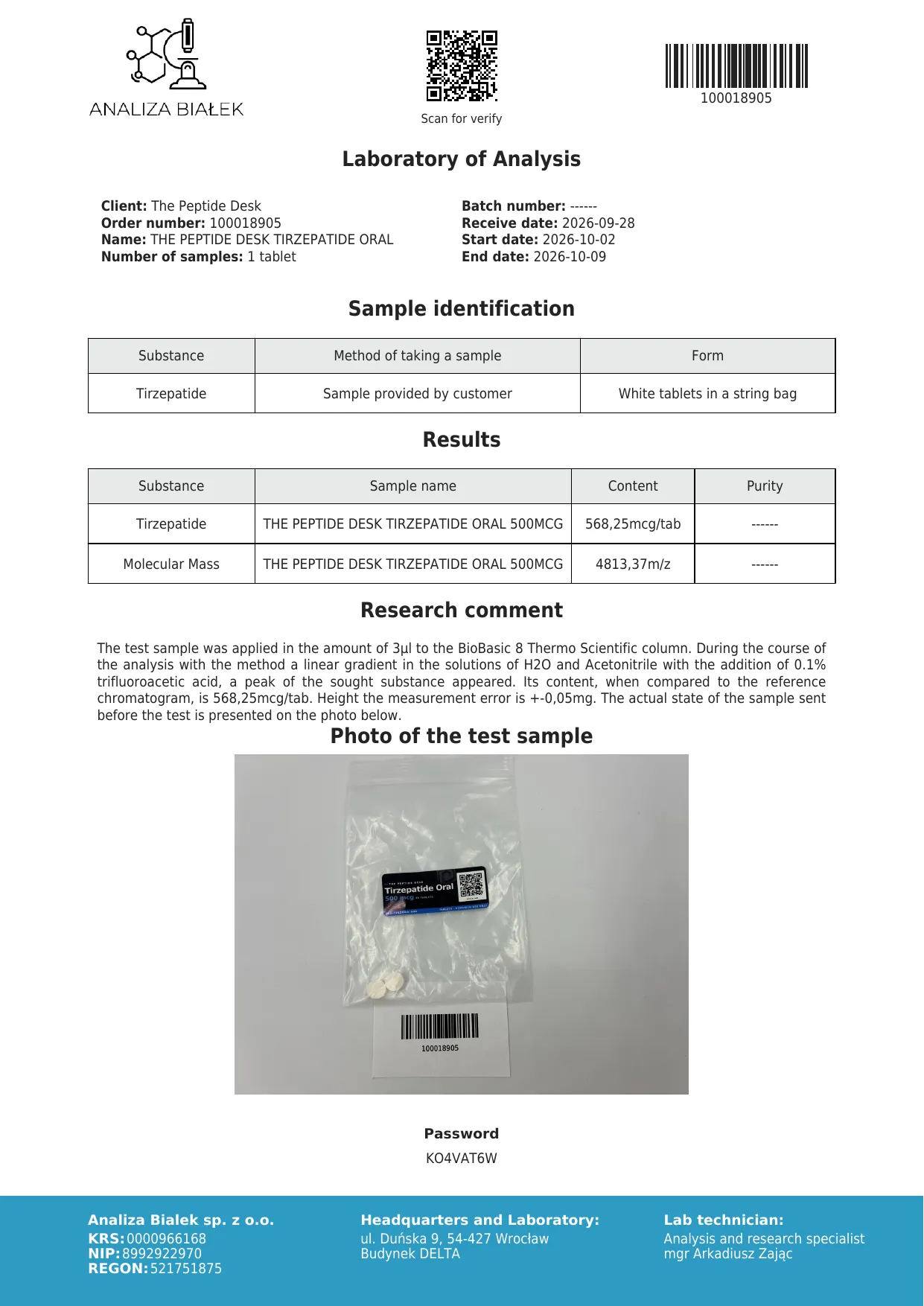
Description
Tirzepatide Oral is the oral variant of the dual incretin agonist Tirzepatide. The injectable form is approved under the brand names Mounjaro (diabetes) and Zepbound (obesity). There is no approved tablet form. No clinical studies of oral intake in humans have been published so far.
Per study reports Tirzepatide activates two incretin receptors simultaneously: GLP-1 (glucagon-like peptide-1) and GIP (glucose-dependent insulinotropic peptide). This dual-agonist action delivers more activity per mole than a pure GLP-1 agonist. In the landmark SURMOUNT-1 study (Jastreboff et al 2022, NEJM) subjects under Tirzepatide 15mg subcutaneous achieved a mean weight loss of 20.9% over 72 weeks, versus 3.1% on placebo.
The GIP component is mechanistically interesting: GIP alone has no significant obesity action, in combination with GLP-1 activation it amplifies satiety and dose-dependently reduces gastrointestinal side effects that dominate under pure GLP-1 agonists.
The tablet faces the same hurdle as any oral peptide: peptides are largely broken down in the gastrointestinal tract before they reach the blood. Whether the tablet contains an absorption enhancer, which one and how much reaches the blood in humans has not been published. For orientation: with oral semaglutide, the only approved GLP-1 peptide you swallow, measured bioavailability is about 0.8 percent (Overgaard 2021). For tirzepatide itself there is so far only formulation research in a cell model and in rats and dogs (Im 2026).
Known effects from the subcutaneous variant: gastrointestinal effects (nausea, vomiting) common at start, subside. Pancreatitis risk low but documented. Thyroid C-cell tumors in rats.
You can order Tirzepatide Oral as a pack of 25 tablets at 500mcg per tablet.
This information is for research and educational purposes only. No medical recommendations.
Risks & Safety
Tirzepatide Oral contains the same GLP-1/GIP dual active ingredient as the subcutaneous form, so the documented profile is correspondingly dominated by gastrointestinal effects. The oral tablet form additionally carries strict intake requirements.
Observed in studies and user reports:
- Gastrointestinal effects: nausea, vomiting, diarrhea and constipation are the most commonly documented observations, particularly at the start, with a clear correlation to the speed of dose escalation. The GIP component dose-dependently reduces these effects in studies.
- Appetite and fluids: the strongly reduced appetite can lead to decreased food and fluid intake. The literature describes an elevated risk of dehydration.
- Muscle mass and gallbladder: weight loss involves a portion of muscle mass alongside fat mass. Gallbladder issues during rapid weight loss are documented.
- Pancreas and thyroid: pancreatitis risk is low but documented. Thyroid C-cell tumors were observed in rats.
- Strict intake requirements and missing oral data: how much of the tablet reaches the blood in humans has not been measured. With oral peptides, uptake depends heavily on fasted intake with little water. No human studies of oral tirzepatide have been published.
- Switching with subcutaneous Tirzepatide: because the tablet’s uptake has not been measured in humans, a dose cannot be converted from the injection to the tablet, nor the other way round.
Risk-Tier 2: a higher level of observation than with the mild compounds, since the GI profile is pronounced and rare but documented safety signals exist. Monitoring via bloodwork is recommended. This classification does not replace medical advice. Risk and responsibility for any actual use lie entirely with the buyer.
Studies
- Tirzepatide Once Weekly for the Treatment of Obesity (SURMOUNT-1) - NEJM 2022, Jastreboff et al: Gold-standard obesity study on the subcutaneous form.
- Tirzepatide versus Semaglutide Once Weekly in Patients with Type 2 Diabetes (SURPASS-2) - NEJM 2021, Frias et al: Direct comparison with Semaglutide, both subcutaneous.
- SURMOUNT-2: Tirzepatide for treatment of obesity in adults with type 2 diabetes - Lancet 2023: Obesity plus diabetes co-morbidity study, subcutaneous.
- Clinical Pharmacokinetics of Oral Semaglutide: Analyses of Data from Clinical Pharmacology Trials - Clinical Pharmacokinetics 2021, Overgaard et al: oral semaglutide bioavailability of 0.8 percent under the recommended dosing conditions, strongly dependent on fasting time and water volume. Orientation for oral peptides, no tirzepatide data.
- Overcoming Gastric Barriers for Oral Peptide Delivery: QbD-Based Development of Sodium Caprate-Enabled Tirzepatide Tablets - Pharmaceutics 2026, Im et al: formulation development of a tirzepatide tablet with sodium caprate as absorption enhancer, cell model, rat and dog only, no human data.



