What is avanafil?
Avanafil is the youngest of the four approved PDE-5 inhibitors and was designed as a refinement of the class: the same target as sildenafil, tadalafil and vardenafil, but a faster onset and an overall sharper selectivity for that target. The molecule, a pyrimidine-5-carboxamide, was discovered at Mitsubishi Tanabe in Japan. It has been approved in the US as Stendra since 2012 and in the EU as Spedra since 2013.
It is taken as a tablet on demand, about 15 to 30 minutes before planned activity according to the EU prescribing information. The US label allows as little as 15 minutes, which makes avanafil the member of the class with the shortest lead time. Its window extends beyond six hours in the trials, well short of the roughly 36 hours of tadalafil. You can get avanafil as tablets of 100mg or 200mg, 4 tablets per blister.
This information is for research and educational purposes only. No medical advice.
How it works
During sexual arousal, nerve endings in the erectile tissue release nitric oxide. That raises the messenger cGMP inside the smooth muscle cells, the muscle relaxes, the feeding arteries widen and the tissue fills with blood. The enzyme phosphodiesterase type 5 (PDE5) breaks cGMP down again and so ends the signal. Avanafil blocks PDE5 and the messenger persists longer. An erection forms more easily and holds more reliably. Without arousal the chain never starts, which is why nothing happens without stimulation.
What sets avanafil apart from the older agents is selectivity. Kotera and colleagues (Journal of Urology 2012) tested it against eleven phosphodiesterase isozymes: PDE5 is inhibited with an IC50 of 5.2 nM, selectivity over PDE6 is 121-fold (sildenafil and vardenafil 16- to 21-fold), over PDE1 more than 10,000-fold (sildenafil 375-fold) and over PDE11 more than 19,000-fold (tadalafil 25-fold). PDE6 sits in the retina and is behind the blue tinge seen with sildenafil, PDE1 in heart and vessels, PDE11 among other places in skeletal muscle, where the back pain under tadalafil is thought to originate. Less binding to those off-targets should in theory mean fewer side effects beyond the intended one. The trial data fit that expectation.
Where it acts
Where avanafil acted in studies
Tap a point or a card. Colour = PDE5, grey = observed in studies.
- Erectile tissue
Inhibits PDE5, cGMP persists, erection with arousal easier10
PDE5 - Retina
121-fold less inhibition of PDE6, one case of changed colour vision5
Observed in trials - Blood pressure
With nitroglycerin blood pressure fell more than without7
Observed in trials - Liver
Breakdown via CYP3A4, strong inhibitors raise the level up to 13-fold7
Observed in trials - Back
Back pain 1.1 to 3.2 percent, without a clear dose relationship7
Observed in trials
Targets in the ChEMBL database10
Compound CHEMBL1963681: one recorded mechanism, Inhibitor, direct binding.
- Gene
- PDE5A
- UniProt
- O76074
- ChEMBL
- CHEMBL1827
- Action
- Inhibitor, direct binding
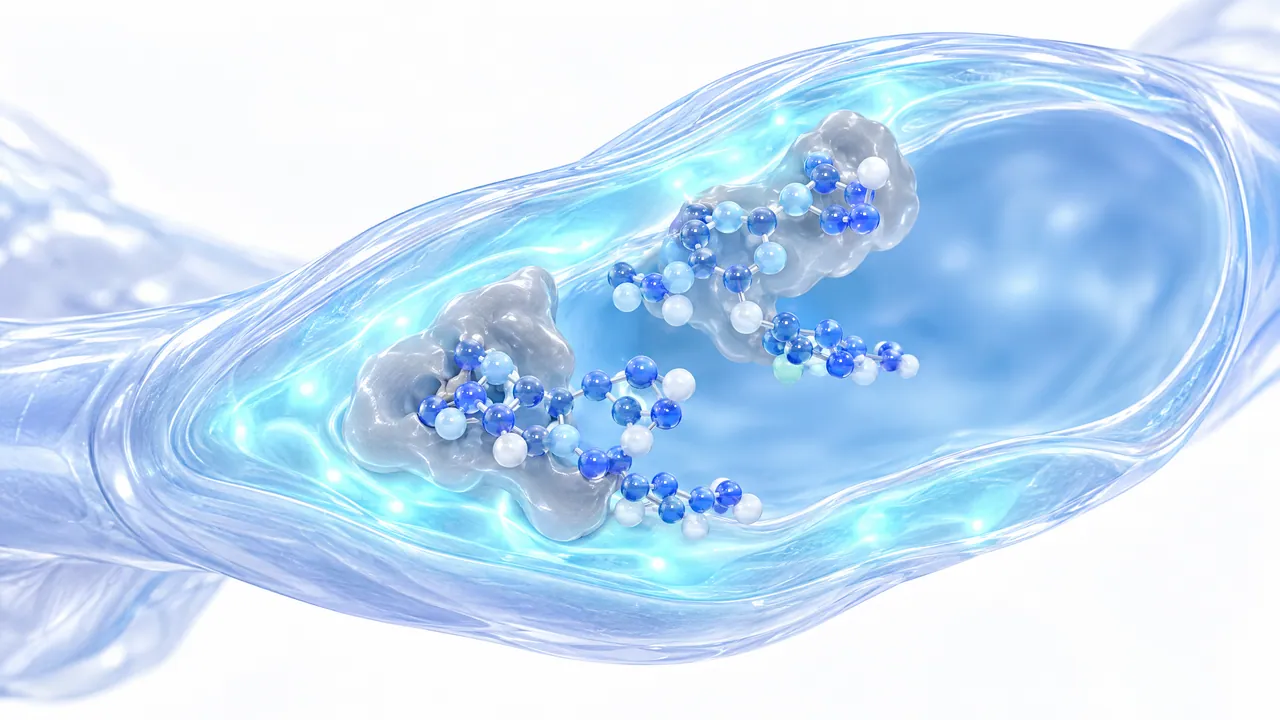
Pharmacokinetics: fast in, fast out
Taken fasted, avanafil reaches its peak level after a median of 30 to 45 minutes, per the prescribing information. A high-fat meal pushes the peak back by about 1.1 to 1.25 hours and lowers it by roughly 39 percent while total absorption barely changes (minus 3.8 percent). That is why it may be taken with or without food, but anyone who wants the fast window should not take it straight after a heavy meal. The registration trial placed no restrictions on food or alcohol. Efficacy held up regardless.
The US prescribing information gives a terminal half-life of about 5 hours, the EU SmPC 6 to 17 hours, depending on how long sampling continued after the dose. What matters in practice is the quick fall after the peak: far shorter than tadalafil (17.5 hours) and in the range of sildenafil. Avanafil is around 99 percent bound to plasma proteins and is cleared mainly through CYP3A4, with the metabolites leaving the body about 62 percent via the faeces and 21 percent via the urine. With daily dosing the accumulation ratio is about 1.2, so practically nothing builds up.
CYP3A4 clearance is where interactions arise. Ketoconazole raised the exposure of a 50mg dose 13-fold and stretched the half-life to about 9 hours; erythromycin, a moderate inhibitor, tripled exposure and extended the half-life to around 8 hours. In older men (65 to 80 years) exposure was only about 7 percent higher. The prescribing information sees no need for a dose adjustment on age alone.
Use and dosing
Dosing
Dosing, titration and syringe
Loading the dosing information …
- Getting started and stepping up, drawn as a staircase
- Units on the U-100 syringe for every step
- How long one vial lasts
Avanafil vs sildenafil vs tadalafil
The three differ less in potency than in time course and side effect profile:
- Avanafil: lead time about 15 minutes, peak after 30 to 45 minutes, half-life about 5 hours (US figure), window beyond 6 hours. High selectivity over PDE1, PDE6 and PDE11 at once, a single participant with a colour vision change across all trials up to 200mg. Food matters little.
- Sildenafil: lead time 30 to 60 minutes, duration about 4 to 6 hours. Sensitive to fatty food, a blue tinge to vision is possible (PDE6). The longest-established agent with the most data.
- Tadalafil: window up to 36 hours, can also be dosed low daily. Back and muscle pain as its class-specific effect (PDE11), food barely matters.
In short: avanafil for spontaneity with a short lead time and a clean side effect profile, tadalafil for a long window or daily dosing, sildenafil as the classic with the broadest evidence base. Avanafil is not approved for daily low-dose use and there are no registration data for it.
Comparison
Four PDE-5 inhibitors side by side
All inhibit the same enzyme and differ in their time course, as stated in the TPD lexicon. Tap a card to open its entry.
Simplified: the selectivity over PDE1, PDE6 and PDE11 comes from a lab comparison, direct comparison trials in humans are missing. 5
What the research shows
Registration trial (Goldstein, Journal of Sexual Medicine 2012): 646 men with mild to severe erectile dysfunction received 50, 100 or 200mg avanafil or placebo for 12 weeks, taken 30 minutes before activity with no restrictions on food or alcohol. All three doses improved the success rate for intercourse (SEP3), penetration (SEP2) and the IIEF erectile function score significantly versus placebo. Of 300 attempts within 15 minutes of dosing, 64 to 71 percent succeeded on avanafil versus 27 percent on placebo. Of 80 attempts more than six hours after dosing, 59 to 83 percent succeeded versus 25 percent.
Stopwatch trial (Hellstrom, Journal of Urology 2015): 440 men, 100 or 200mg or placebo, with success timed by stopwatch to 15 minutes after dosing. Within that limit 25.9 percent of attempts succeeded on 100mg and 29.1 percent on 200mg, versus 14.9 percent on placebo. The difference was statistically significant from 10 minutes (200mg) and 12 minutes (100mg). That is the evidence for the short lead time, even though absolute rates within such a tight window are naturally lower than across a whole evening.
Hard populations: in 390 men with diabetes (Goldstein, Mayo Clinic Proceedings 2012), 100 and 200mg improved all three co-primary endpoints significantly, with the same window from 15 minutes to beyond six hours. After bilateral nerve-sparing radical prostatectomy (Mulhall, Journal of Urology 2013), 71.5 percent of the 298 participants had severe dysfunction, yet both doses met all three endpoints. Of the attempts within 15 minutes, 36.4 percent succeeded versus 4.5 percent on placebo.
Long term (Belkoff, International Journal of Clinical Practice 2013): 712 men from two of the phase 3 trials continued avanafil open-label for 52 weeks, initially on 100mg with the option of 200 or 50mg. The SEP3 success rate rose from 13 to 68 percent and the IIEF erectile function score from 13.6 to 22.2. Fewer than 3 percent discontinued because of adverse events. What is missing: data on daily low-dose use and head-to-head trials against sildenafil or tadalafil. The short lead time is well established; the claim of better tolerability rests on selectivity data and indirect comparisons.
Study results
What the trials measured
Interactive: switch tabs, tap points, show or hide arms. Arms are named relative to each other, no dosing advice.
Share of successful attempts at the end of the trial7
646 men with mild to severe erectile dysfunction, taken about 30 minutes before
Values from the US label (study 1). Between the middle and highest dose there was hardly any difference in success, but there was in headache.
Success within about 15 minutes2
440 men, share of successful attempts per person, measured with a stopwatch
Significant from 10 minutes at the highest and from 12 minutes at the middle dose. In this narrow window the shares are naturally lower than over a whole evening.
Intercourse successful (SEP3) in difficult groups7
Share at the end of the trial after 12 weeks
Values from the US label (studies 2 and 3). After surgery 36.4 percent of attempts within 15 minutes were successful, 4.5 percent with placebo.
Research status
Where the research stands
Avanafil has been approved in the US since 2012. ClinicalTrials.gov lists 24 trials with avanafil, one of them with unknown status (comparison with sildenafil after spinal cord injury) is not shown here. As of 26 Oct 2026. 9
- Preclinical Selectivity across eleven phosphodiesterases and erection in dogs
- Phase 1 11 trials, 11 completed
- Phase 2 1 trial, 1 completed
- Phase 3 7 trials, 7 completed
- Approval in the US since 2012
Show all 12 phase 2, 3 and 4 trials on a timelineHide timeline
NCT02477436 · 159 participants, started Feb 2008, primary endpoint reached Sept 2008.
Registry entry ↗ · Results not yet in PubMed
REVIVE · NCT00790751 · 646 participants, started Nov 2008, primary endpoint reached Aug 2009.
Registry entry ↗ · Results: Goldstein et al., Journal of Sexual Medicine, 2012
REVIVE-D · NCT00809471 · 390 participants, started Dec 2008, primary endpoint reached Feb 2010.
Registry entry ↗ · Results: Goldstein et al., Mayo Clinic Proceedings, 2012
NCT00853606 · 712 participants, started Mar 2009, primary endpoint reached Apr 2010.
Registry entry ↗ · Results: Belkoff et al., International Journal of Clinical Practice, 2013
ALERT · NCT00903981 · 208 participants, started Mar 2009, primary endpoint reached Oct 2009.
Registry entry ↗ · Results not yet in PubMed
NCT00895011 · 298 participants, started Apr 2009, primary endpoint reached Apr 2011.
Registry entry ↗ · Results: Mulhall et al., Journal of Urology, 2013
SPEED · NCT01705197 · 195 participants, started Feb 2012, primary endpoint reached Apr 2013.
Registry entry ↗ · Results not yet in PubMed
CEDAR · NCT02503306 · 189 participants, started Jul 2015, primary endpoint reached Mar 2016.
Registry entry ↗ · Results not yet in PubMed
NCT01698684 · 440 participants, started Sept 2012, primary endpoint reached Apr 2013.
Registry entry ↗ · Results not yet in PubMed
NCT01768676 · 181 participants, started Dec 2012, primary endpoint reached Aug 2014.
Registry entry ↗ · Results not yet in PubMed
NCT02033200 · 80 participants, started Jan 2014, primary endpoint reached Jan 2014.
Registry entry ↗ · Results not yet in PubMed
NCT04374994 · 70 participants, started Sept 2018, primary endpoint reached Apr 2019.
Registry entry ↗ · Results not yet in PubMed
Bar: start to primary endpoint (planned for running trials). Green = completed, blue = progress until 26 Oct 2026. Phase 1: 11 trials on safety and pharmacokinetics, not shown as bars.
Side effects
- Headache: the most common side effect and clearly dose-dependent: 5.1 percent on 50mg, 6.9 on 100mg, 10.5 on 200mg, versus 1.7 percent on placebo (pooled registration trials, prescribing information).
- Flushing: facial redness in 3 to 4 percent, in nobody on placebo.
- Nasal congestion and nasopharyngitis: 1 to 3 percent, with nasopharyngitis barely above placebo (2.9 percent). The stuffy nose is mechanism-driven as in the whole class.
- Back pain: 1 to 3 percent, without a clear dose relationship.
- Less common (1 to 2 percent): dyspepsia, nausea, constipation, rash, raised blood pressure, upper respiratory infections.
- Vision and hearing: across all avanafil trials only a single participant reported a change in colour vision, per the US prescribing information, but the class warnings still apply: a sudden loss of vision (NAION) or a sudden loss of hearing is a reason to stop at once and seek medical help.
- Priapism: rare, but any erection lasting more than four hours is an emergency.
The discontinuation rate for adverse events in the registration trials was 1.4 to 2.0 percent, on a par with placebo (1.7 percent). Over 52 weeks it was 2.8 percent.
Tolerability
Side effects compared with placebo
Out of 100 participants per group, how many had the event over 12 weeks.
| Event | Placebo | Lowest study dose | Middle study dose | Highest study dose |
|---|---|---|---|---|
| Headache7 | 2% | 5% | 7% | 11% |
| Flushing7 | 0% | 3% | 4% | 4% |
| Nasal congestion7 | 1% | 2% | 3% | 2% |
| Back pain7 | 1% | 3% | 2% | 1% |
Values from the US label. Across all trials a single participant reported a change in colour vision. In the 52-week extension fewer than 3 percent stopped because of side effects.76
Safety and interactions
The one rule that applies to the whole class and leaves even less room with avanafil because of its fast onset: never combine with nitrates. That includes nitroglycerin, isosorbide dinitrate and mononitrate as well as the alkyl nitrites sold as poppers. Both act on the same signalling chain. Together they can drop blood pressure to life-threatening levels. The prescribing information also lists guanylate cyclase stimulators such as riociguat (the US label adds vericiguat) as contraindications and requires at least 12 hours between the last avanafil dose and a nitrate in an emergency.
Blood pressure: alpha-blockers (tamsulosin, alfuzosin, doxazosin), other antihypertensives and more than three units of alcohol add to the blood pressure drop. The prescribing information advises against avanafil after a heart attack, stroke or revascularisation within the last six months, with resting blood pressure below 90/50 or above 170/100 mmHg, with unstable angina and with heart failure of NYHA class II or worse, simply because those groups were not in the trials. Sexual activity is physical exertion. Anyone with a cardiovascular history should clear this with a doctor first.
CYP3A4: strong inhibitors (ketoconazole, itraconazole, clarithromycin, ritonavir and other HIV protease inhibitors) raise exposure up to 13-fold and rule avanafil out. Moderate inhibitors (erythromycin, diltiazem, verapamil, fluconazole, aprepitant) cap the dose at 50mg in 24 hours. Grapefruit juice also inhibits CYP3A4. The EU SmPC advises avoiding it in the 24 hours before a dose.
Storage
Store dry, at room temperature and protected from light. Leave the tablets in the blister until you need them. Use a split 100mg tablet promptly rather than keeping the half around for weeks. Keep out of reach of children and mind the expiry date.