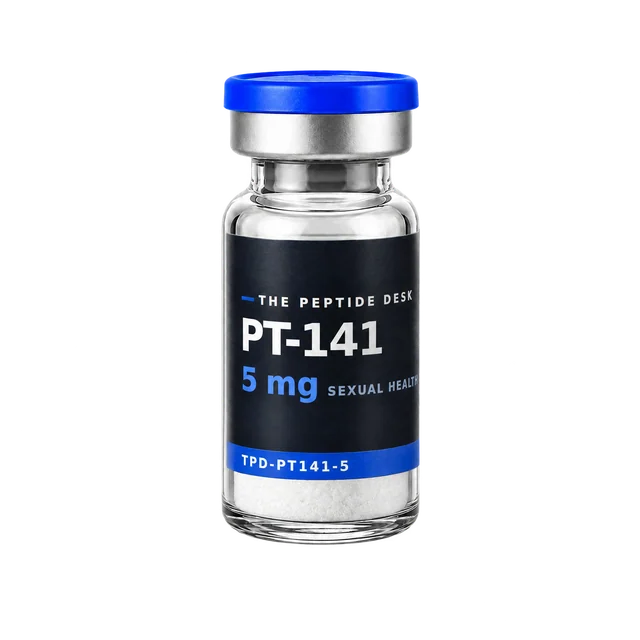
What is PT-141?
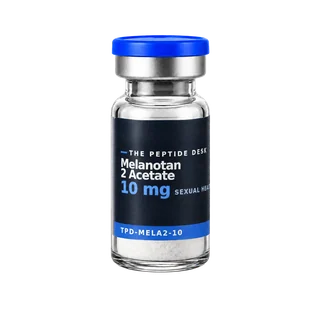
PT-141 (active name bremelanotide) is a melanocortin agonist and related to Melanotan II, but for a different purpose. While Melanotan II is mainly known for skin tanning, PT-141 is used for sexual function and is even approved as a medicine for it.
The key difference from agents like PDE-5 inhibitors: PT-141 acts centrally via the brain (desire), not via blood flow. It is used subcutaneously on demand. It ships as a freeze-dried powder you dissolve in bacteriostatic water.
Comparison
Melanocortin peptides and other paths
Which receptors each compound targets, as stated in the TPD lexicon. Tap a card to open its entry.
Simplified from the lexicon entries. Melanotan II acts on further melanocortin receptors, PDE-5 inhibitors act via blood flow instead of the brain. 9
How it works
PT-141 activates melanocortin receptors in the brain, mainly the MC4 receptor, which is involved in regulating sexual desire. So the effect runs through the central nervous system and the sense of desire, not through the vessels. That is why it can work even when purely blood-flow-related agents miss the point.
Unlike Melanotan II, PT-141 is not designed for tanning; skin pigmentation is not the focus here.
Where it acts
Where PT-141 acts
Tap a point or a card. Colour = receptor, grey = seen in studies.
- Brain
Nerve cells with MC4R in many brain regions, how the effect arises is unknown according to the label9
MC4R - Skin
More pigment, rarely dark patches, more often with daily dosing4
MC1R - Stomach
Nausea in 40% in phase 3, weaker from the second dose for most9
Observed in trials - Blood pressure
Briefly up to 3 mmHg higher, heart rate somewhat lower5
Observed in trials - Appetite and weight
In phase 1 trials in obesity about 400 kcal less per day and 1.3 kg more loss than on placebo in 16 days6
Observed in trials
Targets in the ChEMBL database10
Compound CHEMBL2070241: two recorded mechanisms, type of action on each card.
- Gene
- MC1R
- UniProt
- Q01726
- ChEMBL
- CHEMBL3795
- Action
- Agonist according to the label, most strongly activated

What you need
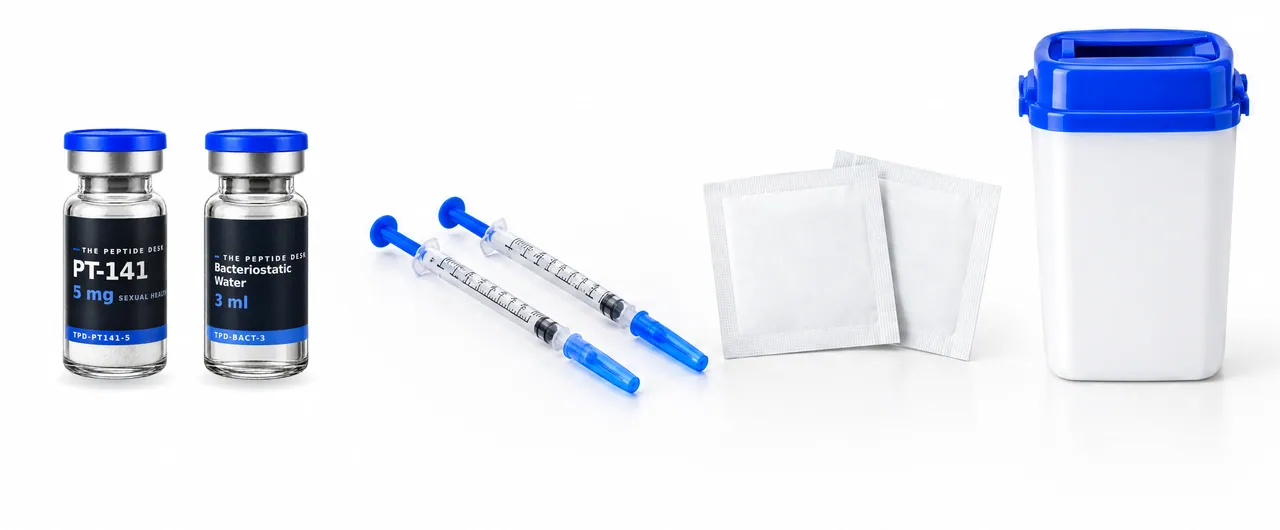
For subcutaneous use you need:
Supplies
5 things, numbered as in the picture
Tick off what you already have. Vial and BAC water are our real shop photos at the same size.
-
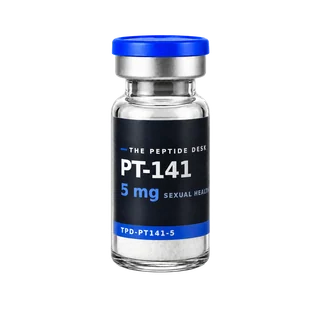
PT-141 vial
The PT-141 vial with the freeze-dried powder
-
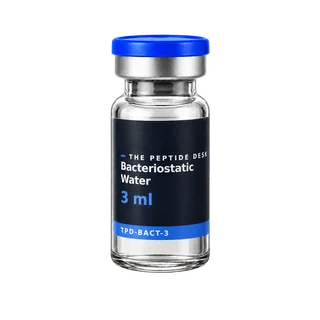
Bacteriostatic water
Bacteriostatic water to dissolve it
-
U-100 insulin syringes
U-100 insulin syringes
-
Alcohol swabs
Alcohol swabs for the vial cap and the skin
-
Sharps container
A sealable sharps container for used needles
As an Amazon associate we earn from qualifying purchases. Links open Amazon - no extra cost for you.
Reconstitution
The powder is dissolved in bacteriostatic water. How much water you add sets the concentration and therefore how many units you draw for your dose on the insulin syringe.
Use the peptide calculator for this: pick the water volume to see the concentration and units per dose.
When dissolving, just add the bac water, it does not matter if it hits the powder directly. Then swirl or shake until everything has dissolved, both are fine.
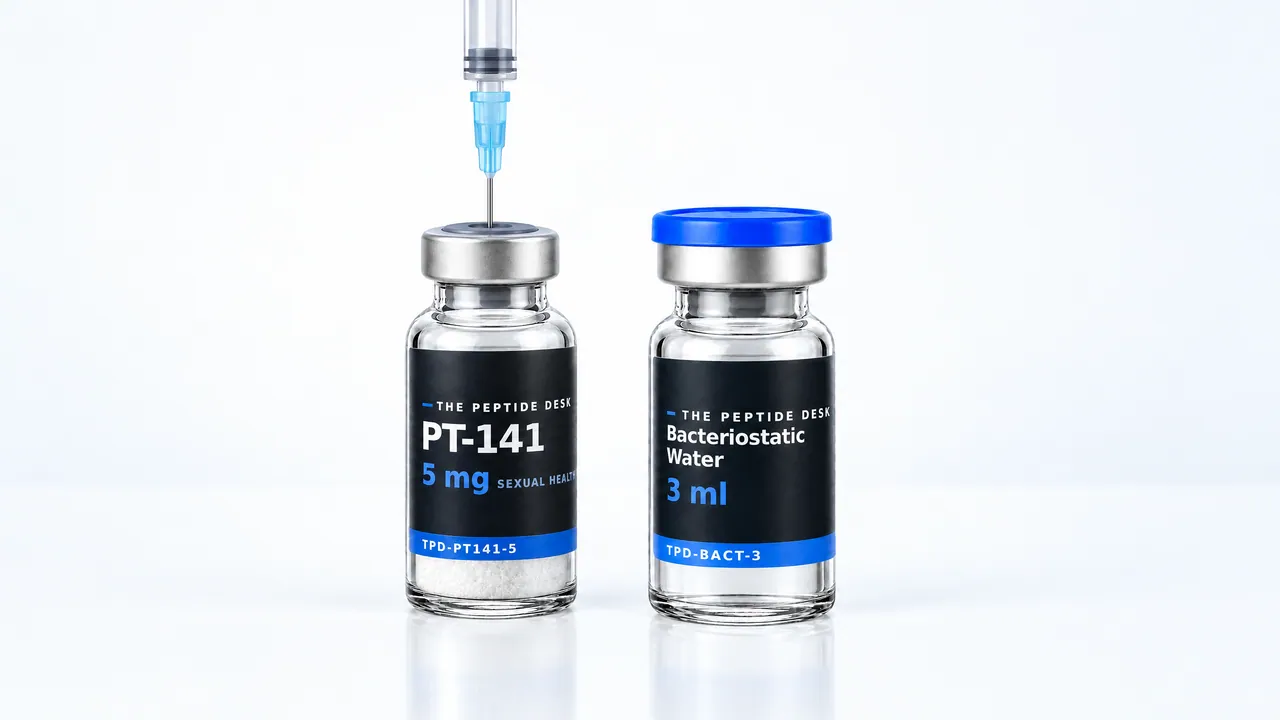
Step by step
Dissolving the powder
Four steps, the same for every vial size.
- 1Wipe the cap
Clean the rubber stopper with an alcohol swab.
- 2Add BAC water
Just add it, it does not matter if it hits the powder directly.
- 3Swirl or shake
Until everything has dissolved, both are fine.
- 4Draw up
With the U-100 insulin syringe.
Injection
The injection is subcutaneous, into the fat layer under the skin, about 45 minutes before the desired effect. Typical spots are the abdomen (keep clear of the area around the navel), the front and the inner side of the thigh or the back of the upper arm.
Injection
Where and at what angle
Pick a spot or switch the angle. Subcutaneous means: into the fat layer, not the muscle.
Rotate the spot each time, never the same one twice in a row.
Rule of thumb: where there is more fat under the skin, insert straight at 90 degrees. In lean people with little fat, 45 degrees, so the needle stays in the fat layer. Simplified diagram.
-
Clean the spot with an alcohol swab and let it dry
-
Pinch up a small fold of skin
-
Insert the needle: at 90 degrees where there is more fat under the skin, at 45 degrees in lean people with little fat
-
Inject slowly, wait a moment, then withdraw
-
Put the needle straight into the sharps container
Rotate the site.
Dosing
Dosing
Dosing, titration and syringe
Loading the dosing information …
- Getting started and stepping up, drawn as a staircase
- Units on the U-100 syringe for every step
- How long one vial lasts
What the research shows
PT-141 is one of the best-evidenced of the substances listed here: two large randomised phase 3 trials (RECONNECT) showed, in premenopausal women with reduced sexual desire, a statistically significant improvement in desire and a reduction in the related distress versus placebo. On this basis bremelanotide was approved.
The study with a link is in the source block below.
Study results
What the trials measured
Interactive: switch tabs, tap points, show or hide arms. Arms are named relative to each other, no dosing advice.
Desire after 24 weeks1
More than on placebo, in points on the desire part of the FSFI questionnaire
Difference from placebo according to the abstract, all statistically significant. 1,202 women in the analysis, dosed on demand.
Distress after 24 weeks1
Less than on placebo, in points on one item of the FSDS-DAO questionnaire
Difference from placebo according to the abstract. What was measured is distress about low desire.
Change after 12 weeks3
Mean change from baseline, 327 women in the analysis
Values from the abstract. The trial tested three levels, the abstract reports the two higher ones combined.

Research status
Where the research stands
From the first trials to approval in the USA: registered trials with status, participants and results. As of 26 Oct 2026. 11
- Preclinical Animal models and early trials with nasal dosing
- Phase 1 1 trial, 1 completed
- Phase 2 3 trials, 2 completed
- Phase 3 3 trials, 3 completed
- Approval in the USA since 2019
Show all 8 phase 2, 3 and 4 trials on a timelineHide timeline
NCT01382719 · 612 participants, started Jun 2011, primary endpoint reached Sept 2012.
Registry entry ↗ · Results: Clayton et al., Women's Health, 2016
BREAKOUT · NCT05709444 · 16 participants, started Dec 2022, primary endpoint reached Apr 2024.
Registry entry ↗ · Results not yet in PubMed
NCT06565611 · 108 participants (planned), started Aug 2024, primary endpoint planned Feb 2025. Tests several agents.
RECONNECT 301 · NCT02333071 · 723 participants, started Dec 2014, primary endpoint reached Jul 2016.
Registry entry ↗ · Results: Kingsberg et al., Obstetrics & Gynecology, 2019, Simon et al., Obstetrics & Gynecology, 2019
RECONNECT 302 · NCT02338960 · 714 participants, started Jan 2015, primary endpoint reached Aug 2016.
Registry entry ↗ · Results: Kingsberg et al., Obstetrics & Gynecology, 2019, Simon et al., Obstetrics & Gynecology, 2019
NCT04943068 · 193 participants, started May 2021, primary endpoint reached May 2023.
Registry entry ↗ · Results not yet in PubMed
NCT04179734 · 40 participants, started Oct 2019, primary endpoint reached Oct 2020.
Registry entry ↗ · Results not yet in PubMed
NCT06867835 · 10 participants, started Jul 2025, primary endpoint reached Nov 2025.
Registry entry ↗ · Results not yet in PubMed
Bar: start to primary endpoint (planned for running trials). Green = completed, blue = progress until 26 Oct 2026. Phase 1: 1 trial on safety and pharmacokinetics, not shown as bars.
Side effects
The most common side effect is nausea, especially at higher doses and at the start. On top come facial flush (heat, redness) and headache. In the studies a transient, slight rise in blood pressure was observed, which is why starting low and not dosing too often makes sense.
Tolerability
Frequency in phase 3
Out of 100 participants per group, how many had the event over 24 weeks.
| Event | Placebo | Bremelanotide (approved dose) |
|---|---|---|
| Nausea4 | 1% | 40% |
| Facial flushing4 | 1% | 20% |
| Headache4 | 2% | 11% |
| Injection site reaction4 | 1% | 5% |
Values according to the abstract, 1,247 women. Nausea was the most common reason for stopping. Blood pressure rose slightly in the first hours after a dose, heart rate fell somewhat.45
Practice
-
Start low and gauge tolerability (especially nausea).
-
Plan about 45 minutes of lead time.
-
Not too often, it is an on-demand agent, not a daily one.

Storage
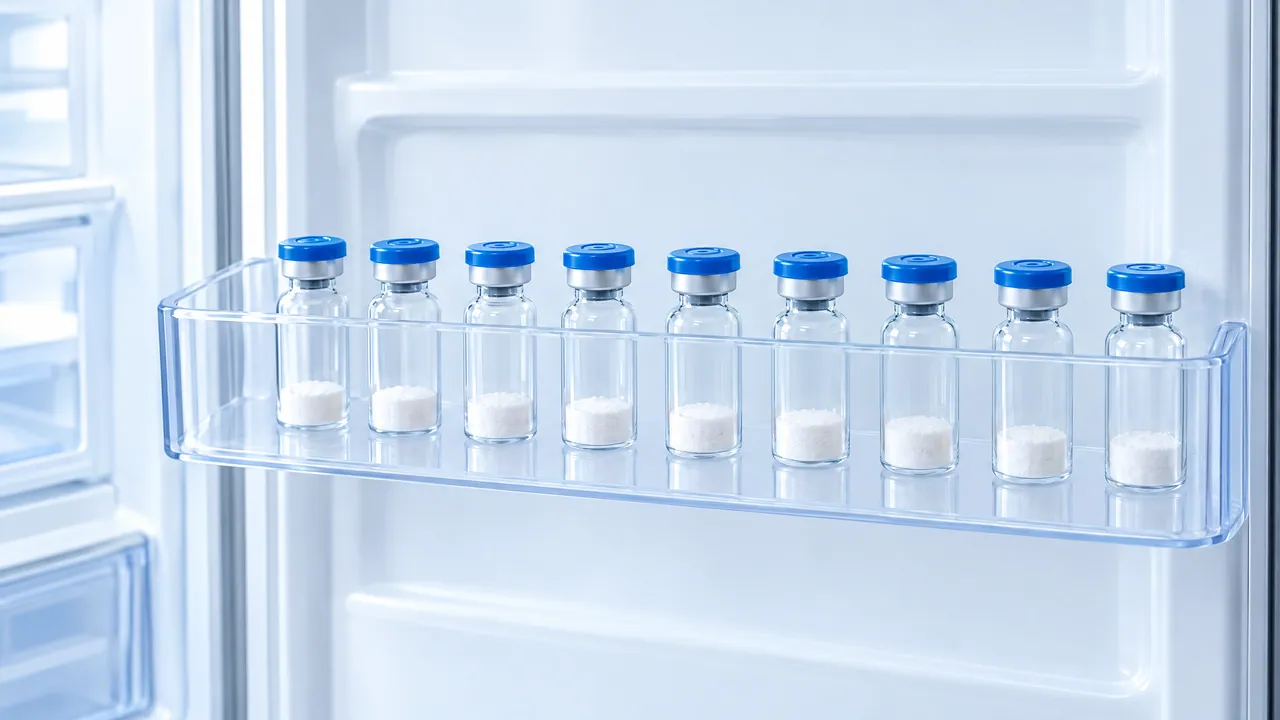
The undissolved powder is robust, normal room temperature (around 20 to 25 degrees) is fine, ideally kept in the dark. The reconstituted solution goes into the fridge (2 to 8 degrees) and stays stable there for at least 4 to 6 months with barely any loss of potency, in practice considerably longer. The bacteriostatic water brings a preservative that keeps the dissolved form stable for longer.
Shelf life
How long it keeps
Robust, no fridge needed.
At least 4 to 6 months with barely any loss of potency. The bacteriostatic water brings a preservative.
- Keep it dark
- Dissolved: 2 to 8 degrees
- Note the mixing date on the vial