Description
Finasteride (Propecia, Proscar) is a selective inhibitor of 5α-reductase type II, the enzyme converting testosterone to dihydrotestosterone (DHT). The substance was developed by Merck and has been clinically approved since 1992 (Proscar for BPH) and 1997 (Propecia for androgenetic alopecia).
Per study reports Finasteride lowers circulating DHT levels by about 70%. Since DHT is the main androgen responsible for hair follicle miniaturization in androgenetic alopecia, DHT lowering leads in studies to hair preservation and partial reactivation of currently inactive follicles.
Clinical Phase III studies document significant reduction of hair loss progression over 5 years in 80%+ of users, with moderate regrowth effect. Action depends on continuous use - upon discontinuation hair loss returns to original trend within 6-12 months.
Pharmacokinetically orally bioavailable with about 5-6 hour half-life. Steady-state of DHT suppression within 7-14 days. A once-daily dose of 1mg for alopecia, 5mg for BPH is clinical standard.
Known effects in studies: in ~2-5% of users sexual side effects (libido decrease, erectile problems, ejaculate volume reduction). In some users these effects persist even after discontinuation (“Post-Finasteride Syndrome” - controversial in the literature). Mood changes are described in some studies.
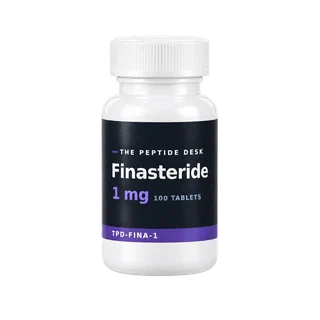
You can order Finasteride as oral tablets with 1mg or 5mg per tablet, each as a blister of 10 or a bottle of 100 tablets.
This information is for research and educational purposes only. No medical recommendations.
Risks & Safety
Finasteride is a 5α-reductase inhibitor approved for decades and is well characterized, but it has a clearly documented side effect profile that primarily concerns hormone metabolism.
Documented in clinical studies:
- Sexual side effects: in about 2-5 percent of users, libido decrease, erectile problems and reduced ejaculate volume are documented. This is the most common and best-supported effect group.
- Post-finasteride syndrome: in a subset of users, sexual and partly cognitive effects persist even after discontinuation. This phenomenon is discussed controversially in the literature but is documented. It is the most relevant honest uncertainty point.
- Mood changes: some studies describe depressive mood and mood swings under use.
- DHT-dependent action: the entire effect rests on an approximately 70 percent reduction of circulating DHT. Upon discontinuation the original course returns within 6-12 months.
This classification does not replace medical advice. Risk and responsibility for any actual use lie entirely with the buyer.
Studies
- The Effect of Finasteride in Men with Benign Prostatic Hyperplasia - NEJM 1992, Gormley et al: pivotal Phase III trial of finasteride in BPH showing prostate volume reduction and symptom improvement.
- Clinical dose ranging studies with finasteride, a type 2 5α-reductase inhibitor, in men with male pattern hair loss - Journal of the American Academy of Dermatology 1999, Roberts et al: two randomized dose-ranging studies with 0.01 to 5mg daily versus placebo. 1mg and 5mg were similarly effective and superior to the lower doses, while 0.01mg was similar to placebo. The optimal dose in androgenetic alopecia was identified as 1mg.
- The Long-Term Effect of Doxazosin, Finasteride, and Combination Therapy on the Clinical Progression of Benign Prostatic Hyperplasia - NEJM 2003, McConnell et al: MTOPS trial, 4.5-year data on BPH progression delay.
- Persistent Sexual Side Effects of Finasteride for Male Pattern Hair Loss - Journal of Sexual Medicine 2011, Irwig & Kolukula: documentation of persistent sexual effects after discontinuation.
- Post-finasteride syndrome: An emerging clinical problem - Neurobiology of Stress 2020, Diviccaro et al: recent review of post-finasteride syndrome with mechanism hypotheses.