This information is for research and educational purposes only. No medical recommendations. Products are not approved for human use. For health questions, consult a doctor.

Lexicon

Finasteride

The oral DHT blocker - the most effective oral standard therapy against androgenetic hair loss.

2 min read 9 sources

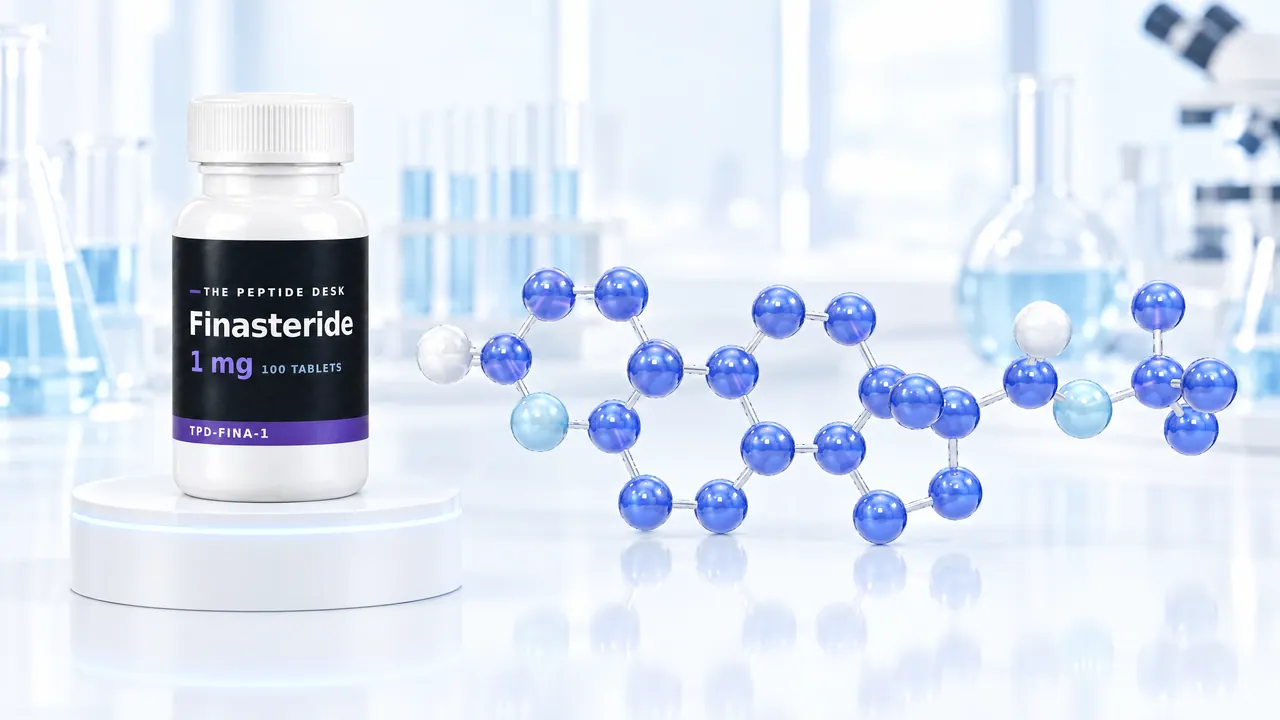
White tablet bottle with a black TPD label for finasteride on a white podium, next to it a large blue 3D molecule in a bright lab
Compound approved · since 1992 according to ChEMBL

Summary

At a glance

Sources checked on 26 Oct 2026

DHT in the blood
-71.4 %

after 42 days at the level used in the hair studies3

DHT in the scalp
-64.1 %

same level, placebo -13.0 percent3

Hair count after 2 years
+138 hairs

versus placebo on 5.1 cm² of the vertex, baseline 876 hairs2

Longest placebo trial
5 years

the improvement lasted, no new safety concerns7

Prostate cancer in PCPT
-24.8 %

relative over 7 years, highest study dose, high-grade tumours more common6

  • Finasteride inhibits the enzyme 5α-reductase type 2. As a result less testosterone is converted to DHT.93
  • In a dose study DHT fell by up to 69.4 percent in the scalp and by up to 72.2 percent in the blood. Even low levels came close to the maximum.3
  • In two trials with 1,553 men the hair count after 2 years was 138 hairs above placebo. The improvement lasted over 5 years.27
  • A meta-analysis found more erectile dysfunction than on placebo. Stopping because of sexual side effects was not more common, though.4
  • Finasteride is an approved compound. Everything here is the state of research, not a recommendation.9
Profile

Updated June 2026

How long does it stay in the body?

Share left after one dose, calculated with a half-life of ~6 hours

Half-life ~6 hours
After 12 hours: 25 %
Hour 6 · 50 %Hour 12 · 25 %Hour 18 · 12.5 %Hour 24, next dose · 6.3 %Hour 30 · 3.1 %

Simplified model without an absorption phase, half-life from the TPD lexicon.

Class
5α-reductase inhibitor type 2
Use
Oral

1 tablet per day

Half-life
about 6 hours
Status
Clinically approved

hair loss, BPH

Sizes
1 to 5 mg

3 sizes in the shop

Contents 15 sections
  1. At a glance
  2. What is finasteride?
  3. How it works
  4. How to take it
  5. Dosing
  6. What the research shows
  7. Research status
  8. On the skin
  9. Side effects
  10. Important notes
  11. Storage
  12. Related compounds
  13. FAQ
  14. Glossary
  15. Sources

What is finasteride?

Finasteride is a selective inhibitor of the enzyme 5α-reductase type 2 - the enzyme that converts testosterone into DHT (dihydrotestosterone). DHT is the main driver of androgenetic hair loss: it binds to hair follicle receptors and gradually miniaturizes the follicles.

Finasteride lowers blood DHT by about 70% and has been the oral gold standard against hereditary hair loss for decades.

Comparison

Three approaches to hair loss

Finasteride and dutasteride slow DHT production, minoxidil works through a different path. Tap a card to open its entry.

Simplified from the targets in ChEMBL: finasteride inhibits type 2 of 5α-reductase, dutasteride several types, minoxidil opens potassium channels. 9

How it works

5α-reductase type 2 sits in skin, prostate, testes and elsewhere. Finasteride selectively blocks this enzyme, reducing:

  • Plasma DHT: drops about 70%.
  • Scalp DHT: drops about 60-65% - the key effect for the hair.
  • Plasma testosterone: stays nearly unchanged or rises slightly (more T doesn't enter the DHT pathway).

Result at the follicles: miniaturization stops, in many cases shrunk follicles grow back to normal size.

Where it acts

Where finasteride acted in studies

Tap a point or a card. Colour = 5α-reductase type 2, grey = observed in studies.

  1. Scalp

    Scalp DHT lowered by up to 69.4 percent3

    5AR2
  2. Blood

    Blood DHT lowered by up to 72.2 percent3

    5AR2
  3. Prostate

    Prostate cancer detected less often, high-grade tumours more often (highest study dose)6

    Observed in trials

Targets in the ChEMBL database9

Compound CHEMBL710: one recorded mechanism, Inhibitor, direct binding.

5α-reductase type 2
Gene
SRD5A2
UniProt
P31213
ChEMBL
CHEMBL1856
Action
Inhibitor, direct binding
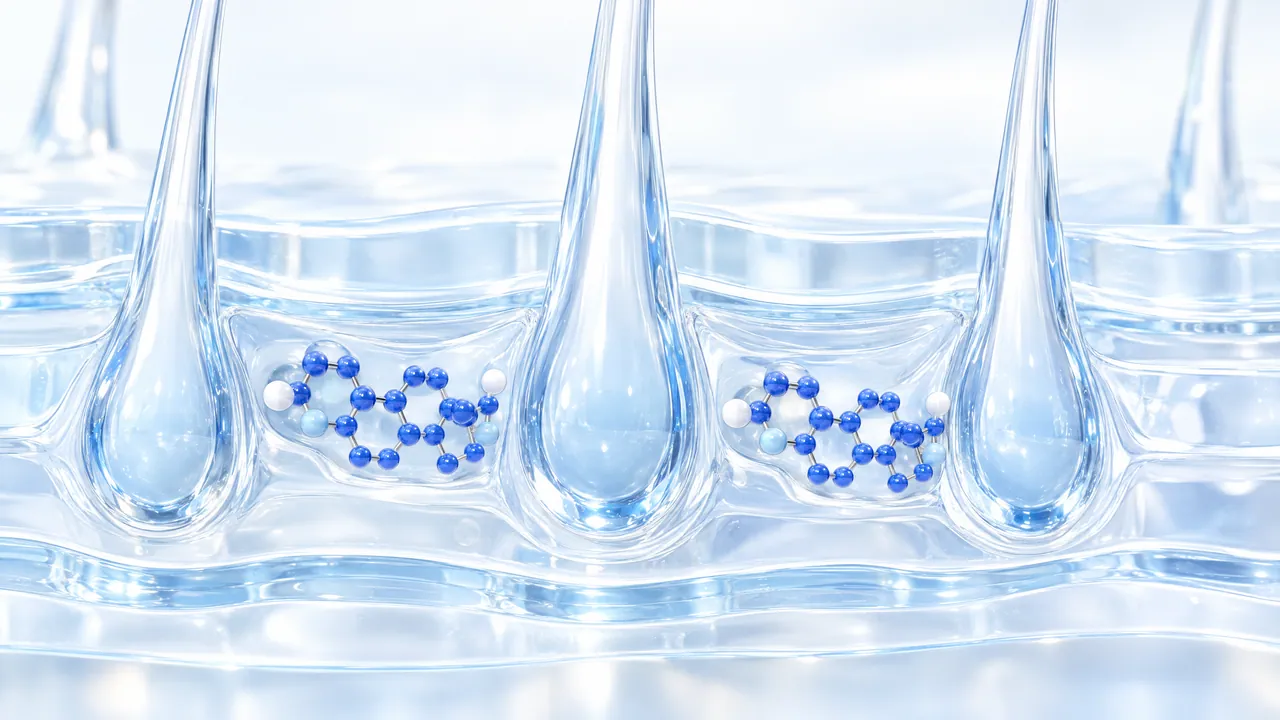
Glassy hair follicles in a transparent skin layer with blue molecules in between
Finasteride inhibits 5α-reductase type 2 and lowers DHT in the scalp. Symbolic image.

How to take it

Oral tablet, once per day. Time of day doesn't matter.

  • 1 tablet (1mg) with some water.
  • With or without food.
  • A fixed daily routine is important - gaps weaken the effect.
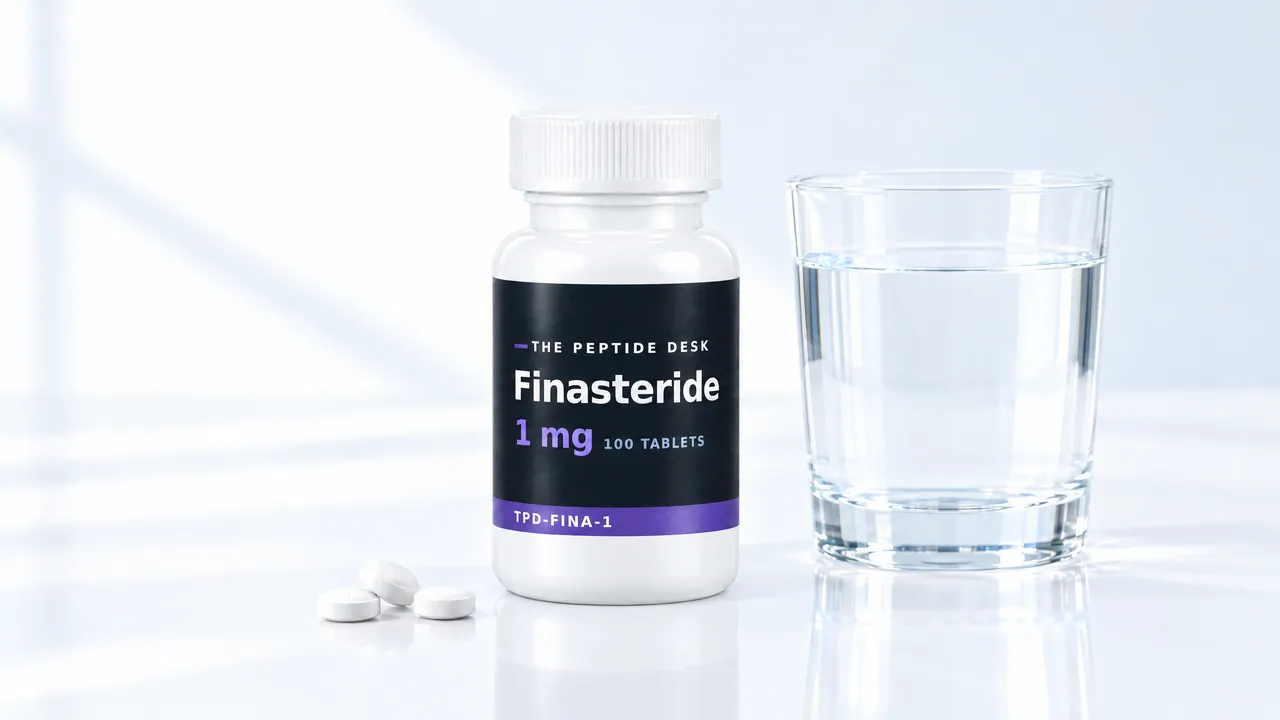
White tablet bottle with a black TPD label for finasteride, next to it three tablets and a glass of water
Tablet with some water, with or without food. Symbolic image.

Dosing

Dosing

Dosing, titration and syringe

Loading the dosing information …

  • Getting started and stepping up, drawn as a staircase
  • Units on the U-100 syringe for every step
  • How long one vial lasts

What the research shows

Finasteride has one of the best data sets of any hair loss therapy:

  • Kaufman et al. 1998: two 1-year trials in 1553 men, extended to 2 years - more hair and slower hair loss on 1mg daily, progressive loss on placebo.
  • Finasteride Male Pattern Hair Loss Study Group 2002: the 5-year data from the same trials - the improvement held, tolerability stayed good and no new safety concerns emerged.

These studies are the basis for worldwide approval.

Study results

What the trials measured

Interactive: switch tabs, tap points, show or hide arms. Arms are named relative to each other, no dosing advice.

DHT after 42 days3

Change in percent, 249 men with hair loss, five levels versus placebo

DHT in the scalp3 measured in skin biopsies
Placebo -13.0%
Level 1 (lowest) -14.9%
Level 2 -61.6%
Level 3 -56.5%
Level 4 (as in the hair studies) -64.1%
Level 5 (highest, 5 mg) -69.4%
DHT in the blood3 No value in the abstract for placebo and the lowest level
Level 2 -49.5%
Level 3 -68.6%
Level 4 (as in the hair studies) -71.4%
Level 5 (highest, 5 mg) -72.2%

Values from the abstract. From the third level on, both values fell almost as much as at the highest. The authors saw this as the basis for the dose of the hair studies.

Hair count versus placebo4

Mean difference in percent of baseline, 12 trials with 3,927 men

Short term4 up to 12 months
Difference to placebo +9.4%
Long term4 24 months or more
Difference to placebo +24.3%

Values from the abstract (9.42 and 24.3 percent), moderate-quality evidence. In the single trials with 1,553 men the hair count after 1 and 2 years was 107 and 138 hairs above placebo.

Relative risk versus placebo45

1.0 means as common as on placebo

Erectile dysfunction4 Meta-analysis, 12 trials
Relative risk versus placebo 2.22-fold
Sexual dysfunction5 Meta-analysis, finasteride only
Relative risk versus placebo 1.66-fold
Any sexual disturbance4 Meta-analysis, 12 trials
Relative risk versus placebo 1.39-fold
Stopped due to sexual side effects4 Meta-analysis, 12 trials
Relative risk versus placebo 0.88-fold

For erectile dysfunction the meta-analysis found one additional case per about 82 treated men. The risk of any sexual disturbance was only possibly raised, stopping was not more common than on placebo.

Prostate cancer over 7 years6

Share of men with a finding, 18,882 men aged 55 or older

Prostate cancer detected6
Placebo 24.4%
Finasteride (5 mg, highest study dose) 18.4%
High-grade tumours6 Gleason 7 to 10, relative to all men in the analysis
Placebo 5.1%
Finasteride (5 mg, highest study dose) 6.4%

Cancer was detected less often, but high-grade tumours more often. Sexual side effects were more common on finasteride, urinary symptoms on placebo.
Tuft of dark hair in a frosted glass block with a follicle model on a bright lab bench
Hair studies over up to 5 years and a meta-analysis of 12 trials. Symbolic image.

Research status

Where the research stands

Finasteride has been approved since 1992. On ClinicalTrials.gov 95 trials list finasteride among their interventions. The hair studies and PCPT from this entry date from the 1990s and are not listed there. Shown are registered phase 3 trials with finasteride on hair loss and the prostate. As of 26 Oct 2026. 8

  1. Preclinical Basis: less DHT by inhibiting 5α-reductase
  2. Phase 1 no registered trial
  3. Phase 2 no registered trial
  4. Phase 3 3 trials, 3 completed
  5. Approval since 1992 according to ChEMBL
355 participants in phase 3 Approved: ChEMBL lists finasteride with phase 4 as the highest phase and first approval in 1992.9
Show all 3 phase 3 trials on a timelineHide timeline 3 completed 0 running 0 with results
Phase 3

Bar: start to primary endpoint (planned for running trials). Green = completed, blue = progress until 26 Oct 2026.

On the skin

Finasteride has also been developed as a spray for the scalp. In a phase 3 trial with 458 men it grew clearly more hair than placebo after 24 weeks, similar to the tablet. Blood levels were far below those of the tablet and blood DHT fell less (Piraccini 2022).
Hand touching a swirl of white cream on a light marble slab with water droplets and white flowers
Symbolic image.

Side effects

  • Libido loss: reported by about 1-4% of users. Usually reversible.
  • Erectile dysfunction: similar frequency.
  • Mood changes: less common but documented.
  • Post-Finasteride Syndrome (PFS): very rare, controversial phenomenon with persistent symptoms after discontinuation. The data is hard to interpret.

If concerned: start low (0.5mg every other day), observe and decide whether to step up.

Important notes

  • Not for women of childbearing age - finasteride is teratogenic, can harm male fetuses.
  • PSA test is lowered by about 50% on finasteride - tell your doctor at prostate screening.
  • Effect is not curative - stopping returns the hair loss.

Storage

Store dry and protected from light. Keep original container closed, out of reach of children.

Three white capsule bottles on a bright shelf next to a folded light blue towel
Store dry and protected from light, out of reach of children. Symbolic image.
Level · Finasteride

How the level builds up

One dose per day: each dose adds to what is left of the previous one.

Lexicon: Oral, 1 tablet per day
Peak 1.07×Trough 0.07×
Day 1 · 2. dose
1.06× of the first dose
Plateau
from Day 1

100 % of the plateau after dose 2

Peak
1.07×

of the first dose

Trough
0.07×

before the next dose

Simplified model, values relative to the first dose, no dosing information. Dashed: the first dose alone, green: the plateau.

Related

Related compounds

Same targets or a different path: all in the TPD lexicon.

FAQ

Common questions about Finasteride

Short answers, each backed by the sources below.

Is finasteride approved?

Yes. ChEMBL lists finasteride with phase 4 as the highest phase and first approval in 1992. ClinicalTrials.gov lists 95 trials with finasteride, as of 26 October 2026.98

How much does finasteride lower DHT?

In a trial with 249 men and five levels DHT fell after 42 days by up to 69.4 percent in the scalp and by up to 72.2 percent in the blood. On placebo scalp DHT fell by 13.0 percent. From the third level on the reduction was almost maximal.3

What did the hair studies show?

In two trials with 1,553 men the hair count on 5.1 cm² of the vertex was 107 and 138 hairs above placebo after 1 and 2 years. On placebo hair loss continued. In the extensions up to 5 years the improvement lasted. A meta-analysis of 12 trials confirms the effect with moderate-quality evidence.274

Which sexual side effects are described?

A meta-analysis found a relative risk of 2.22 for erectile dysfunction, about one additional case per 82 treated men. A second one found a relative risk of 1.66 for sexual dysfunction. Stopping because of sexual side effects was not more common than on placebo.45

What did the prostate trial PCPT show?

18,882 men aged 55 or older received the highest study dose or placebo for 7 years. Prostate cancer was detected in 18.4 instead of 24.4 percent, a 24.8 percent reduction. High-grade tumours were more common, though (6.4 instead of 5.1 percent). The PSA value was adjusted for the effect of finasteride.6

How does finasteride differ from dutasteride?

According to ChEMBL finasteride specifically inhibits type 2 of 5α-reductase, dutasteride several types. A head-to-head trial in hair loss with 917 participants is listed as completed in the registry.98

Is there finasteride to apply to the scalp?

Yes, as a scalp spray. In a phase 3 trial with 458 men it grew clearly more hair than placebo after 24 weeks, similar to the tablet. Peak blood levels were more than 100 times lower than with the tablet and blood DHT fell less.1

Glossary

Terms explained briefly

Dotted words in the text open these explanations directly.

5α-reductase
Enzyme that converts testosterone into the more potent DHT. Type 2 sits in hair follicles and the prostate, among other places.
Androgenetic alopecia
Hereditary hair loss in which hair follicles gradually shrink under DHT.
BPH
Benign prostatic hyperplasia, a non-cancerous enlargement of the prostate common in older men.
DHT
Dihydrotestosterone, a potent androgen. It plays a major role in hereditary hair loss.
Hair follicle
The root sheath in the skin from which the hair grows.
Meta-analysis
Analysis that pools the results of several trials into one combined figure.
Miniaturisation
The shrinking of hair follicles. Hairs get thinner and shorter until they are barely visible.
Placebo
Dummy preparation without active substance. Comparing against it shows what is due to the substance itself.
Post-finasteride syndrome
Reported complaints said to persist after stopping. The evidence is disputed.
PSA
Prostate-specific antigen, a blood marker for early detection of prostate cancer. Finasteride lowers it, which has to be considered when reading it.
Teratogenic
Can harm an unborn child in the womb.

Evidence

Sources

Show all 9 sourcesHide sources 6 Studies1 Trial registry2 Database checked 26 Oct 2026

Studies

  1. Finasteride as a scalp spray, phase 3

    Piraccini et al., Journal of the European Academy of Dermatology and Venereology, 2022

    Checked 26 Oct 2026 via doi.org, Crossref, PubMed
  2. Two phase 3 trials of finasteride in hair loss over 2 years

    Kaufman et al., Journal of the American Academy of Dermatology, 1998

    Checked 26 Oct 2026 via doi.org, Crossref, PubMed
  3. Dose study: DHT in scalp and blood on finasteride

    Drake et al., Journal of the American Academy of Dermatology, 1999

    Checked 26 Oct 2026 via doi.org, Crossref, PubMed
  4. Systematic review of efficacy and safety in hair loss

    Mella et al., Archives of Dermatology, 2010

    Checked 26 Oct 2026 via doi.org, Crossref, PubMed
  5. Meta-analysis of sexual side effects in hair loss

    Lee et al., Acta Dermato-Venereologica, 2019

    Checked 26 Oct 2026 via doi.org, Crossref, PubMed
  6. PCPT: finasteride and prostate cancer over 7 years

    Thompson et al., New England Journal of Medicine, 2003

    Checked 26 Oct 2026 via doi.org, Crossref, PubMed

Trial registry

  1. All trials with finasteride on ClinicalTrials.gov

    ClinicalTrials.gov, U.S. National Library of Medicine

    Checked 26 Oct 2026 via ClinicalTrials.gov API v2

Database

  1. 5-year data on finasteride in hair loss (study without DOI, PubMed record)

    Finasteride Male Pattern Hair Loss Study Group, European Journal of Dermatology, 2002

    Checked 26 Oct 2026 via PubMed
  2. Finasteride, dutasteride and minoxidil in ChEMBL (targets and approval)

    ChEMBL, EMBL-EBI (CHEMBL710, CHEMBL1200969, CHEMBL802)

    Checked 26 Oct 2026 via ChEMBL

In the shop

Finasteride in the catalog

Sizes, prices and shipping times are on the product page.

To the product