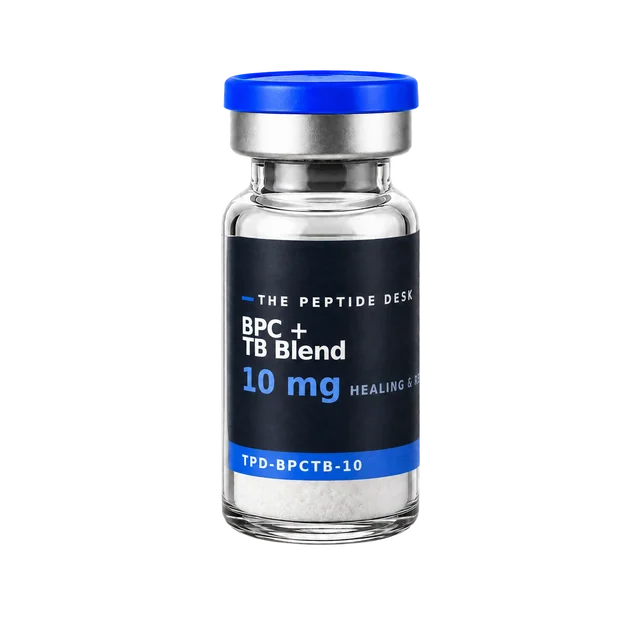
Description
Glow Blend Mini is a compact multi-peptide research formulation with focus on skin and anti-aging effects. Typical composition includes GHK-Cu, BPC-157 and smaller amounts of further healing or aging peptides in one injection.
Per study reports the formulation combines mechanisms relevant in skin research: GHK-Cu for collagen synthesis and gene expression regulation, BPC-157 for connective tissue repair, plus possible additional active ingredients like TB-500 for actin mobilization.
The “Mini” designation indicates a more compact compound amount per vial vs full Glow Blend formulations - typical for shorter research protocols or for users preferring lower total compound amounts.
Typical application is subcutaneous once daily in 6-10 week courses.
You can order Glow Blend Mini as lyophilized peptide in 10-pack.
This information is for research and educational purposes only. No medical recommendations.
Risks & Safety
Glow Blend Mini is considered well tolerated per study reports. The included compounds - GHK-Cu, BPC-157 and further healing peptides - each have a mild profile in the preclinical literature.
Observed in research and user reports:
- Injection site: mild redness, pressure or transient irritation at the injection site is the most common observation with subcutaneous use.
- Copper component: as a copper-containing formulation, the GHK-Cu component can cause somewhat more pronounced local irritation at the injection site than pure peptide solutions.
- Circulation: isolated reports of brief fatigue or a feeling of warmth shortly after application.
- No long-term data: robust long-term human studies do not exist for the individual compounds. The exact blend composition is less well characterized than the separate peptides.
This classification does not replace medical advice. Risk and responsibility for any actual use lie entirely with the buyer.
Studies
- GHK peptide as a natural modulator of multiple cellular pathways in skin regeneration - BioMed Research International 2015, Pickart et al: collagen synthesis and multi-pathway action on skin.
- Regenerative and protective actions of the GHK-Cu peptide in the light of the new gene data - International Journal of Molecular Sciences 2018, Pickart and Margolina: gene-expression modulation by the copper complex.
- Skin regenerative and anti-cancer actions of copper peptides - Cosmetics 2018, Pickart and Margolina: skin-specific effects of copper peptides.
- Stable gastric pentadecapeptide BPC 157 and wound healing - Frontiers in Pharmacology 2021, Seiwerth et al: BPC-157 healing mechanism.
- The regenerative peptide thymosin beta-4 accelerates the rate of dermal healing in preclinical animal models and in patients - Annals of the New York Academy of Sciences 2012, Treadwell et al: TB-500 in dermal healing.