This information is for research and educational purposes only. No medical recommendations. Products are not approved for human use. For health questions, consult a doctor.

Lexicon

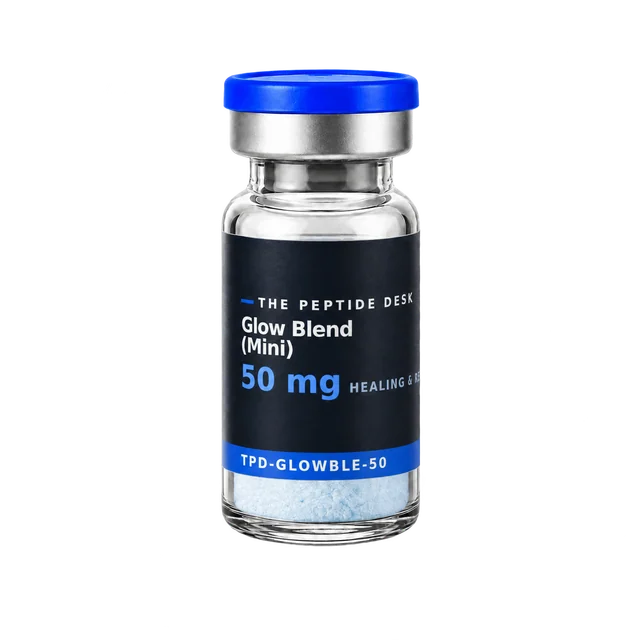
Glow Blend (Mini)

The well-known Glow stack in a smaller vial size: BPC-157, TB-500 and GHK-Cu for healing and skin.

2 min read 13 sources

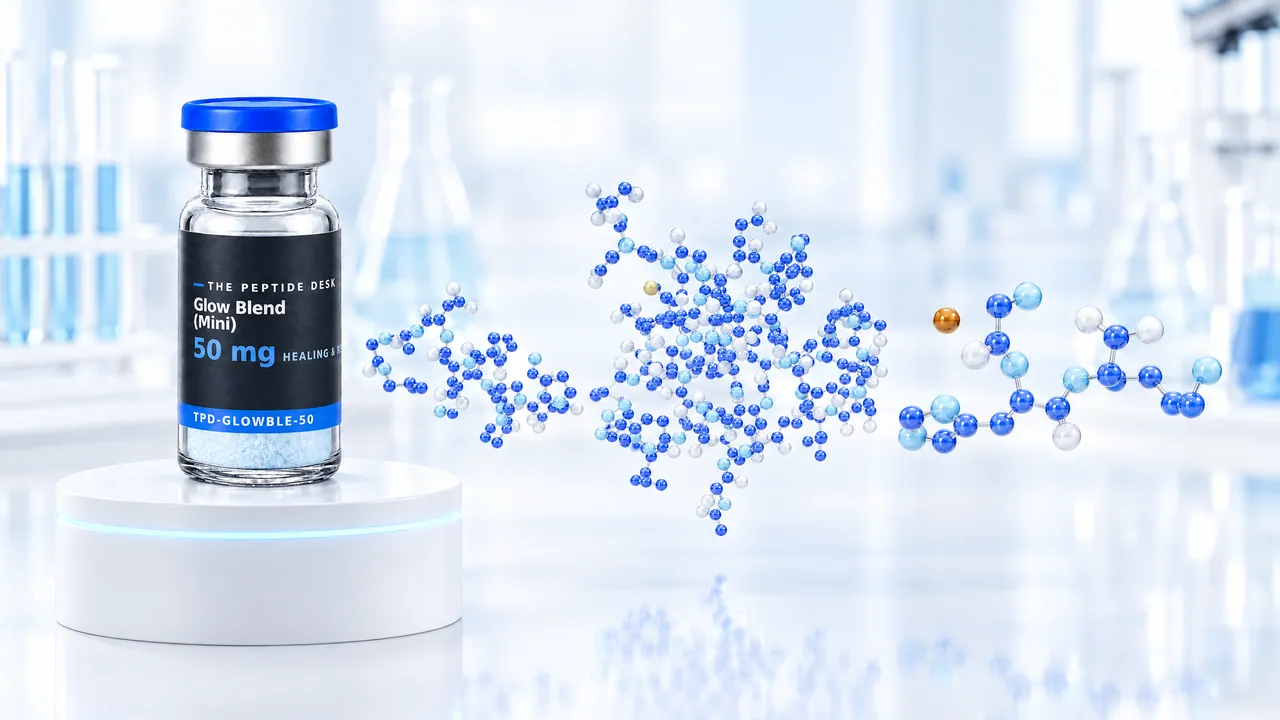
Glow Blend (Mini) vial with white powder and the black TPD label on a white podium, next to three blue 3D molecule models, one with a copper-coloured atom
Components in phase 1 · not approved

Summary

At a glance

Sources checked on 26 Oct 2026

On the blend itself
0 studies

neither in the trial registry nor in PubMed, as of 26 Oct 202611

BPC-157 studies in animals or cells
35 of 36

systematic review, only one study in humans4

All BPC-157 human studies
30 people

three small studies combined, very low certainty3

Wound closure in rats
+61 %

thymosin beta-4 at day 7 versus saline5

Wound area closed (GHK-Cu gel)
98.5 %

median in diabetic foot ulcers, vehicle gel 60.8%7

  • The Glow Blend is a ready-made mix of three peptides: BPC-157, TB-500 and GHK-Cu. The mini version is the smaller vial of the same mix.
  • There is no study on the blend itself, neither in the trial registry nor in PubMed. Everything here comes from studies on single components.1112
  • The only study testing two of the three components together (BPC-157 plus TB-500, tendon healing in rats) found no added benefit over either compound alone.2
  • The components have mainly been studied in animals and cells. For BPC-157, 35 of 36 studies in a systematic review were preclinical; GHK-Cu has been tested in humans almost only as a gel or cream.47
  • None of the three compounds is approved (as of October 2026). Everything here is the state of research, not a recommendation.133
Profile

Updated May 2026

Class
Healing/beauty blend
Use
Subcutaneous

in mg

Contents
BPC-157 + TB-500 + GHK-Cu
WADA
Banned

peptides

Sizes
50 mg

1 size in the shop

Contents 16 sections
  1. At a glance
  2. What is the Glow Blend (Mini)?
  3. How it works
  4. What you need
  5. Reconstitution
  6. Dosing
  7. Injection
  8. What the research shows
  9. Research status
  10. On the skin
  11. Side effects
  12. Storage
  13. Related compounds
  14. FAQ
  15. Glossary
  16. Sources

What is the Glow Blend (Mini)?

The Glow Blend combines the two healing peptides BPC-157 and TB-500 with GHK-Cu, a copper peptide for skin, collagen and tissue regeneration. The mini variant is simply the smaller 50mg vial of the same stack. You also find all three compounds individually in the lexicon.

The name "Glow" comes from the skin and connective-tissue focus via GHK-Cu.

Comparison

Two, three or four compounds

Which compounds each blend contains, as stated in the TPD lexicon. Tap a card to open its entry.

Simplified: more compounds in one vial does not automatically mean better. There is no study on the blend itself. 11

How it works

BPC-157 and TB-500 drive structural repair and cell migration, GHK-Cu adds the promotion of collagen and skin regeneration. So the combination targets healing plus a better skin appearance.

The individual mechanisms are in the lexicon entries for BPC-157, TB-500 and GHK-Cu.

Where it acts

Components and where they act

Tap a point or a card. Colour = component, data from studies on the single compound.

  1. Skin and wounds

    Gel: diabetic foot ulcers closed by a median 98.5% (vehicle gel 60.8%)7

    GHK-Cu
  2. Tendons

    Achilles tendon in rats: stronger with TB-500, the combination with BPC-157 added no benefit2

    TB-500BPC-157
  3. Muscle, ligament and bone

    Better healing of muscle, ligament and bone injuries in animal models4

    BPC-157
Glass-like tissue layers with fibres, blue molecules and copper-coloured atoms inside in a warm glow
Symbolic image.

What you need

Supplies

2 things, numbered as in the picture

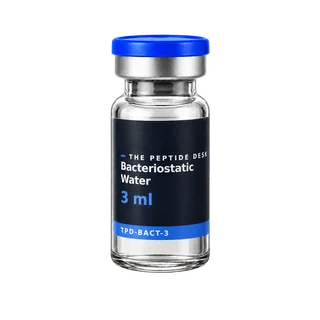
Tick off what you already have. Vial and BAC water are our real shop photos at the same size.
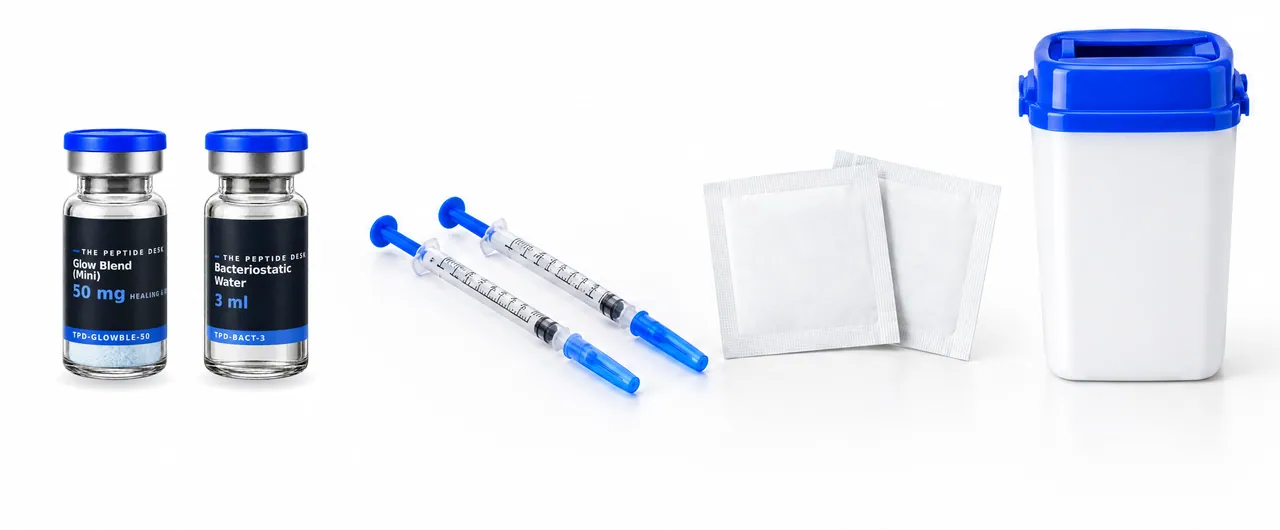
Glow Blend (Mini) vial and bacteriostatic water at the same size with the black TPD label, next to two U-100 insulin syringes, two alcohol swabs and a sharps container with a blue lid
  1. Glow vial (mini)

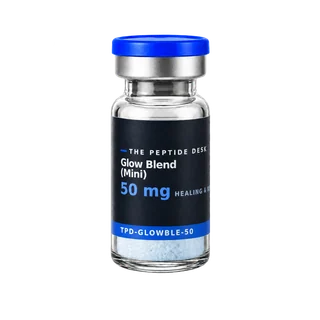
    The Glow vial (lyophilized powder, three compounds).

    In the shop
  2. BAC water, syringes and swabs

    Bacteriostatic water, U-100 insulin syringes, alcohol swabs.

As an Amazon associate we earn from qualifying purchases. Links open Amazon - no extra cost for you.

Reconstitution

Use the peptide calculator. The values refer to the total amount in the vial. A 50mg vial with 2ml water gives 25mg per ml. Just add the water to the vial and let it dissolve.
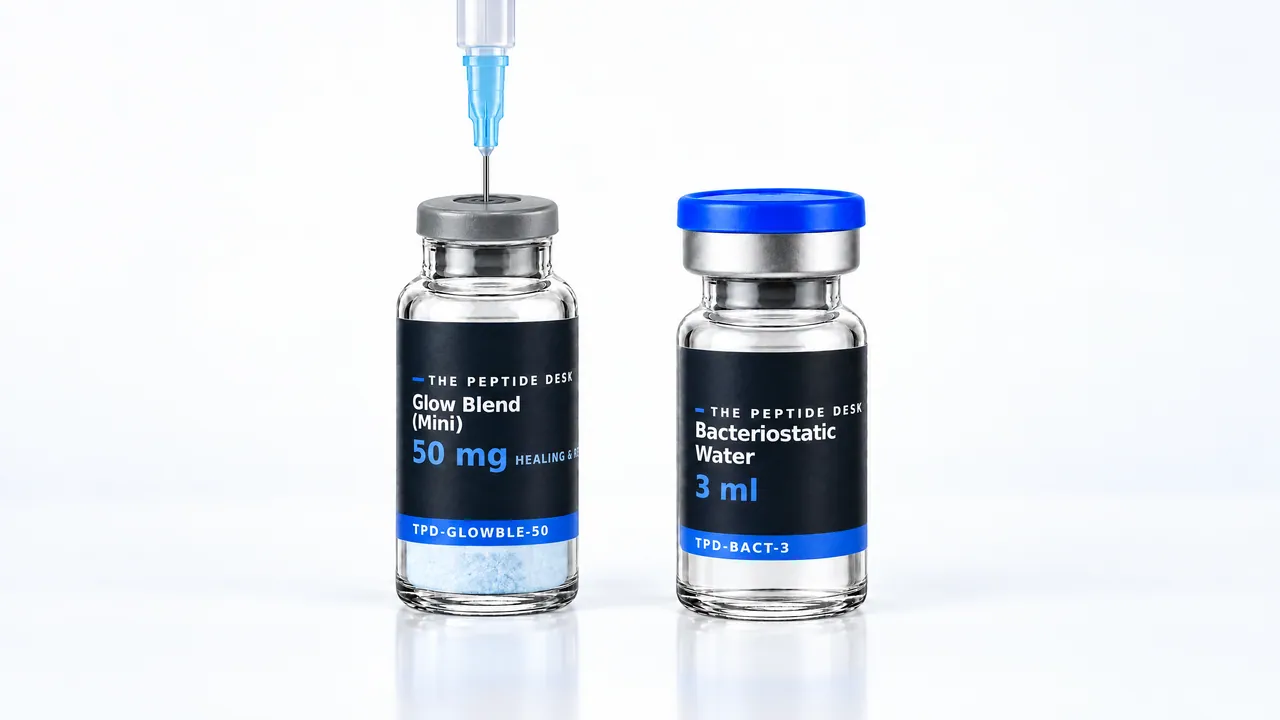
Step by step

Dissolving the powder

Four steps, the same for every vial size.

  1. 1Wipe the cap

    Clean the rubber stopper with an alcohol swab.

  2. 2Add BAC water

    Just add it, it does not matter if it hits the powder directly.

  3. 3Swirl or shake

    Until everything has dissolved, both are fine.

  4. 4Draw up

    With the U-100 insulin syringe.

Less water higher concentration fewer units on the syringe Example: 50 mg + 2 ml = 25 mg/ml

Dosing

Dosing

Dosing, titration and syringe

Loading the dosing information …

  • Getting started and stepping up, drawn as a staircase
  • Units on the U-100 syringe for every step
  • How long one vial lasts

Injection

The injection is subcutaneous, into the fat layer under the skin. Common spots are the abdomen (keep about two finger-widths clear of the navel), the front and the inner side of the thigh, or the back of the upper arm.

The short version:

Injection

Where and at what angle

Pick a spot or switch the angle. Subcutaneous means: into the fat layer, not the muscle.

Rotate the spot each time, never the same one twice in a row.

90°More fat under the skin

Rule of thumb: where there is more fat under the skin, insert straight at 90 degrees. In lean people with little fat, 45 degrees, so the needle stays in the fat layer. Simplified diagram.

  1. Clean the spot with an alcohol swab and let it dry

  2. Pinch up a small fold of skin

  3. Insert the needle: at 90 degrees where there is more fat under the skin, at 45 degrees in lean people with little fat

  4. Inject slowly, wait a moment, then withdraw

  5. Put the needle straight into the sharps container

Rotate the site each time so the tissue does not get irritated. Never the same spot twice in a row.

What the research shows

The components are individually well described preclinically (thymosin beta-4: Crockford, 2010). For the fixed combination in humans there are no controlled studies, the benefit derives from the complementary mechanisms.

Study results

What the trials measured

Interactive: switch tabs, tap points, show or hide arms. Arms are named relative to each other, no dosing advice.

Wound healing in rats with thymosin beta-45

More skin closure or wound contraction versus the saline control

Skin closure at day 45
Thymosin beta-4 (rat) +42%
Skin closure at day 75 up to this value
Thymosin beta-4 (rat) +61%
Wound contraction at day 75 at least this value
Thymosin beta-4 (rat) +11%

Thymosin beta-4 was applied to the wound or into the abdominal cavity. TB-500 is derived from it. These values are not shown for TB-500 alone or for the blend.

Wound closure in diabetic foot ulcers7

Median closed wound area, randomised trial with GHK-Cu gel

All ulcers on the sole of the foot7
Vehicle gel without active substance +60.8%
GHK-Cu gel +98.5%
Large ulcers (over 100 mm²)7 On vehicle gel the ulcer grew at the median
Vehicle gel without active substance -10.3%
GHK-Cu gel +89.2%

Only GHK-Cu as a gel on the skin, without BPC-157 and TB-500 and not as an injection.

Where the knowledge on BPC-157 comes from4

Share of the 36 studies in a systematic review (literature up to June 2024)

Systematic review4 35 preclinical, 1 clinical study
Animal and cell studies 97.2%
Human studies 2.8%

The only clinical paper in the review was a retrospective analysis of 12 people. The authors found no clinical safety data.
Stainless steel incubator with Petri dishes, a layered tissue sample and a fine mesh tissue in front
The data come from studies on single components. Symbolic image.

Research status

Where the research stands

There is no study on the blend itself. Shown are registered trials on single components: thymosin beta-4 into a vein and a skin serum with GHK-Cu. The BPC-157 trials in the registry have not started yet or have an unknown status. As of 26 Oct 2026. 10

  1. Preclinical Animal and cell studies on each component
  2. Phase 1 3 trials on components, 2 completed
  3. Phase 2 2 trials on components, 2 completed
  4. Phase 3 no registered trial
  5. Approval not yet
Not approved, neither the blend nor any component. ChEMBL lists BPC-157 with phase 1, thymosin beta-4 with phase 3 (as eye drops) and GHK without a clinical phase.13
Show all 2 phase 2 trials on a timelineHide timeline 2 completed 0 running 0 with results
Phase 2

Bar: start to primary endpoint (planned for running trials). Green = completed, blue = progress until 26 Oct 2026. Phase 1: 3 trials on safety and pharmacokinetics, not shown as bars.

On the skin

Two components have also been studied applied directly. In humans GHK-Cu was used as a gel on foot ulcers in diabetes; the wounds closed better than with a gel without active ingredient (Mulder 1994). Thymosin beta-4, the model for TB-500, sped up wound closure in rats as a solution put on the wound (Malinda 1999). Applying the blend itself to the skin has not been studied.
Hand touching a swirl of white cream on a light marble slab with water droplets and white flowers
Symbolic image.

Side effects

  • Generally well tolerated, mainly local reactions at the injection site.
  • Solid long-term human data are missing.

Storage

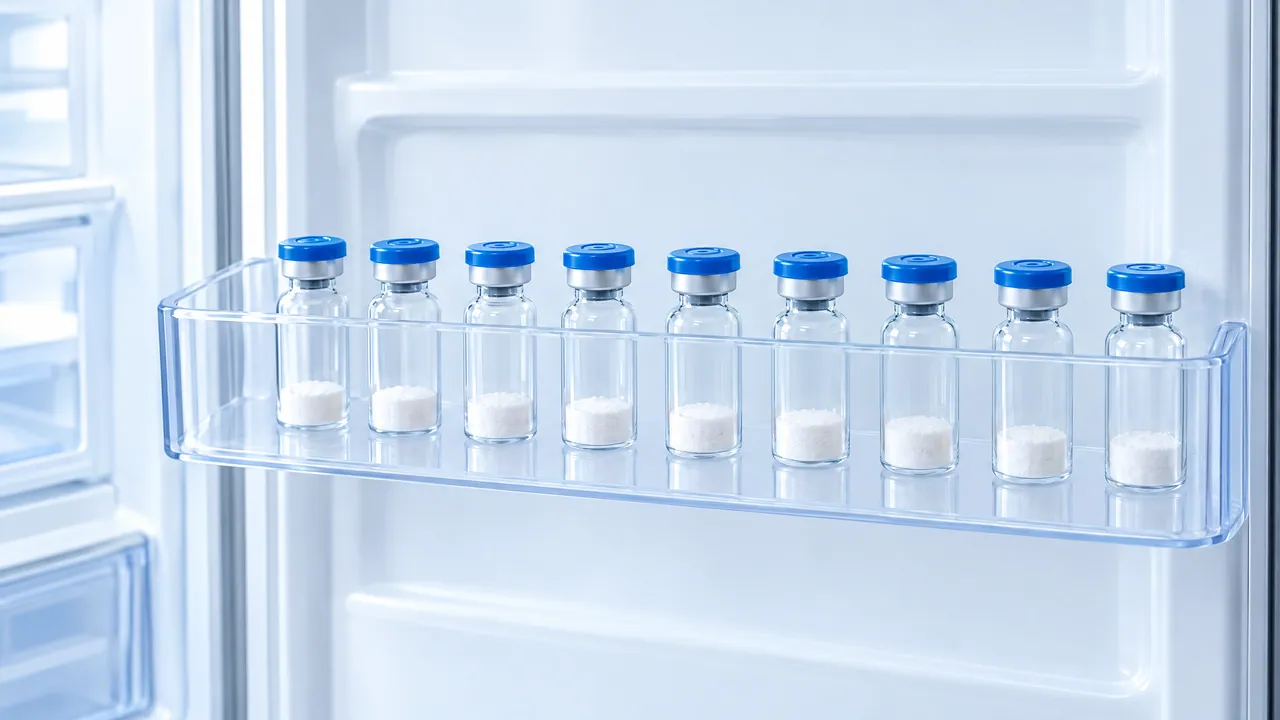
Before mixing the powder is robust, normal room temperature (around 20 to 25 degrees) is fine, ideally kept in the dark. After mixing, keep in the fridge (2 to 8 degrees), do not freeze. It stays good there for at least 4 to 6 months with barely any loss of potency, in practice considerably longer. Swirl or shake to mix, both are fine.

Shelf life

How long it keeps

Undissolved (powder) Room temperature, around 20 to 25 degrees, dark

Robust, no fridge needed. Best kept in the dark.

Dissolved (mixed) Fridge, 2 to 8 degrees, do not freeze

At least 4 to 6 months with barely any loss of potency.

  • Keep it dark
  • Dissolved: 2 to 8 degrees
  • Note the mixing date on the vial
Nine vials with white powder and blue caps in the door shelf of a bright fridge
Powder dark at room temperature, once dissolved into the fridge (2 to 8 degrees), stable there for at least 4 to 6 months. Symbolic image.

Related

Related compounds

Same compounds: all in the TPD lexicon.

FAQ

Common questions about Glow Blend (Mini)

Short answers, each backed by the sources below.

Are there studies on the Glow Blend?

No. As of 26 October 2026 there is no study on the ready-made blend, neither on ClinicalTrials.gov nor in PubMed. All three compounds together only appear in reviews. The components have been studied, almost always each on its own.1112

What is the difference from the large Glow Blend?

It is the same mix of BPC-157, TB-500 and GHK-Cu, just in a smaller vial. The evidence is identical for both, since only the single components have been studied.11

Is the combination stronger than the single compounds?

That has not been studied. In the only study with two of the three components (tendon healing in rats), BPC-157 plus TB-500 gave no advantage over either compound alone. The authors suspect that both act on shared pathways. There are no data on GHK-Cu in combination.2

How well has BPC-157 been studied in humans?

Barely. A systematic review found 36 studies: 35 in animals or cells and one retrospective analysis of 12 people with knee pain. A second review from 2026 counted three small human studies with 30 people in total and rated the evidence as very low.43

Is TB-500 the same as thymosin beta-4?

Not quite. TB-500 is described as a fragment of thymosin beta-4. The studies, including the wound healing in rats and the phase 1 trial into a vein, used full thymosin beta-4. We found no study with TB-500 itself.956

Which side effects are known?

There are no data for the blend. The three small BPC-157 human studies reported no treatment-related side effects. Thymosin beta-4 was well tolerated in a phase 1 trial into a vein. Solid long-term data are missing for all three. Reviews also warn about contamination from unregulated manufacturing.3649

Is the Glow Blend approved?

No. Neither the blend nor any of the three components is approved as a medicine (as of October 2026). The least studied are BPC-157 (phase 1 as the highest phase in ChEMBL) and GHK-Cu (only an early phase 1 trial in the registry), which is why phase 1 is shown as the stage here.1310

Glossary

Terms explained briefly

Dotted words in the text open these explanations directly.

Blend
Several compounds ready-mixed in one vial. The proportions are fixed and cannot be adjusted individually.
BPC-157
Synthetic peptide of 15 amino acids, derived from a protective protein in gastric juice. Studied almost only in animals.
Cell migration
Movement of cells to the site of an injury, an early step of wound healing.
Collagen
Main structural protein of skin, tendons and connective tissue.
GHK-Cu
Tripeptide of glycine, histidine and lysine with bound copper. Found in the blood, the level falls with age.
Lyophilisate
Freeze-dried powder. Without water a peptide keeps much longer.
Preclinical
Studied in cells or animals, not yet in humans.
Subcutaneous
Into the fat layer just under the skin.
Systematic review
Overview that searches and rates all studies on a question by fixed rules.
TB-500
Peptide derived from thymosin beta-4. Thymosin beta-4 binds actin and plays a role in cell migration and repair.
Vehicle gel
The same gel without the active substance. Comparing against it shows what is due to the substance itself.

Evidence

Sources

Show all 13 sourcesHide sources 8 Studies2 Trial registry3 Database checked 26 Oct 2026

Studies

  1. BPC-157, TB-500 and both combined in tendon healing (rat)

    Biçer et al., Joint Diseases and Related Surgery, 2026

    Checked 26 Oct 2026 via doi.org, Crossref, PubMed
  2. Systematic review of all human studies on BPC-157

    Poolton et al., Acta Orthopaedica Belgica, 2026

    Checked 26 Oct 2026 via doi.org, Crossref, PubMed
  3. Systematic review of BPC-157 in orthopaedic sports medicine

    Vasireddi et al., HSS Journal, 2025

    Checked 26 Oct 2026 via doi.org, Crossref, PubMed
  4. Thymosin beta-4 accelerates wound healing (rat)

    Malinda et al., Journal of Investigative Dermatology, 1999

    Checked 26 Oct 2026 via doi.org, Crossref, PubMed
  5. Phase 1 trial of intravenous thymosin beta-4 in healthy adults

    Ruff et al., Annals of the New York Academy of Sciences, 2010

    Checked 26 Oct 2026 via doi.org, Crossref, PubMed
  6. Randomised trial of GHK-Cu gel in diabetic foot ulcers

    Mulder et al., Wound Repair and Regeneration, 1994

    Checked 26 Oct 2026 via doi.org, Crossref, PubMed
  7. Review of GHK in skin regeneration

    Pickart et al., BioMed Research International, 2015

    Checked 26 Oct 2026 via doi.org, Crossref, PubMed
  8. Review of safety and efficacy of peptides in sports medicine

    Mendias & Awan, Sports Medicine, 2026

    Checked 26 Oct 2026 via doi.org, Crossref, PubMed

Trial registry

  1. Trials on the components on ClinicalTrials.gov

    ClinicalTrials.gov, U.S. National Library of Medicine

    Checked 26 Oct 2026 via ClinicalTrials.gov API v2
  2. Registry search for the blend (0 results)

    ClinicalTrials.gov, U.S. National Library of Medicine

    Checked 26 Oct 2026 via ClinicalTrials.gov API v2

Database

  1. Review of the structure and function of thymosin beta-4 (PubMed record)

    Crockford et al., Annals of the New York Academy of Sciences, 2010 (DOI 10.1111/j.1749-6632.2010.05492.x)

    Checked 26 Oct 2026 via PubMed, Crossref, doi.org
  2. PubMed search for all three compounds (reviews only)

    PubMed, U.S. National Library of Medicine

    Checked 26 Oct 2026 via PubMed E-utilities
  3. BPC-157, thymosin beta-4 and GHK in ChEMBL

    ChEMBL, EMBL-EBI (CHEMBL4297358, CHEMBL4594314, CHEMBL1814493)

    Checked 26 Oct 2026 via ChEMBL

In the shop

Glow Blend (Mini) in the catalog

Sizes, prices and shipping times are on the product page.

To the product