Description
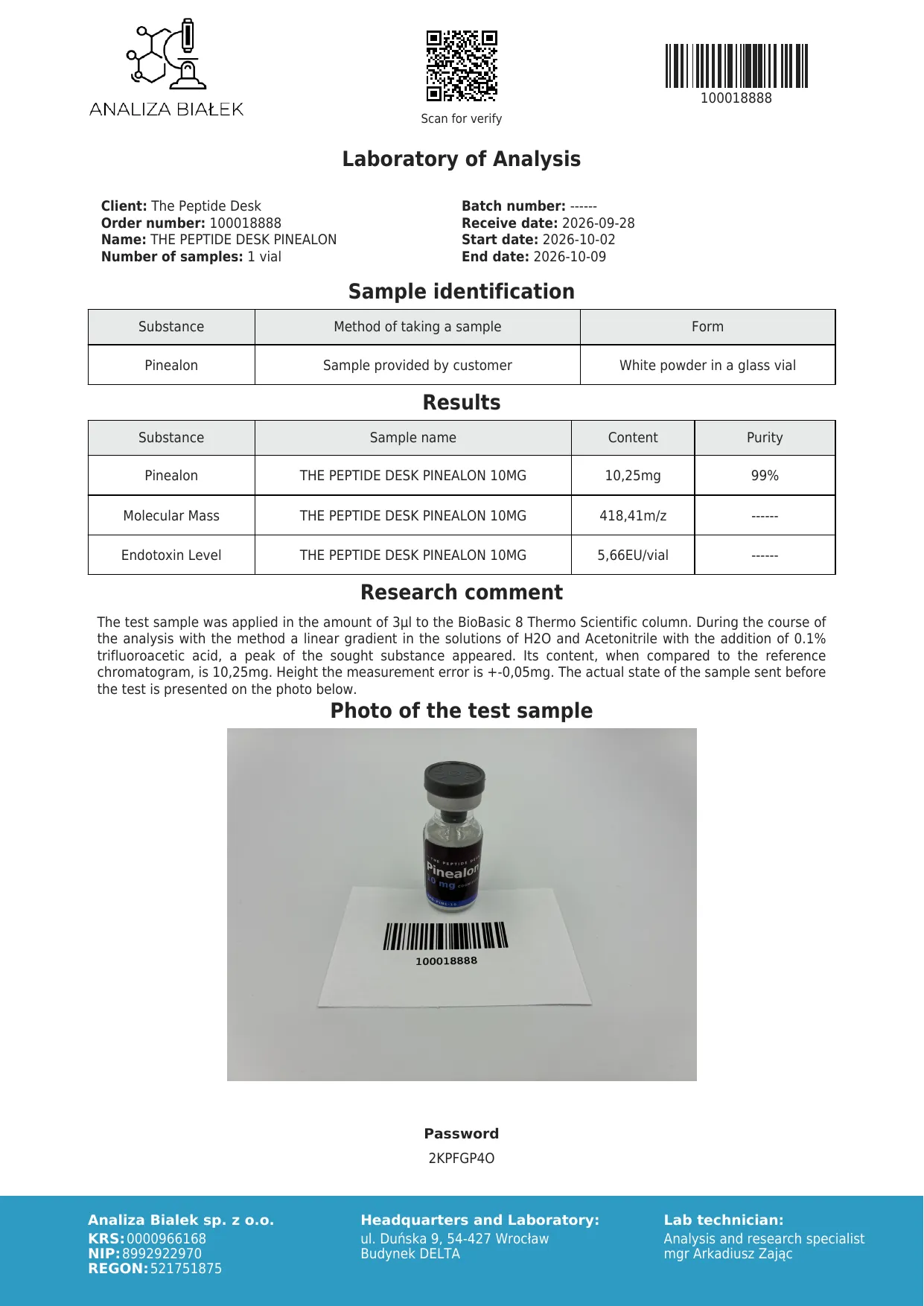
Pinealon is a synthetic tripeptide with the amino acid sequence Glu-Asp-Arg (glutamine-aspartate-arginine), developed within the Khavinson program at the St. Petersburg Institute of Bioregulation and Gerontology. Vladimir Khavinson and his team have characterized a family of short peptides over several decades that show tissue-specific effects in preclinical studies. Pinealon is one of the best-known members of this tripeptide family, with focus on neuronal function.
In research context, pinealon is associated with the pineal gland axis and neuronal plasticity pathways. The central research hypothesis in Khavinson literature: short peptides can enter the cell nucleus, bind to specific DNA sequences and modulate gene expression patterns. This epigenetic mechanism hypothesis is controversial in international research but has a substantial data base in Russian and Eastern European preclinical studies.
Observed research effects include modulation of antioxidative pathways, reduction of oxidative stress in neuronal cell cultures and effects on behavior in animal models. In aging models, pinealon has been associated with extended anagen phase of neuronal cells and reduced age-related neuronal apoptosis.
Pinealon is offered in our portfolio in the extended Innopeptide variant, with higher active substance concentration than the original standard form.
Pinealon is available in 50mg vials as 10-vial packs.
This information is for research and educational purposes only. No medical recommendations.
Risks & Safety
Pinealon is considered very well tolerated per study reports. Like other short Khavinson peptides, the compound is described as remarkably low in side effects across the available preclinical literature.
Observed in research and user reports:
- Injection site: mild redness or pressure at the injection site is the most common observation, typical for subcutaneously applied peptides.
- Very mild profile: Khavinson tripeptides are described in animal models without significant toxic effects, even at high dosages.
- Controversial mechanism: the epigenetic mechanism hypothesis (short peptides binding to DNA sequences) is controversial in international research, which complicates assessment of the biological effects.
- Data base and long-term data: the evidence comes predominantly from Russian and Eastern European preclinical studies. Robust long-term human data are largely lacking.
This classification does not replace medical advice. Risk and responsibility for any actual use lie entirely with the buyer.
Studies
- Pinealon increases cell viability by suppression of free radical levels and activating proliferative processes - Rejuvenation Research 2011: Cell study: pinealon dose-dependently limited the accumulation of reactive oxygen species in cerebellar granule cells, neutrophils and PC12 cells under oxidative stress and reduced necrotic cell death.
- EDR Peptide: Possible Mechanism of Gene Expression and Protein Synthesis Regulation Involved in the Pathogenesis of Alzheimer’s Disease - Molecules 2020: Review by the Khavinson group on the EDR peptide: describes effects on gene expression, antioxidant enzymes and the preservation of dendritic spines in cell and animal models and discusses histone binding as a possible mechanism.
- Short Peptides Protect Fibroblast-Derived Induced Neurons from Age-Related Changes - International Journal of Molecular Sciences 2024: In induced neurons derived from fibroblasts of elderly donors, the short peptides EDR, KED and AEDG promoted arborization of the dendritic tree, EDR additionally reduced oxidative DNA damage, while mitochondrial activity and p16 were unchanged.