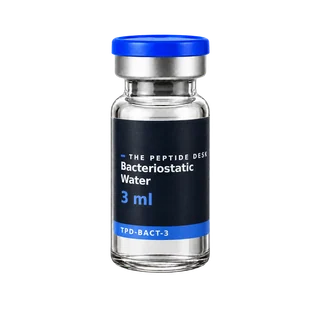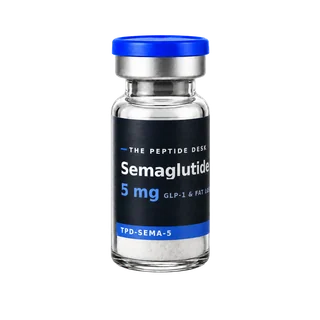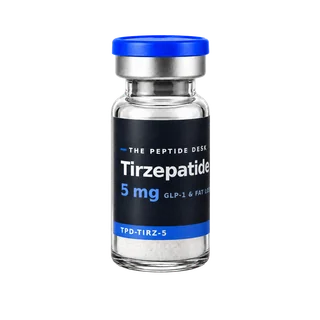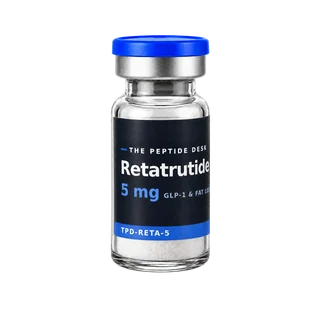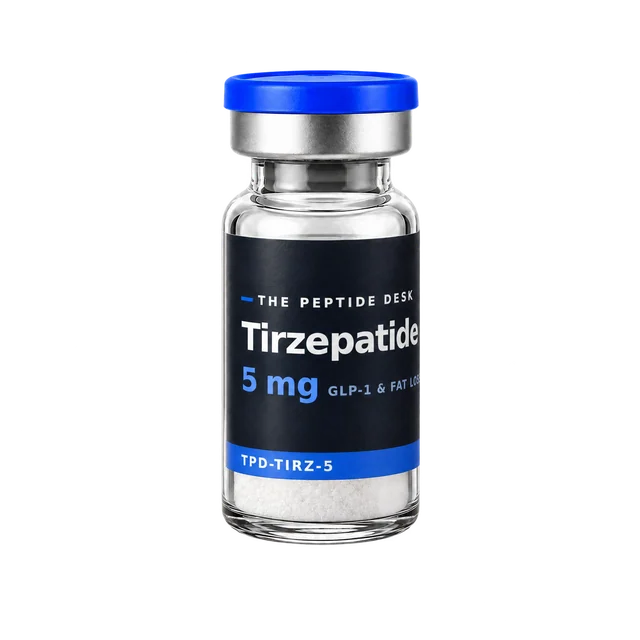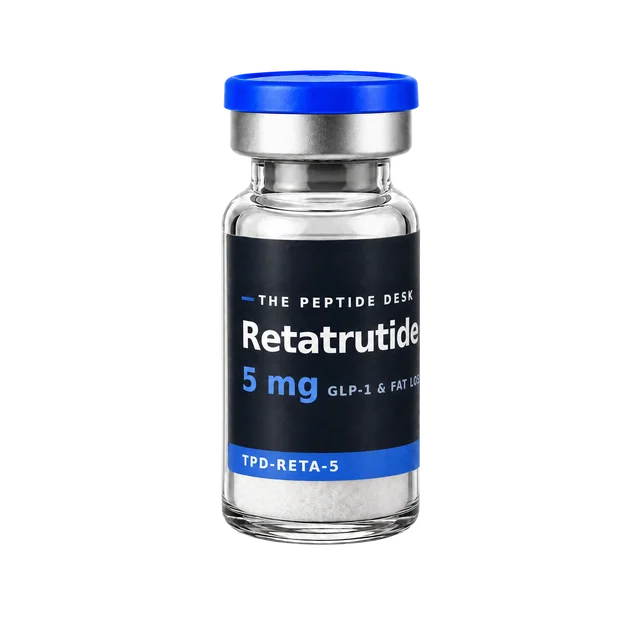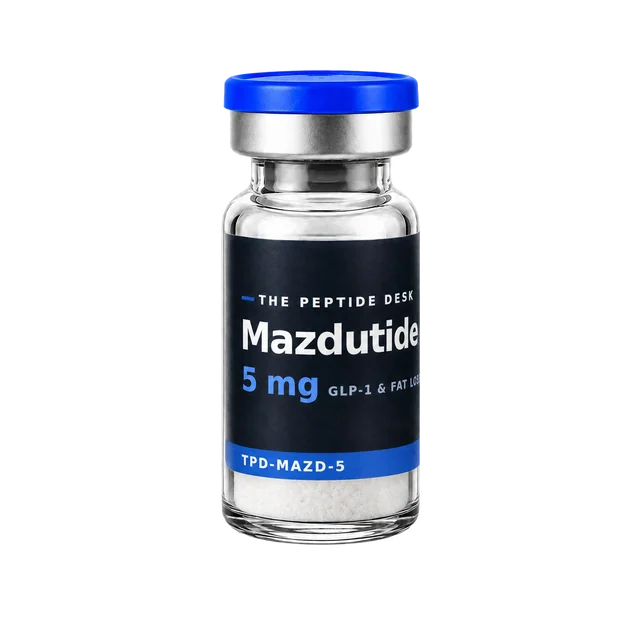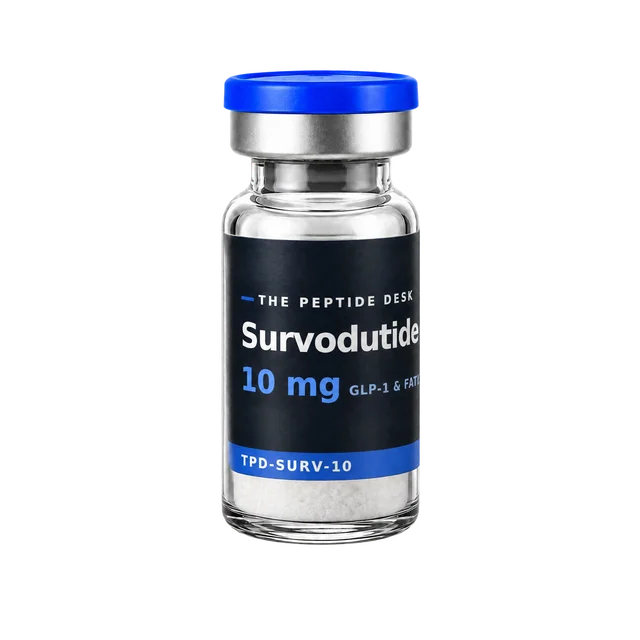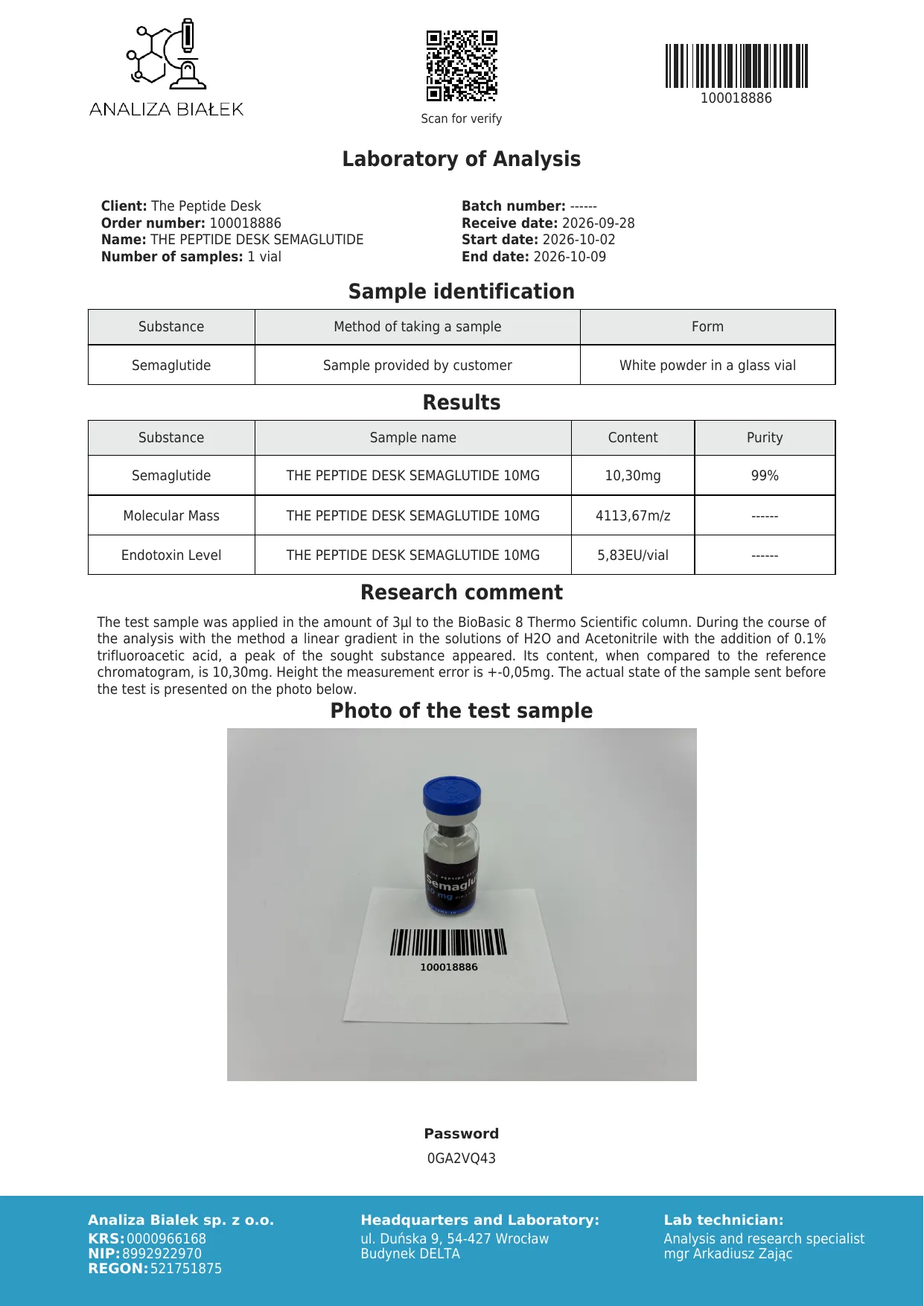
Semaglutide, product photo

Lab report

PDF
99%
Purity
Tested
Semaglutide 10mg
Lab
Analiza Białek
Date
October 2026
Result
99% purity (10.30 mg measured)
Endotoxins
5.83 EU/vial
Order no.
Password

Tested independently, verifiable with the password directly at the lab.

GLP-1

Semaglutide

The GLP-1 classic. Mono-agonist with the broadest clinical data base in metabolic research.

Order

Unit price -
  • DHL with tracking
  • Discreet packaging

Also searched as: Semaglutid · Sema

Also available as tablet: Semaglutide Oral →
At a glance

Semaglutide by the numbers

The key figures from our lexicon. Drag the point along the curve to see how much is left after one dose, by calculation.

Full lexicon entry

How long does it stay in the body?

Share left after one dose, calculated with a half-life of ~7 days

Half-life ~7 days
After 14 days: 25 %
Day 7 · 50 %Day 14 · 25 %Day 21 · 12.5 %Day 35 · 3.1 %

Simplified model without an absorption phase, half-life from the TPD lexicon.

Class
GLP-1 agonist

single

Half-life
~7 days
Frequency
Once weekly

subcutaneous

Form
Lyophilised powder

reconstituted with BAC water

Sizes
5 to 50 mg

6 sizes in the shop

What studies show

  1. ~15 %

    Phase 3 study in obesity (STEP 1, ~15% weight reduction at 68 weeks) (opens in a new tab)Wilding et al., New England Journal of Medicine, 2021

  2. 2

    Cardiovascular study in obesity without diabetes (SELECT) (opens in a new tab)Lincoff et al., New England Journal of Medicine, 2023

  3. 3

    Cardiovascular study in type 2 diabetes (SUSTAIN-6) (opens in a new tab)Marso et al., New England Journal of Medicine, 2016

All 5 sources in the lexicon

For research and educational purposes only. Values from the TPD lexicon, sources linked there.

Knowledge

Everything about Semaglutide

Description

Semaglutide is a GLP-1 receptor agonist and the most extensively studied compound in the GLP-1 family. Structurally it is a modified human GLP-1 analog with a fatty acid side chain that improves albumin binding and extends the half-life to approximately 7 days. This property makes it the reference compound for weekly application frequencies in research settings.

In research models, semaglutide activates the GLP-1 receptor in pancreatic beta cells, in the brain and in the gastrointestinal tract. Central mechanisms include delayed gastric emptying, enhanced satiety signaling in the hypothalamus and glucose-dependent insulin secretion. The large STEP trials documented average body weight reduction of approximately 15 percent over 68 weeks at highest dose.

Compared to dual or triple agonists in the family (tirzepatide, retatrutide), semaglutide acts on a single receptor. This makes it a clean research tool when the GLP-1 pathway is to be studied in isolation, without confounding through GIP or glucagon activation.

In research setups, semaglutide is typically started at low concentrations and increased weekly to minimize nausea effects. The half-life allows once-weekly application with consistent plasma levels.

Semaglutide is available in 5mg and 10mg vials, each as 10-vial packs.

This information is for research and educational purposes only. No medical recommendations.

Risks & Safety

Semaglutide is the most extensively studied compound in the GLP-1 family and is considered generally well tolerated per study reports. As a pure GLP-1 agonist the documented profile is clearly defined and dominated by gastrointestinal effects.

Observed in studies and user reports:

  • Gastrointestinal effects: nausea, vomiting, diarrhea and constipation are the most commonly documented observations, particularly at the start and during the titration phase. In the STEP trials these are markedly reduced by slow titration.
  • Appetite and fluids: the reduced appetite can lead to decreased food and fluid intake. The literature describes an elevated risk of dehydration.
  • Muscle mass: weight loss in studies involves a portion of muscle mass alongside fat mass.
  • Gallbladder and injection site: gallbladder issues during rapid weight loss as well as mild irritation at the injection site are documented.
  • Long-term data: despite the broad clinical data base, data on use beyond very long periods are lacking.

This classification does not replace medical advice. Risk and responsibility for any actual use lie entirely with the buyer.

Studies

Good to have

What you need with it

Bacteriostatic water is added to your cart automatically. Syringes and swabs with one click.

automatic

Bacteriostatic water

Matched to your amount, price in the cart.

Insulin Syringes

10 pcs · 5.50 €

Alcohol Swabs

50 pcs · 10 €

How much water?

Units on the syringe for your vial size.

Open calculator →

FAQ

Frequently asked

Sources for every answer: lexicon entry

Still have a question?

Write to us, our team will help you.

Is Semaglutide approved?

Yes. ChEMBL lists Semaglutide with phase 4 as the highest phase and a first approval in 2017. As an injection it is given once a week, there is also a tablet (separate entry). The information here describes the state of research and is not a recommendation for use.

How does Semaglutide differ from Tirzepatide and Retatrutide?

The number of receptors. Semaglutide acts only on the GLP-1 receptor, Tirzepatide also on GIP, Retatrutide additionally on the glucagon receptor. In return Semaglutide has the longest series of trials in the group, with large outcome trials on heart, kidney and liver.

What did the weight trials show?

In STEP 1 weight fell by 14.9 percent on average after 68 weeks, by 2.4 percent on placebo. Half of the participants lost at least 15 percent. In STEP 4 those who switched to placebo after 20 weeks regained weight: 6.9 percent by week 68, while the other group lost a further 7.9 percent.

What is known about heart, kidney and liver?

In SELECT (cardiovascular disease, overweight without diabetes) there were 6.5 versus 8.0 percent major cardiovascular events. In FLOW (type 2 diabetes with kidney disease) the risk of major kidney events was 24 percent lower. In ESSENCE MASH resolved after 72 weeks in 62.9 percent, in 34.3 percent on placebo.

How high were the doses in trials?

The highest study dose was 16 mg per week in a phase 2 trial in type 2 diabetes. Compared with the lowest dose there, blood sugar fell barely more, weight somewhat more, but there were more side effects and discontinuations. In STEP UP a higher dose also brought more weight loss and more complaints. The entry describes the opposite as a principle: start low and only increase until an effect is noticeable. This is not a dosing recommendation.

Which side effects were seen?

Most often nausea and diarrhoea, mostly transient and mild to moderate. In STEP 1 4.5 percent stopped because of gastrointestinal effects, 0.8 percent on placebo. In SUSTAIN-6 complications of the retina occurred more often in type 2 diabetes. With the higher dose from STEP UP altered skin sensations were more common.

How long does Semaglutide stay in the body?

According to the label the half-life is about one week, Semaglutide is still in the blood for about five weeks after the last dose. More than 99 percent is bound to the blood protein albumin. A steady level is reached after four to five weeks of weekly dosing.

Comparisons

How it compares

Related

Related products