Description
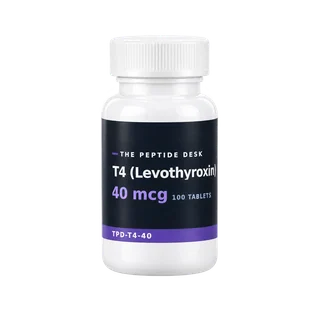
T4 (Levothyroxine, Thyroxine) is the main storage hormone of the thyroid. In physiologic metabolism T4 is converted to active T3 via peripherally-expressed deiodinases (DIO1, DIO2). This conversion happens cellularly and tissue-specifically - skeletal muscle, adipose tissue and liver have different conversion rates.
Per study reports T4 offers a milder activity profile than direct T3. Effects on BMR, lipolysis and proteolysis are the same, but plasma peaks are smoother because activation is buffered via conversion. T4 half-life at about 7 days is substantially longer than T3 (2.5 days) - steady-state is established only after 4-6 weeks.
In cutting research T4 is used less than T3 because direct action is milder and onset slower. The main use case is TRT-like replacement therapy after longer T3 suppression of the endogenous thyroid axis: T4 allows gentle restart of conversion mechanisms.
Pharmacokinetically orally bioavailable with good bioavailability. Important: T4 absorption is inhibited by calcium, iron and some antacids - take fasting and at least 30 min before other supplements.
Known effects are similar to T3 but milder and slower onset: tachycardia, tremor, sweating, sleep disturbances. TSH axis suppression with longer use is documented.
You can order T4 as oral tablets in bottles with 40, 100 or 200 mcg per tablet.
This information is for research and educational purposes only. No medical recommendations.
Risks & Safety
T4 sits in the mid range of the risk scale - milder than direct T3, but as a thyroid hormone the compound still intervenes in a central endocrine axis.
Documented in studies and the literature:
- Axis suppression: as with T3, suppression of the TSH axis with longer use is documented, though milder because activation is buffered via conversion.
- Slow onset: the long half-life means action reaches its full level only after weeks and likewise lingers for weeks after discontinuation.
- Cardiac effects: tachycardia and tremor are documented, but slower in onset and milder than under T3.
- Absorption interference: calcium, iron and some antacids inhibit uptake - described in the literature as a relevant source of fluctuating levels.
- Sleep disturbance: documented in studies as an accompanying effect of the metabolic acceleration.
Monitoring via bloodwork is recommended. This classification does not replace medical advice. Risk and responsibility for any actual use lie entirely with the buyer.
Studies
- Guidelines for the Treatment of Hypothyroidism: Prepared by the American Thyroid Association Task Force on Thyroid Hormone Replacement - Thyroid 2014, Jonklaas et al: comprehensive review of the goals, dosing and alternatives of levothyroxine therapy.
- Pharmacokinetics and Comparative Bioavailability of a Levothyroxine Sodium Oral Solution and Soft Capsule - Clinical Pharmacology in Drug Development 2018, Tanguay et al: pharmacokinetic study on absorption and bioavailability of different levothyroxine formulations.
- Thyroid Hormone Therapy for Older Adults with Subclinical Hypothyroidism - New England Journal of Medicine 2017, Stott et al: randomized placebo-controlled trial on T4 replacement in subclinical hypothyroidism.
- Thyroid Hormone Regulation of Metabolism - Physiological Reviews 2014, Mullur et al: comprehensive review of the mechanisms by which thyroid hormones govern basal metabolic rate and thermogenesis.