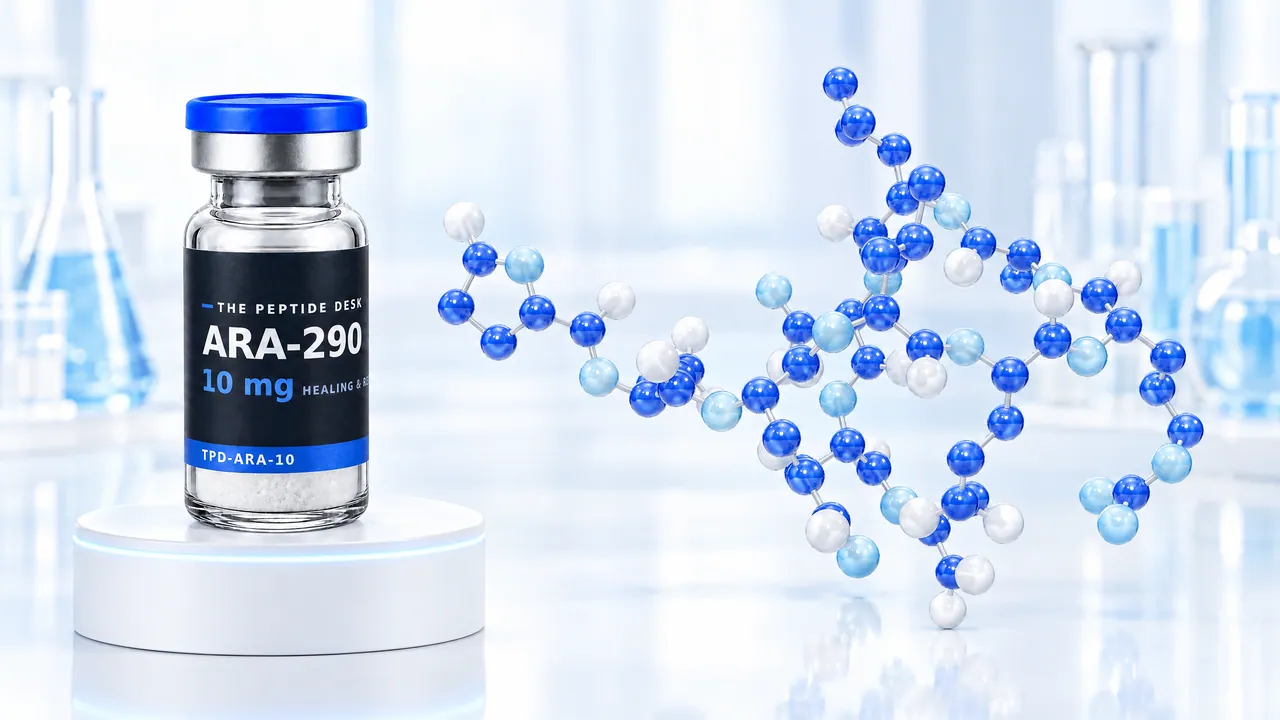
What is ARA-290?
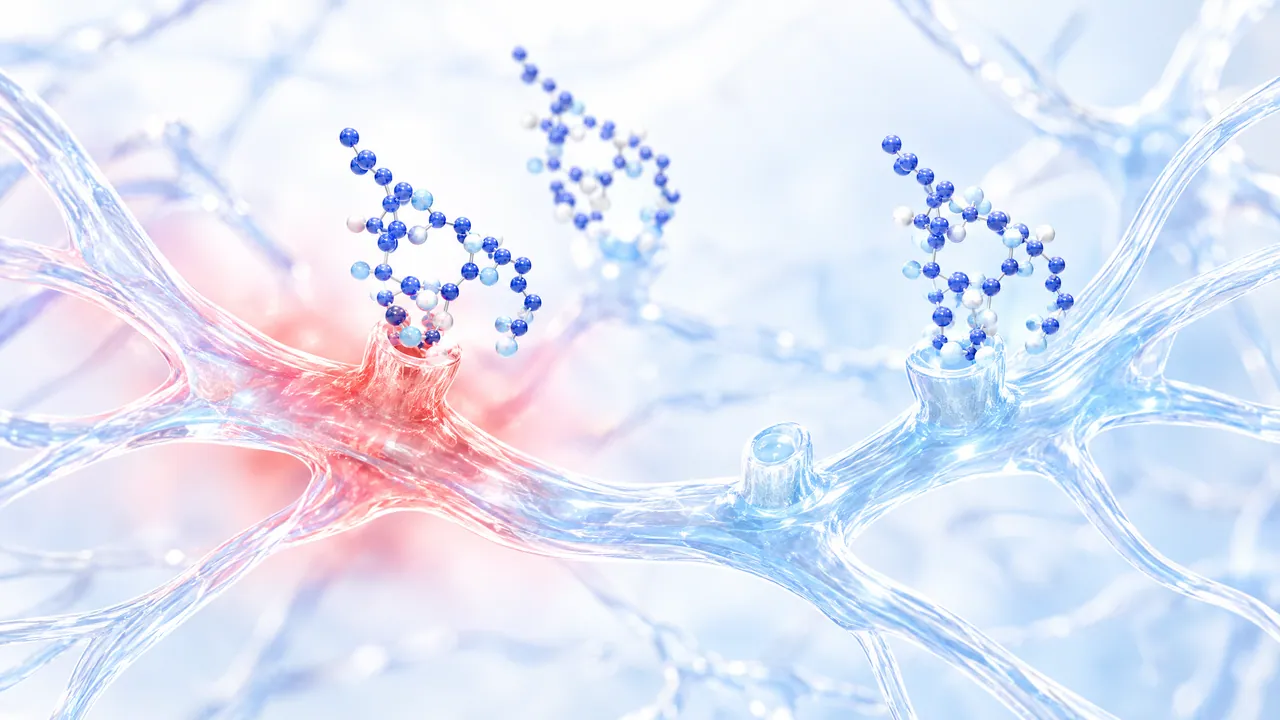
ARA-290 (cibinetide) is a small peptide derived from a part of the erythropoietin molecule, but deliberately without its blood-forming action. It activates the so-called innate repair receptor, which brakes inflammation and triggers tissue repair.
Comparison
Erythropoietin and its derivative
Compounds from the TPD lexicon, as described there. Tap a card to open its entry.
Simplified: EPO stimulates blood formation. ARA-290 was designed from the structure of EPO so that it does not. It acts through the innate repair receptor. 48
How it works
Via the innate repair receptor, ARA-290 acts anti-inflammatory and tissue-protective without raising red blood cells (unlike classic EPO). In research the focus is mainly on relieving nerve pain in small-fiber neuropathy.
Where it acts
Where ARA-290 acted in studies
Tap a point or a card. Colour = innate repair receptor, grey = observed.
- Eye (corneal nerves)
More nerve fibre area in the cornea in sarcoidosis (phase 2b)3
IRR - Skin (fine nerve fibres)
More regenerating nerve fibres in the skin at the middle study dose3
Observed in trials - Exercise capacity
Longer distance in the 6-minute walk test in sarcoidosis2
Observed in trials - Blood sugar and lipids
Better long-term blood sugar (HbA1c) and blood lipids in type 2 diabetes4
Observed in trials - Brain
Weaker brain response to happy faces, no effect on mood (healthy people)6
Observed in trials
Targets in the ChEMBL database8
Compound CHEMBL3545305 (Cibinetid): one recorded mechanism, Agonist according to ChEMBL.
- Gene
- EPOR, CSF2RB
- UniProt
- P19235, P32927
- ChEMBL
- CHEMBL4804252
- Action
- Agonist according to ChEMBL
What you need
Supplies
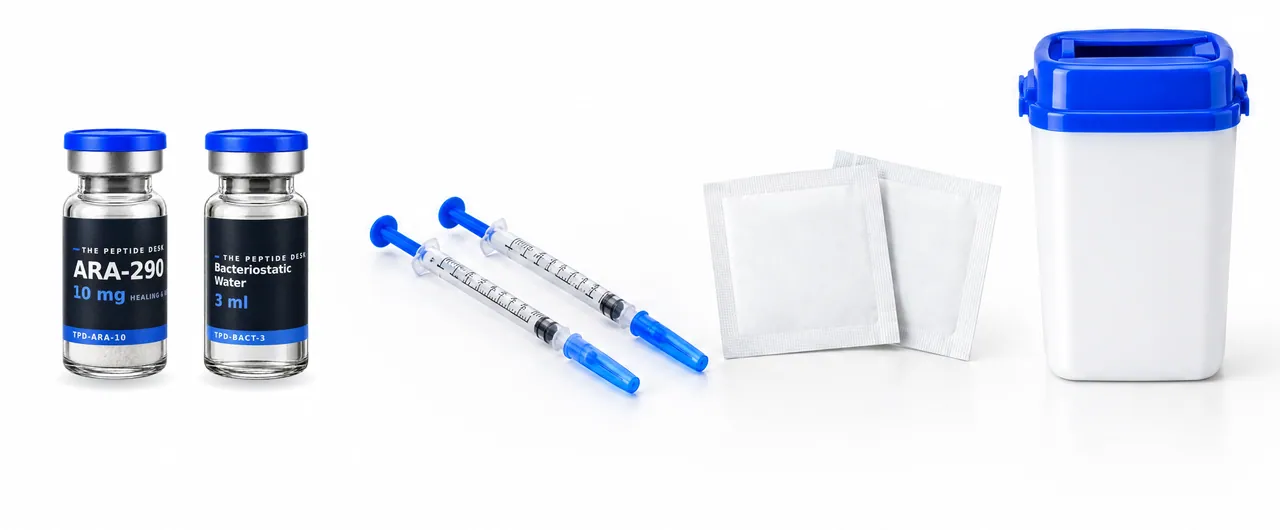
2 things, numbered as in the picture
Tick off what you already have. Vial and BAC water are our real shop photos at the same size.
-
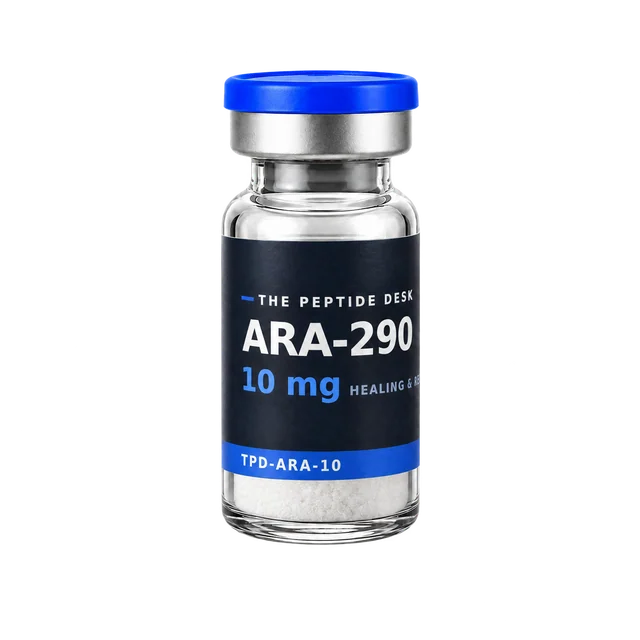
ARA-290 vial
The ARA-290 vial (lyophilized powder).
-
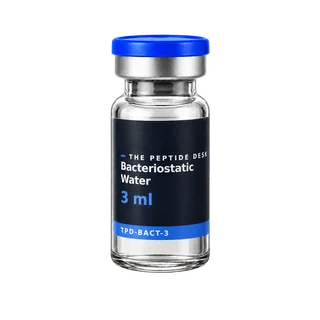
Water and supplies
Bacteriostatic water, U-100 insulin syringes, alcohol swabs.
Reconstitution
Use the peptide calculator. A 4mg vial with 2ml water gives 2mg per ml, 2mg is then 100 units on the U-100 syringe. Just add the water to the vial and let it dissolve.
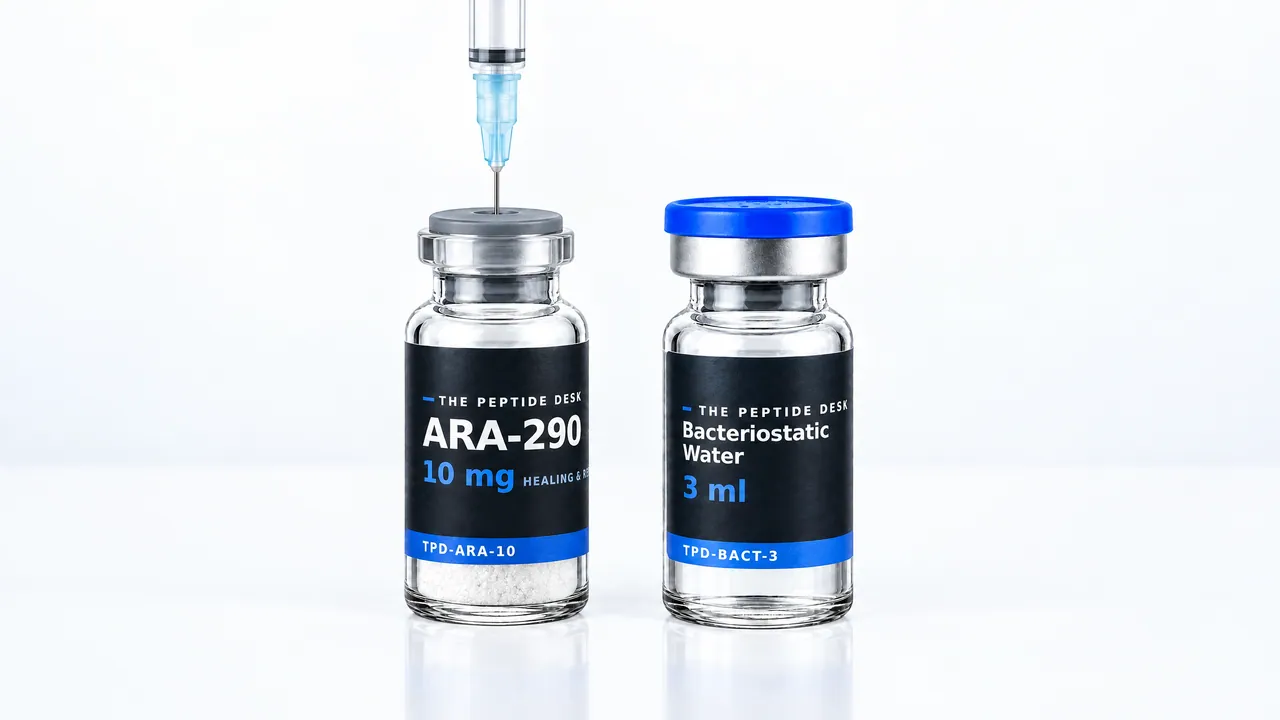
Step by step
Dissolving the powder
Four steps, the same for every vial size.
- 1Wipe the cap
Clean the rubber stopper with an alcohol swab.
- 2Add BAC water
Just add it, it does not matter if it hits the powder directly.
- 3Swirl or shake
Until everything has dissolved, both are fine.
- 4Draw up
With the U-100 insulin syringe.
Dosing
Dosing
Dosing, titration and syringe
Loading the dosing information …
- Getting started and stepping up, drawn as a staircase
- Units on the U-100 syringe for every step
- How long one vial lasts
Injection
The injection is subcutaneous, into the fat layer under the skin. Common spots are the abdomen (keep about two finger-widths clear of the navel), the front and the inner side of the thigh, or the back of the upper arm.
The short version:
Injection
Where and at what angle
Pick a spot or switch the angle. Subcutaneous means: into the fat layer, not the muscle.
Rotate the spot each time, never the same one twice in a row.
Rule of thumb: where there is more fat under the skin, insert straight at 90 degrees. In lean people with little fat, 45 degrees, so the needle stays in the fat layer. Simplified diagram.
-
Clean the spot with an alcohol swab and let it dry
-
Pinch up a small fold of skin
-
Insert the needle: at 90 degrees where there is more fat under the skin, at 45 degrees in lean people with little fat
-
Inject slowly, wait a moment, then withdraw
-
Put the needle straight into the sharps container
Rotate the site each time so the tissue does not get irritated. Never the same spot twice in a row.
What the research shows
A randomized pilot study (Heij/Brines, 2012) gave sarcoidosis patients with small-fiber neuropathy 2mg ARA-290 three times a week and saw significant improvement in neuropathy symptoms and quality of life, with good tolerability. The data is promising but still at the pilot stage.
Study results
What the trials measured
Interactive: switch tabs, tap points, show or hide arms. Arms are named relative to each other, no dosing advice.
Small fibre symptoms in sarcoidosis1
Change in the questionnaire score (SFNSL) after 4 weeks, lower is better
Values from the abstract. In this pilot study ARA-290 was given three times a week as an infusion into a vein. Pain and fatigue improved equally in both groups, depression scores did not change.
Nerve fibres in the cornea3
Placebo-adjusted change in fibre area after 28 days
Values from the abstract, already adjusted for placebo. Only the middle study dose was significant, the ranges of the other two included zero. Regenerating nerve fibres in the skin also increased only at the middle dose.
Research status
Where the research stands
The registry lists four trials with ARA-290, all phase 2 or earlier. The first pilot studies in sarcoidosis (2012 and 2013) are not entered there. A trial in type 2 diabetes and prediabetes has no current status in the registry and is not shown here. As of 26 Oct 2026. 7
- Preclinical Animal models of nerve pain
- Phase 1 no registered trial
- Phase 2 3 trials, 2 completed, 1 stopped early
- Phase 3 no registered trial
- Approval not yet
Show all 3 phase 2 trials on a timelineHide timeline
CONEARA · NCT02070783 · 36 participants, started Feb 2012, primary endpoint reached Feb 2013.
Registry entry ↗ · Results: Cerit et al., European Neuropsychopharmacology, 2015
NCT02039687 · 64 participants, started Jan 2014, primary endpoint reached Jan 2015.
Registry entry ↗ · Results: Culver et al., Investigative Ophthalmology and Visual Science, 2017
ARA290DMO · NCT06626971 · 9 participants, started Apr 2016, stopped early May 2017.
Registry entry ↗ · Results: Lois et al., Journal of Clinical Medicine, 2020
Bar: start to primary endpoint (planned for running trials). Green = completed, blue = progress until 26 Oct 2026, grey = stopped early.
Side effects
- Well tolerated in the studies, unlike EPO without a rise in red blood cells.
- Local reactions at the injection site.
Storage
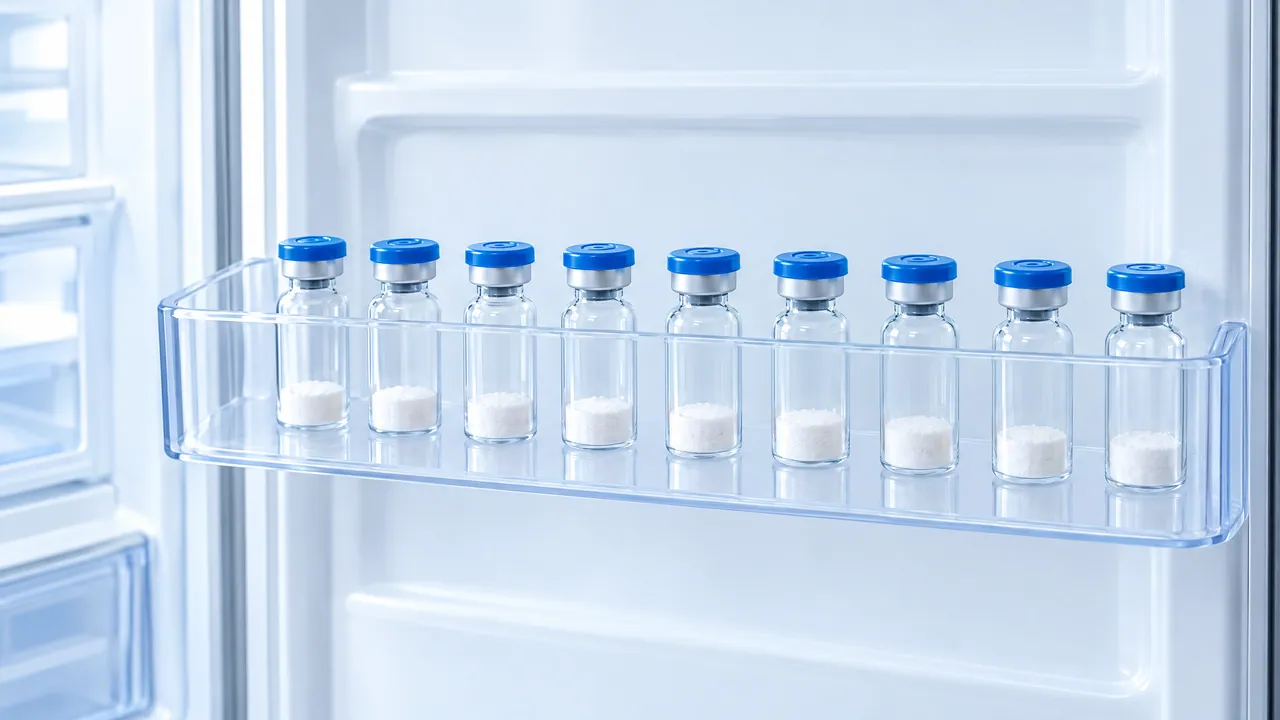
Before mixing the powder is robust, normal room temperature (around 20 to 25 degrees) is fine, ideally kept in the dark. After mixing, keep in the fridge (2 to 8 degrees), do not freeze. It stays good there for at least 4 to 6 months with barely any loss of potency, in practice considerably longer. Swirl or shake to mix, both are fine.
Shelf life
How long it keeps
Robust, no fridge needed. Best kept in the dark.
At least 4 to 6 months with barely any loss of potency. The bacteriostatic water brings a preservative.
- Keep it dark
- Dissolved: 2 to 8 degrees
- Note the mixing date on the vial