This information is for research and educational purposes only. No medical recommendations. Products are not approved for human use. For health questions, consult a doctor.

Lexicon

Teriparatide

The active piece of parathyroid hormone (PTH 1-34), a clinically established agent that stimulates bone formation.

2 min read 8 sources

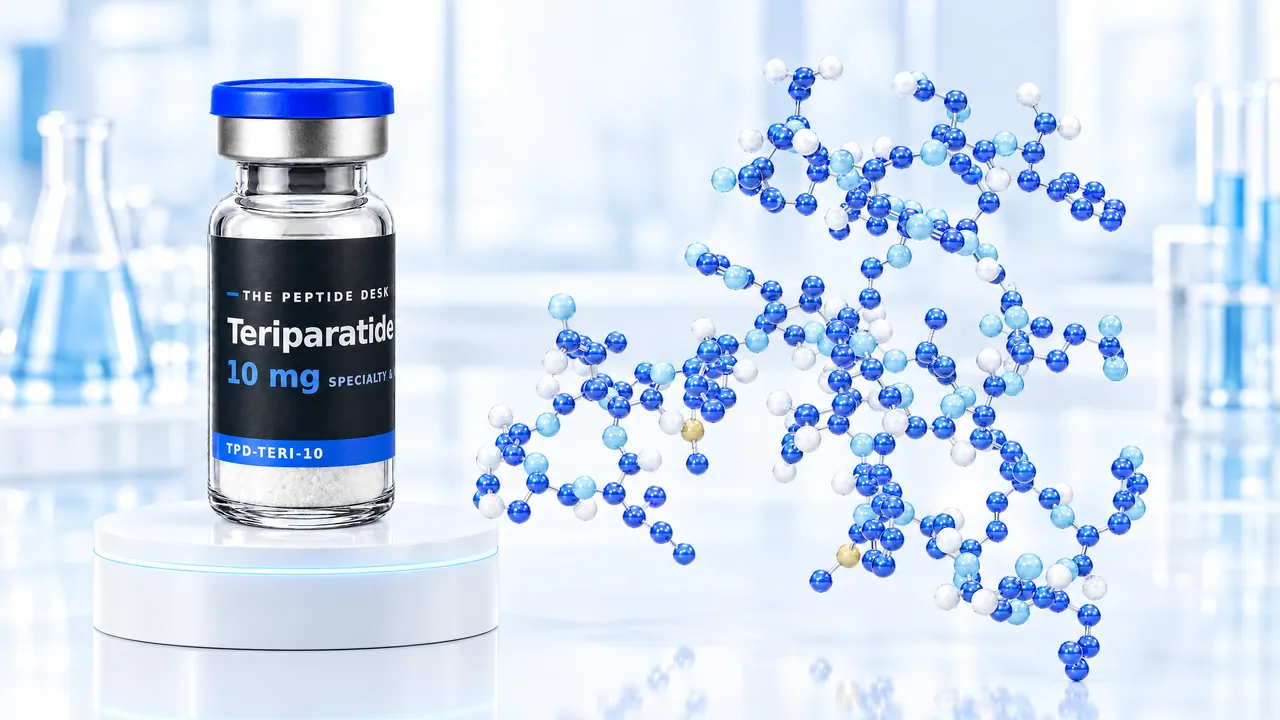
Teriparatide vial with white powder and the black TPD label on a white podium with a glowing ring, next to a large tangled molecule model of blue and white spheres
Compound approved · for osteoporosis since 2002

Summary

At a glance

Sources checked on 26 Oct 2026

New vertebral fractures
-65 %

standard dose against placebo, relative risk 0.35, 1,637 women1

Lumbar spine bone density
+9 pp

percentage points more than on placebo, standard dose1

Half-life
~1 hour

after injection under the skin, no longer measurable after 3 hours6

Bioavailability
~95 %

injected under the skin, peak after about 30 minutes6

  • Teriparatide is the first 34 amino acids of the body's own parathyroid hormone (PTH 1-34). It binds to the PTH1 receptor in bone and kidney.68
  • Timing is what matters: given briefly once a day it stimulates the bone-building cells more than the bone-resorbing ones. Permanently raised parathyroid hormone, by contrast, breaks bone down.6
  • In the approval trial with 1,637 postmenopausal women new vertebral fractures occurred in 5 instead of 14 percent. Lumbar spine bone density rose 9 percentage points more than on placebo.1
  • Against the bisphosphonate risedronate it halved new vertebral fractures in severe osteoporosis. The most common effects were nausea, dizziness, leg cramps and a brief rise in calcium.26
  • Teriparatide is approved for osteoporosis, usually for at most two years. Everything here is the state of research, not a recommendation.86
Profile

Updated May 2026

Class
Parathyroid hormone fragment

PTH 1-34

Use
Subcutaneous, daily

in mcg

Half-life
short
Status
Clinically approved

osteoporosis

Sizes
10 mg

1 size in the shop

Contents 15 sections
  1. At a glance
  2. What is Teriparatide?
  3. How it works
  4. What you need
  5. Reconstitution
  6. Dosing
  7. Injection
  8. What the research shows
  9. Research status
  10. Side effects
  11. Storage
  12. Related compounds
  13. FAQ
  14. Glossary
  15. Sources

Equipment

Equipment you need

For reconstitution and injection you need a bit of basic gear. Here are solid, cheap options:

As an Amazon associate we earn from qualifying purchases. Links open Amazon - no extra cost for you.

What is Teriparatide?

Teriparatide is the active piece of the body's own parathyroid hormone (the first 34 amino acids, hence PTH 1-34). It is clinically approved for treating osteoporosis and one of the few agents that actively builds bone rather than just slowing breakdown.

Comparison

Two paths to bone formation via PTH1R

Teriparatide next to abaloparatide, as stated in the TPD lexicon. Tap a card to open its entry.

PTH 1-34, bone formation Teriparatide PTH1R
PTHrP derivative, bone formation Abaloparatide PTH1R

Simplified: both act on the same receptor, abaloparatide is a derivative of the PTH-related peptide. 8

How it works

The trick is in the timing: continuously elevated parathyroid hormone breaks down bone, while a once-daily short dose stimulates the bone-building cells (osteoblasts) more than the breaking-down ones. Net new bone forms, especially in the spine and hip.

Where it acts

One receptor, several sites of action

Tap a point or a card. Colour = receptor, grey = observed.

  1. Bone

    New vertebral fractures 5 instead of 14 percent, lumbar density +9 percentage points over placebo1

    PTH1R
  2. Kidney

    Controls reabsorption of calcium and phosphate, more calcium in urine6

    PTH1R
  3. Blood

    Calcium briefly raised 4 to 6 hours after the dose, above normal in 11 percent of women6

    Observed in trials
  4. Circulation

    Brief drop in blood pressure on standing in 5 percent of healthy volunteers during the first doses6

    Observed in trials

Targets in the ChEMBL database8

Compound CHEMBL525610: one recorded mechanism, Agonist, binds with the same affinity as full parathyroid hormone.

Parathyroid hormone receptor 1
Gene
PTH1R
UniProt
Q03431
ChEMBL
CHEMBL1793
Action
Agonist, binds with the same affinity as full parathyroid hormone
Spongy glass bone lattice, two large blue molecule models docking onto its struts, the contact points glowing blue as small glass beads build up
Brief stimulus, more bone formation. Symbolic image.

What you need

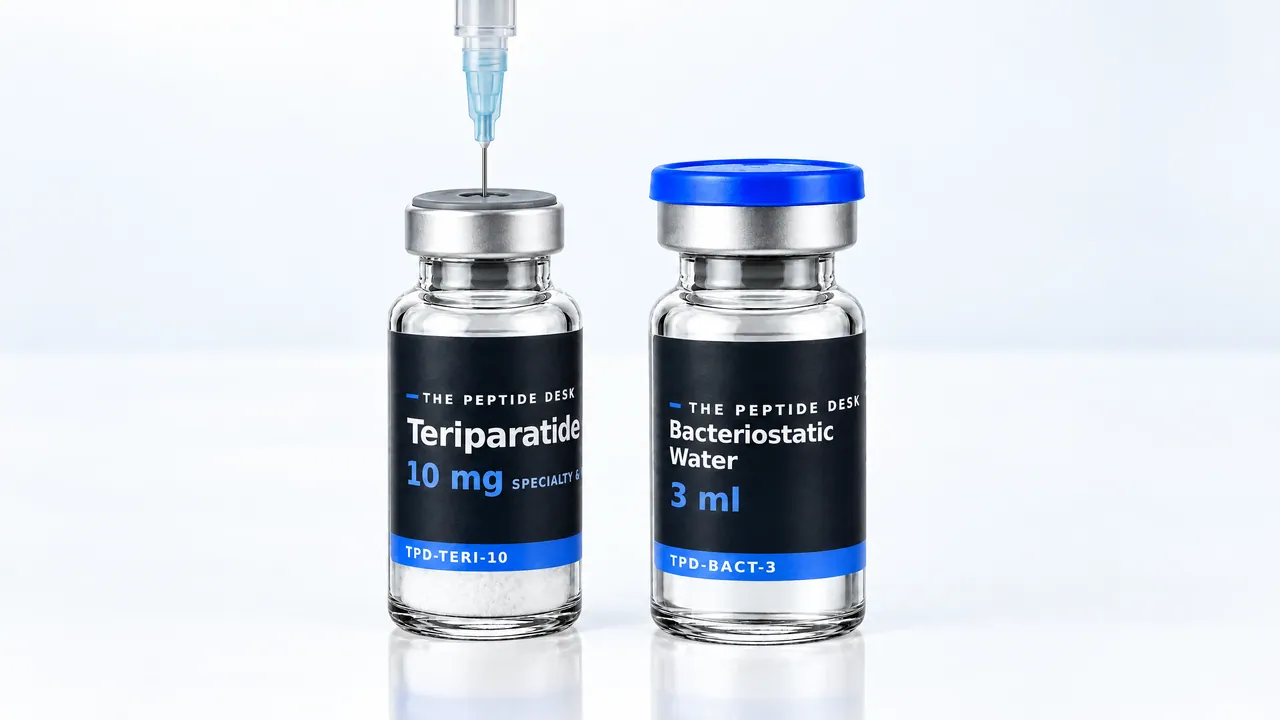
  • The teriparatide vial (lyophilized powder).
  • Bacteriostatic water, U-100 insulin syringes, alcohol swabs.
  • A sterile empty vial for the dilution.
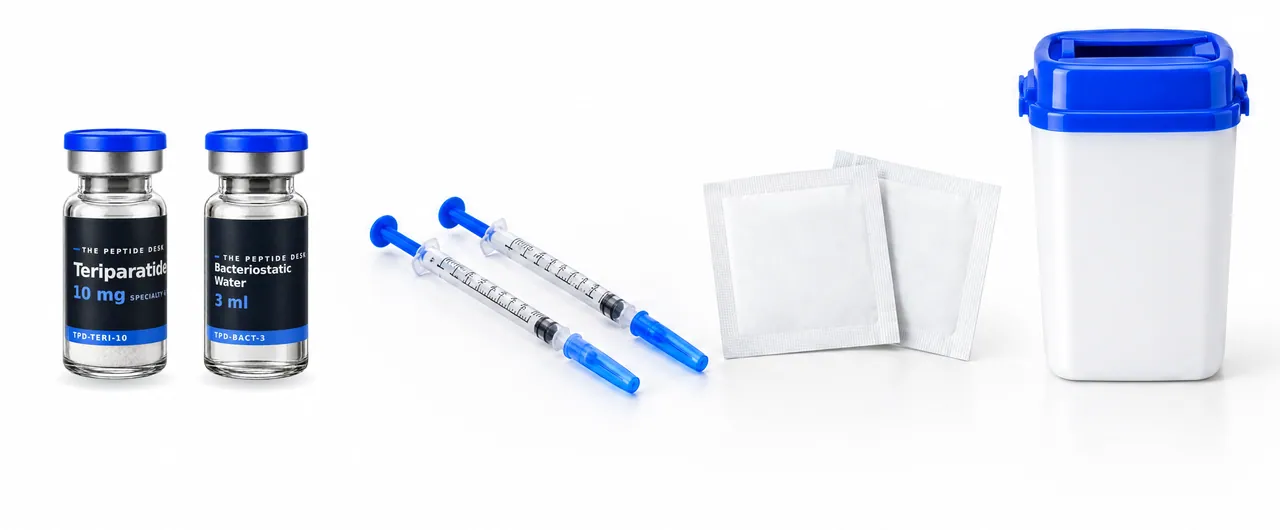
Teriparatide vial and bacteriostatic water at the same size with the black TPD label, next to two U-100 insulin syringes, two alcohol swabs and a sharps container with a blue lid
The sterile empty vial for dilution is not pictured.

Reconstitution

Teriparatide is dosed in mcg, the standard dose is 20mcg (0.02mg). From a 10mg vial this cannot be measured accurately with a U-100 syringe directly: with 2ml water the vial gives 5mg per ml, so 20mcg would be only 0.004ml, i.e. 0.4 units. That is why it is diluted in two steps:

  1. Dissolve the 10mg vial in 2ml water. That gives 5mg per ml.
  2. Transfer 0.1ml of it (10 units, i.e. 0.5mg) into a sterile empty vial.
  3. Add 2.4ml bacteriostatic water. The empty vial then holds 0.5mg in 2.5ml, i.e. 200mcg per ml.

20mcg is then 0.1ml, i.e. 10 units on the U-100 syringe. One diluted vial lasts for 25 doses. The peptide calculator does not cover the second step, so it shows no dose steps for teriparatide.
Step by step

Dissolving the powder

Four steps, the same for every vial size.

  1. 1Wipe the cap

    Clean the rubber stopper with an alcohol swab.

  2. 2Add BAC water

    Just add it, it does not matter if it hits the powder directly.

  3. 3Swirl or shake

    Until everything has dissolved, both are fine.

  4. 4Draw up

    With the U-100 insulin syringe.

Less water higher concentration fewer units on the syringe Example: 10 mg + 2 ml = 5 mg/ml

Dosing

Dosing

Dosing, titration and syringe

Loading the dosing information …

  • Getting started and stepping up, drawn as a staircase
  • Units on the U-100 syringe for every step
  • How long one vial lasts

Injection

Subcutaneous into the subcutaneous fat (abdomen or the front and inner side of the thigh). Disinfect the site, pinch a skin fold, insert at 90 degrees (45 degrees with little fat under the skin), rotate sites.
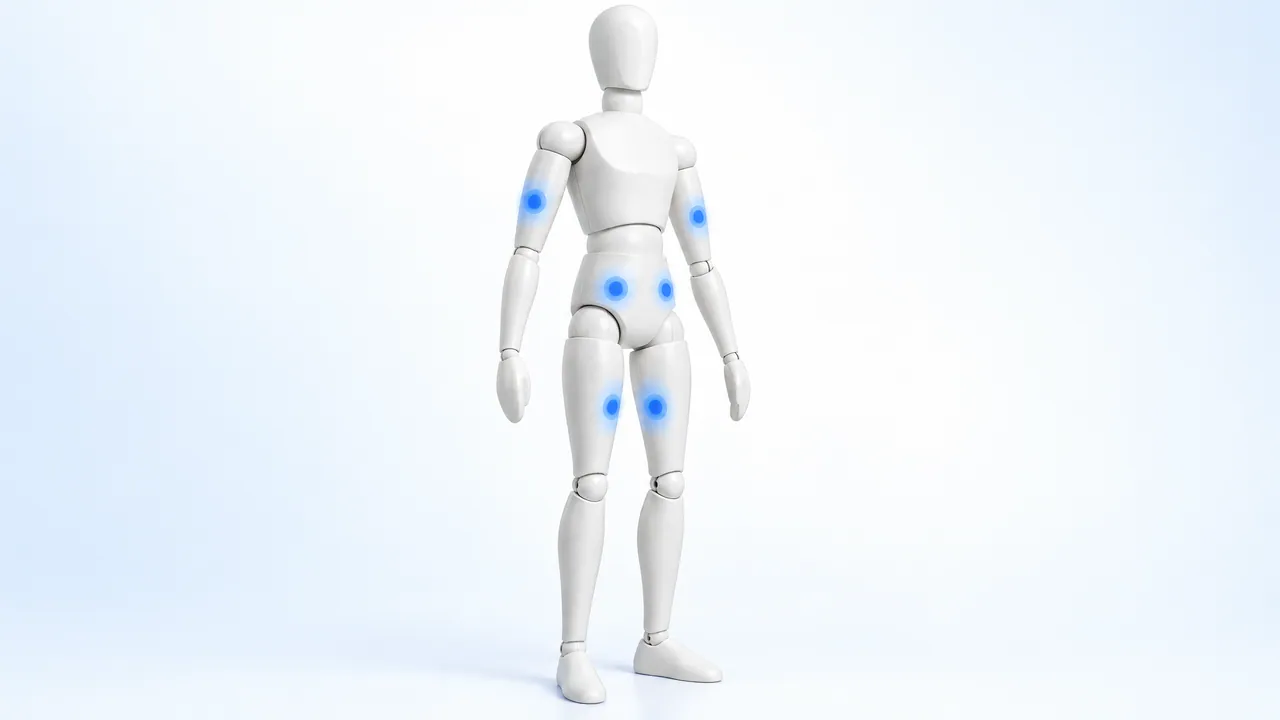
White jointed mannequin with glowing blue dots on the abdomen, thighs and upper arms against a light background
Subcutaneous into the fat layer under the skin, rotate the site every time. Symbolic image.

What the research shows

The approval study (Neer, NEJM 2001) showed a marked reduction of new vertebral fractures and an increase in bone density in postmenopausal women with osteoporosis. Teriparatide is thus a well-evidenced, clinically established agent with solid data.

Study results

What the trials measured

Interactive: switch tabs, tap points, show or hide arms. Arms are named relative to each other, no dosing advice.

New fractures in the approval trial1

Share of women with a new fracture, median observation 21 months

New vertebral fractures (X-ray)1
Placebo 14%
Teriparatide, standard dose 5%
Teriparatide, highest study dose 4%
Other fragility fractures1
Placebo 6%
Teriparatide, standard dose 3%
Teriparatide, highest study dose 3%

The higher dose raised bone density more but did not lower fracture risk further and had side effects more often. The standard dose is therefore the approved one.

Bone density beyond placebo1

Difference from placebo in percentage points, measured by DXA

Lumbar spine1
Teriparatide, standard dose 9 pp
Teriparatide, highest study dose 13 pp
Femoral neck1
Teriparatide, standard dose 3 pp
Teriparatide, highest study dose 6 pp

At the forearm (radius) density fell 2 percentage points more than on placebo with the higher dose.

Fractures after 24 months in severe osteoporosis2

Share with a new fracture, 680 women each, double-blind

New vertebral fractures2
Risedronate (comparison) 12.0%
Teriparatide 5.4%
Clinical fractures2
Risedronate (comparison) 9.8%
Teriparatide 4.8%
Other fragility fractures2
Risedronate (comparison) 6.1%
Teriparatide 4.0%

Vertebral and clinical fractures differed significantly. For the other fractures the difference was not significant.

Osteoporosis caused by cortisone, 18 months3

428 women and men, teriparatide against alendronate

Gain in lumbar spine bone density3
Alendronate (comparison) 3.4%
Teriparatide 7.2%
New vertebral fractures3
Alendronate (comparison) 6.1%
Teriparatide 0.6%

Other fractures were about equally frequent in both groups. On teriparatide more participants had raised blood calcium at least once.
Matte vertebra with visible spongy inner bone in a petri dish on a microscope stage, the objectives above
Approval trial with 1,637 women. Symbolic image.

Research status

Where the research stands

A selection from 182 registry entries, among them 32 in phase 3 and 48 in phase 4. Shown are the approval trial, large comparison trials and studies on new forms. As of 26 Oct 2026. 7

  1. Preclinical Bone formation and long-term safety in rats
  2. Phase 1 2 trials, 2 completed
  3. Phase 2 no registered trial
  4. Phase 3 5 trials, 5 completed
  5. Approval for osteoporosis since 2002
3,106 participants in phase 3 Approved for osteoporosis, first in 2002 according to ChEMBL. The prescribing information advises against use for more than two years in a lifetime unless fracture risk stays high.8
Show all 6 phase 3 and 4 trials on a timelineHide timeline 6 completed 0 running 3 with results
Phase 3
Phase 4

Bar: start to primary endpoint (planned for running trials). Green = completed, blue = progress until 26 Oct 2026. Phase 1: 2 trials on safety and pharmacokinetics, not shown as bars.

Side effects

  • Dizziness, leg cramps, nausea, especially at the start.
  • Temporary rise in blood calcium.
  • Local reactions at the injection site.

Tolerability

Frequency in the two main trials

Out of 100 participants per group, how many had the event in the two main trials in women and men.

8 of 100 Placebo
10 of 100 Teriparatide
Event PlaceboTeriparatide
Joint pain6 8%10%
Nausea6 7%9%
Dizziness6 5%8%
Leg cramps6 1%3%
Briefly raised calcium (women)6 2%11%

Calcium rose briefly 4 to 6 hours after the dose and was back to baseline after 16 hours. In healthy volunteers 5 percent had brief dizziness on standing during the first doses.6

Storage

Delicate: keep refrigerated throughout (2 to 8 degrees), do not freeze and protect from light. Once mixed, it keeps for at least 4 to 6 months in the fridge (2 to 8 °C).

Shelf life

How long it keeps

Undissolved (powder) Fridge, 2 to 8 degrees, dark

Delicate: keep refrigerated even before mixing, do not freeze.

Dissolved (mixed) Fridge, 2 to 8 degrees, away from light

Keeps for at least 4 to 6 months.

  • Keep it dark
  • Dissolved: 2 to 8 degrees
  • Note the mixing date on the vial
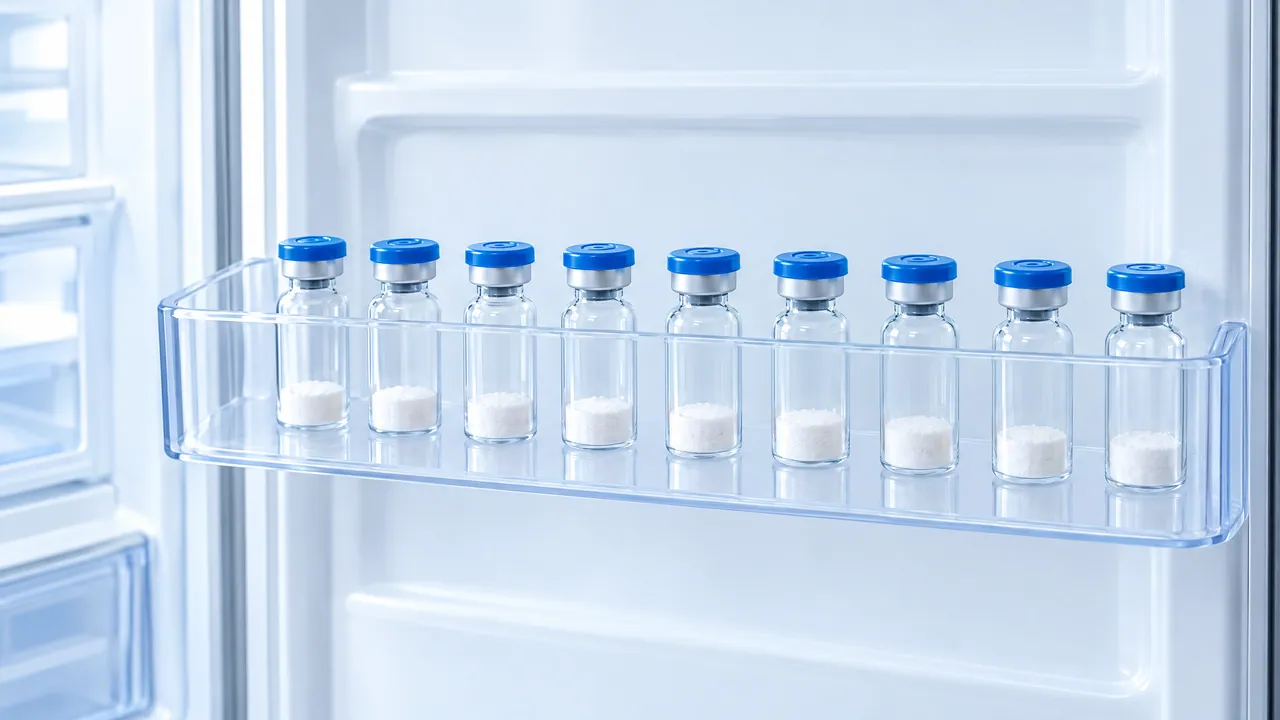
Nine vials with white powder and blue caps in the door shelf of a bright fridge
Always in the fridge (2 to 8 degrees), stable once mixed for at least 4 to 6 months, do not freeze, protect from light. Symbolic image.

Related

Related compounds

Same receptors: all in the TPD lexicon.

FAQ

Common questions about Teriparatide

Short answers, each backed by the sources below.

What is teriparatide?

The first 34 amino acids of the body's own parathyroid hormone, made by genetic engineering. According to the prescribing information this fragment binds the receptor as strongly as the full hormone of 84 amino acids and has the same effect on bone and kidney.6

Why does it build bone when parathyroid hormone breaks bone down?

It depends on the pattern. Given once a day the level rises briefly and is no longer measurable after about three hours. That mainly stimulates the bone-building cells. Permanently raised parathyroid hormone, by contrast, tips the balance towards breakdown.6

What did the approval trial show?

In 1,637 postmenopausal women with earlier vertebral fractures new vertebral fractures occurred in 14 percent on placebo and in 5 and 4 percent on teriparatide. Other fragility fractures halved from 6 to 3 percent.1

How does it compare with other osteoporosis drugs?

In severe osteoporosis new vertebral fractures occurred in 5.4 percent on teriparatide and 12.0 percent on risedronate. In osteoporosis caused by cortisone lumbar spine density rose more than on alendronate (7.2 against 3.4 percent).23

Why is use limited in time?

Rats given teriparatide daily for two years developed bone tumours (osteosarcomas), depending on dose and duration. In humans observational studies showed no increased risk, but data beyond two years are limited. Hence the usual limit of two years.56

Does it work in men too?

In a study of 437 men lumbar spine density rose by 5.9 percent with the standard dose and 9.0 percent with the higher dose over a median of 11 months. The study was stopped early because of the findings in rats.45

Which side effects are known?

Most often joint pain, nausea, dizziness and leg cramps, each only a few percentage points more frequent than on placebo. Calcium rises for a few hours after each dose. During the first doses circulation can dip briefly on standing.6

Glossary

Terms explained briefly

Dotted words in the text open these explanations directly.

Bisphosphonate
A group of osteoporosis drugs such as alendronate and risedronate. They slow bone breakdown but do not build bone.
Bone density
The mineral content of bone, measured by an X-ray method (DXA). A measure of fracture resistance.
Lyophilisate
Freeze-dried powder. Without water a peptide keeps much longer.
Osteoblasts
Cells that form new bone. Their counterparts, the osteoclasts, break bone down.
Osteoporosis
Bone loss: bones become thinner and break more easily, often at the vertebrae and hip.
Osteosarcoma
A malignant bone tumour. It occurred in rats on long-term dosing, in humans no increased risk was observed.
Parathyroid hormone (PTH)
Hormone of the parathyroid glands made of 84 amino acids. It regulates calcium and phosphate in bone, kidney and gut.
PTH1 receptor
The docking site for parathyroid hormone on bone and kidney cells.
Raised calcium
Calcium above the normal range in the blood. On teriparatide usually brief and over after a few hours.
Subcutaneous
Into the fat layer just under the skin.

Evidence

Sources

Show all 8 sourcesHide sources 5 Studies1 Trial registry2 Database checked 26 Oct 2026

Studies

  1. Approval trial: fractures and bone density in postmenopausal women

    Neer et al., New England Journal of Medicine, 2001

    Checked 26 Oct 2026 via doi.org, Crossref, PubMed
  2. VERO: teriparatide against risedronate in severe osteoporosis

    Kendler et al., The Lancet, 2018

    Checked 26 Oct 2026 via doi.org, Crossref, PubMed
  3. Teriparatide against alendronate in cortisone-induced osteoporosis

    Saag et al., New England Journal of Medicine, 2007

    Checked 26 Oct 2026 via doi.org, Crossref, PubMed
  4. Bone density in men with osteoporosis

    Orwoll et al., Journal of Bone and Mineral Research, 2003

    Checked 26 Oct 2026 via doi.org, Crossref, PubMed
  5. Bone changes in rats after two years of daily dosing

    Vahle et al., Toxicologic Pathology, 2002

    Checked 26 Oct 2026 via doi.org, Crossref, PubMed

Trial registry

  1. Trials on teriparatide on ClinicalTrials.gov

    ClinicalTrials.gov, U.S. National Library of Medicine

    Checked 26 Oct 2026 via ClinicalTrials.gov API v2

Database

  1. US prescribing information for teriparatide (generic)

    DailyMed, U.S. National Library of Medicine (Stand 08/2026)

    Checked 26 Oct 2026 via DailyMed
  2. Teriparatide in ChEMBL (mechanism, approval)

    ChEMBL, EMBL-EBI (CHEMBL525610)

    Checked 26 Oct 2026 via ChEMBL

In the shop

Teriparatide in the catalog

Sizes, prices and shipping times are on the product page.

To the product