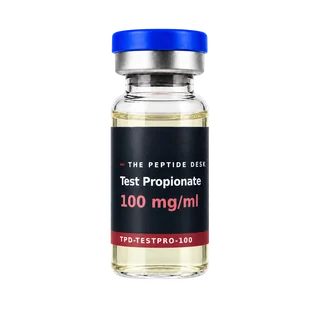
What is Testosterone Phenylpropionate?
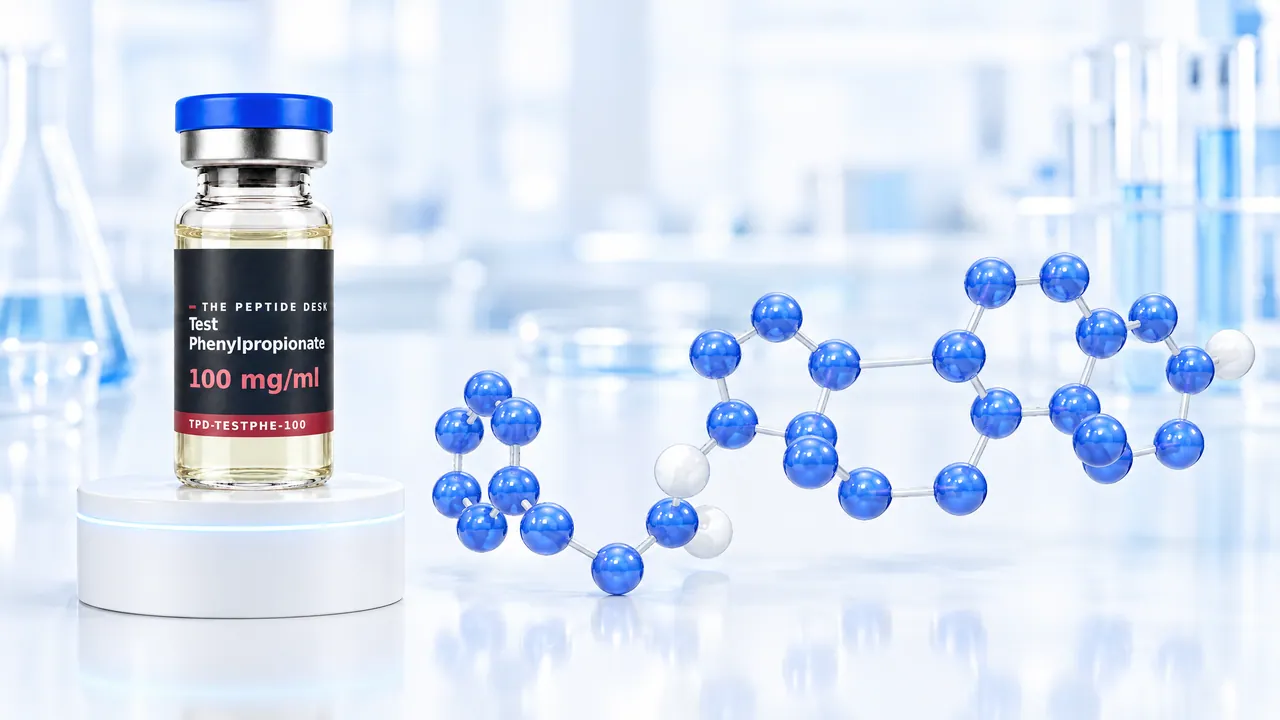
Testosterone Phenylpropionate (TPP) is testosterone with a phenylpropionate ester. The ester carries a benzene ring and sits between fast propionate and long enanthate in duration. It is best known as one of the four esters in classic Sustanon; here it comes as a single ester at 100 mg/ml.
As a standalone product TPP has barely been studied clinically. What we know comes from studies on ester blends and from general testosterone research.
This information is for research and educational purposes only. No medical advice.
Comparison
Short and long esters
The same compound at the same receptor with esters of different length, as stated in the TPD lexicon. Tap a card to open its entry.
How it works
After injection the ester is cleaved in the blood and testosterone remains. It binds the androgen receptor and raises protein synthesis, nitrogen retention and red blood cell production.
Like any testosterone, part of it is converted to estradiol by aromatase and part to DHT. The mid-short ester makes levels rise faster than with enanthate but also drop sooner. That is why TPP needs more frequent doses.
Where it acts
One receptor, several organs
Tap a point or a card. Grey = effect seen in trials.
- Skeletal muscle
Fat-free mass, muscle volume and leg strength rose with the level3
Observed in trials - Blood
Haemoglobin rose with the testosterone level3
Observed in trials - Liver and blood lipids
HDL cholesterol fell as levels rose3
Observed in trials - Fat tissue
Fat mass fell as levels rose3
Observed in trials - Kidney and urine
Urinary steroid profile clearly changed after one injection of the ester blend2
Observed in trials
Targets in the ChEMBL database8
Compound CHEMBL386630: one recorded mechanism, Testosterone once the ester is split off: agonist, direct binding.
- Gene
- AR
- UniProt
- P10275
- ChEMBL
- CHEMBL1871
- Action
- Testosterone once the ester is split off: agonist, direct binding

Use and dosing
Dosing
Dosing, titration and syringe
Loading the dosing information …
- Getting started and stepping up, drawn as a staircase
- Units on the U-100 syringe for every step
- How long one vial lasts
Injection
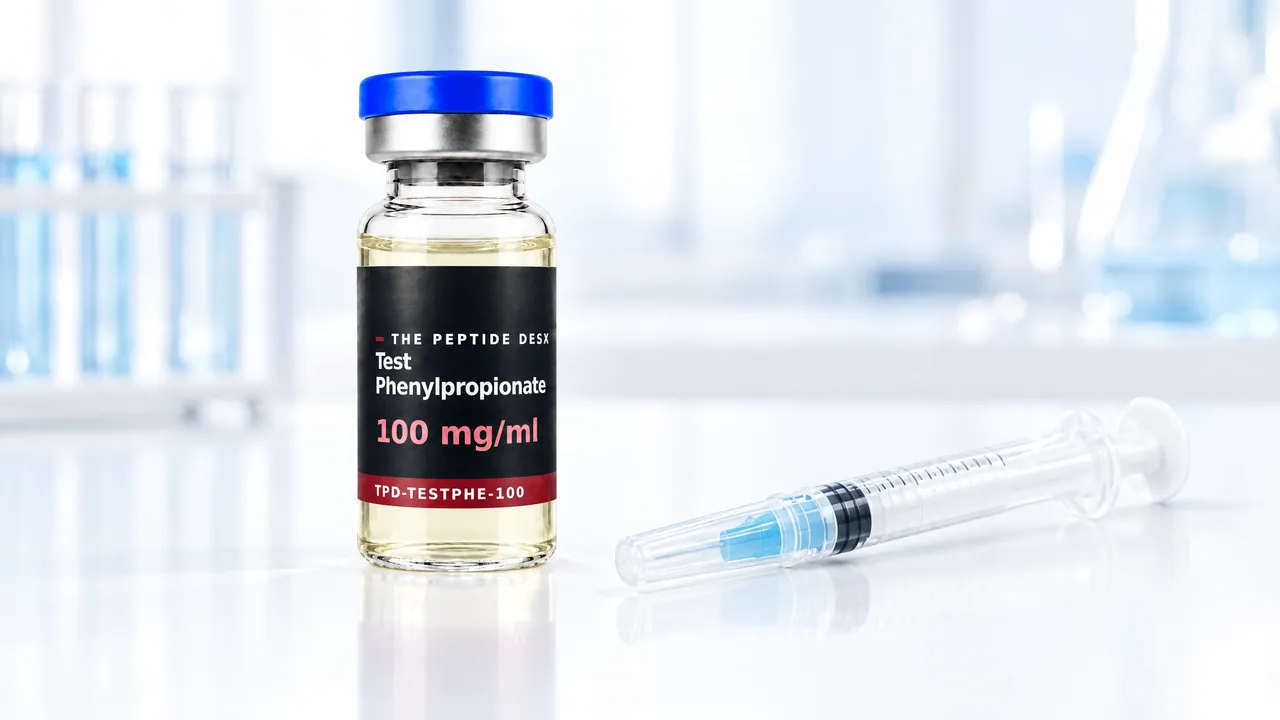
The oil is ready to use. Intramuscular injection into the glute, thigh or shoulder is recommended, with rotating sites. Short and mid-short esters irritate tissue more than long esters.
- Thicker needle to draw, thinner needle to inject.
- Subcutaneous only in small amounts and if well tolerated, otherwise intramuscular.
- Mild soreness at the site is more common with this ester than with enanthate.
What the research shows
Phenylpropionate has almost only been studied as part of ester blends. In two doping control studies (Forsdahl and colleagues, 2015 and 2020), volunteers received a mix of 30mg propionate, 60mg phenylpropionate, 60mg isocaproate and 100mg decanoate. All esters were detectable in blood, detection time depended on the ester and the urinary steroid profile shifted for weeks.
For the effect of testosterone itself, Bhasin's dose-response trial (2001) is a good reference: 61 young men received 25 to 600mg per week. Fat-free mass and strength rose in line with testosterone levels. Kicman (2008) summarizes the general pharmacology of the esters.
Study results
What the trials measured
Interactive: switch tabs, tap points, show or hide arms. Arms are named relative to each other, no dosing advice.
Fat-free mass after 20 weeks3
Gain in kg in the three higher of five dose levels, 61 young men, study with enanthate
Same testosterone, different ester. Leg strength, muscle volume, haemoglobin and IGF-1 rose with the level while fat mass and HDL cholesterol fell. Sexual function, mood and PSA did not change at any level.
Research status
Where the research stands
There is no registered trial with the single ester. Shown are trials with the approved blend of four testosterone esters, in which phenylpropionate is one of the medium-length components. As of 26 Oct 2026. 7
- Preclinical Pharmacology of esterification and depot action
- Phase 1 1 trial, 0 completed
- Phase 2 no registered trial
- Phase 3 1 trial, 1 completed
- Approval not as a single ester
Show all 9 phase 3 and 4 trials on a timelineHide timeline
CDGP · NCT01797718 · 35 participants, started Oct 2013, primary endpoint reached Mar 2017. Tests several agents.
Registry entry ↗ · Results not yet in PubMed
NCT00355537 · 19 participants, started Feb 2006, primary endpoint reached Dec 2009.
Registry entry ↗ · Results not yet in PubMed
NCT01107067 · 32 participants, started Jun 2008, primary endpoint reached Dec 2009.
Registry entry ↗ · Results not yet in PubMed
NCT01533129 · 106 participants, started Aug 2008, primary endpoint reached Apr 2011. Tests several agents.
Registry entry ↗ · Results not yet in PubMed
NCT02171390 · 130 participants, started Aug 2008, primary endpoint reached Jun 2012.
Registry entry ↗ · Results not yet in PubMed
NCT01454011 · 140 participants, started Sept 2008, primary endpoint reached Feb 2011. Tests several agents.
Registry entry ↗ · Results not yet in PubMed
NCT02111473 · 49 participants, started May 2009, primary endpoint reached May 2012.
Registry entry ↗ · Results not yet in PubMed
NCT01160341 · 312 participants, started Aug 2009, primary endpoint reached Jan 2010.
Registry entry ↗ · Results not yet in PubMed
NCT02111434 · 150 participants, started Jul 2013, primary endpoint reached Apr 2014.
Registry entry ↗ · Results not yet in PubMed
Bar: start to primary endpoint (planned for running trials). Green = completed, blue = progress until 26 Oct 2026. Phase 1: 1 trial on safety and pharmacokinetics, not shown as bars.
Side effects
TPP has the same risk profile as other testosterone esters. The more frequent doses add more injections, but side effects fade faster after stopping than with long esters.
- Estrogen: water retention, rising blood pressure, gyno risk.
- Hematocrit: rises with the dose.
- HPTA suppression: your own testosterone production is turned down.
- Lipids: HDL falls.
- Androgenic: acne, hair loss if predisposed.
- Injection site: pain or redness, more often than with long esters.
Storage
Keep the oil at room temperature, in the dark and closed. Do not put it in the fridge, as the compound can crystallize in the cold. Visible crystals dissolve when the vial is warmed and swirled until the solution is clear again.