What is VIP?
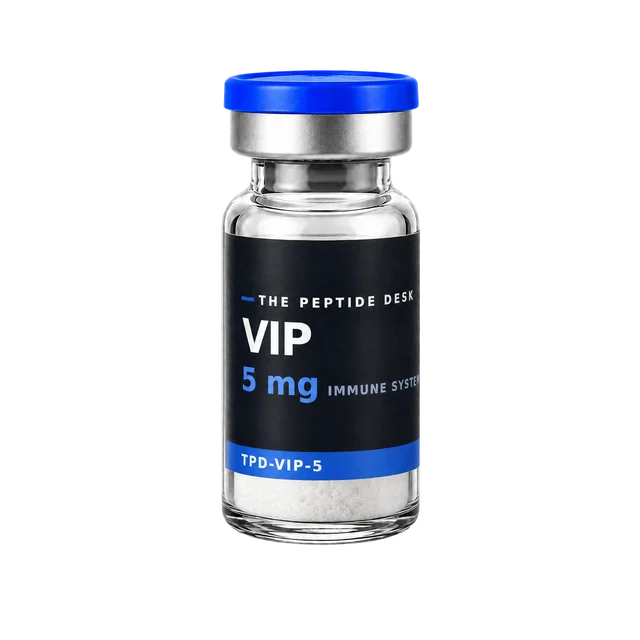
VIP (vasoactive intestinal peptide) is an endogenous messenger found in many tissues that plays an inflammation-regulating, vessel-widening role. In the scene it is often used in the context of chronic inflammation and stress topics, usually nasally.
Comparison
VIP and related entries
VIP as a vial and as a nasal spray, next to other immune-regulating peptides from the TPD lexicon. Tap a card to open its entry.
Simplified: only the two VIP entries hit VPAC1 and VPAC2. The others regulate the immune system via other paths. 2
How it works
VIP dampens inflammatory messengers and regulates the immune system. It also acts on blood vessels, airways and hormone balance. Because of the very short half-life, each dose acts only briefly.
Where it acts
Where VIP was studied
Tap a point or a card. Colour = receptor, grey = observed in studies.
- Lung
Sarcoidosis, inhaled: less TNF-alpha from lung cells, more regulatory T cells1
VPAC1VPAC2 - Head and vessels
2-hour infusion: migraine attacks in 71 percent, temporal artery widened6
Observed in trials - Immune cells
Immune cells make VIP and carry its receptors, VIP dampens inflammation (review)2
VPAC1VPAC2
Known targets2
Compound CHEMBL1981592: two described targets, all Binds VIP and PACAP equally, mainly switches on the cAMP pathway.
- Gene
- VIPR1
- UniProt
- P32241
- ChEMBL
- CHEMBL5144
- Action
- Binds VIP and PACAP equally, mainly switches on the cAMP pathway
- Gene
- VIPR2
- UniProt
- P41587
- ChEMBL
- CHEMBL4532
- Action
- Binds VIP and PACAP equally, mainly switches on the cAMP pathway

Use (nasal or subcutaneous)
Dosing
Dosing
Dosing, titration and syringe
Loading the dosing information …
- Getting started and stepping up, drawn as a staircase
- Units on the U-100 syringe for every step
- How long one vial lasts
What the research shows
A clinical study (Prasse, 2010) showed that inhaled VIP lowered inflammatory messengers in the lungs of sarcoidosis patients and was well tolerated. That supports the immune-regulating action but comes from a specific clinical context, not broad everyday use.
Study results
What the trials measured
Interactive: switch tabs, tap points, show or hide arms. Arms are named relative to each other, no dosing advice.
Died with severe COVID-1935
Share in percent, two trials versus placebo
The large infusion trial was stopped for lack of benefit. The small inhalation study was too small for mortality, its main goal was the time to discharge.
Days until discharge5
Mean in days, 80 people with COVID-19 pneumonia
The difference was just statistically significant. There were no dropouts due to side effects.

Research status
Where the research stands
A selection of registered trials with VIP or aviptadil. The large trials tested VIP as an infusion or inhalation in COVID-19, smaller ones as a trigger of headache and migraine. As of 26 Oct 2026. 7
- Preclinical Cell and animal models of inflammation and autoimmunity
- Phase 1 no registered trial
- Phase 2 2 trials, 1 completed, 1 stopped early
- Phase 3 3 trials, 2 completed, 1 stopped early
- Approval not yet
Show all 7 trials on a timelineHide timeline
HOPE · NCT04844580 · 80 participants, started Mar 2021, primary endpoint reached Jun 2022.
Registry entry ↗ · Results: Esendagli et al., Medical Principles and Practice, 2025
NCT04536350 · 83 participants, started May 2021, stopped early Jun 2023.
COVID-AIV · NCT04311697 · 203 participants, started May 2020, primary endpoint reached Feb 2021.
Registry entry ↗ · Results: Youssef et al., Critical Care Medicine, 2022
AVICOVID-2 · NCT04360096 · 144 participants, started Feb 2021, stopped early Dec 2021.
TESICO · NCT06729606 · 471 participants, started Apr 2021, primary endpoint reached Aug 2022.
Registry entry ↗ · Results: Brown et al., The Lancet Respiratory Medicine, 2023
NCT03989817 · 12 participants, started Jun 2019, primary endpoint reached Jun 2020.
Registry entry ↗ · Results not yet in PubMed
NCT04260035 · 21 participants, started May 2020, primary endpoint reached Sept 2020.
Registry entry ↗ · Results: Pellesi et al., JAMA Network Open, 2021
Bar: start to primary endpoint (planned for running trials). Green = completed, blue = progress until 26 Oct 2026, grey = stopped early.
Side effects
- Due to the vessel-widening action, drops in blood pressure, flush or dizziness are possible.
- Irritation of the nasal mucosa (nasal), local reactions (subcutaneous).
Tolerability
Events with VIP as an infusion
Out of 100 participants per group, how many had the event. Both trials gave VIP into the vein.
The composite endpoint covers death, serious events, organ failure and serious infections, the difference was not significant. VIP widens vessels, which is why the regular entry lists a drop in blood pressure, flushing and dizziness.63
Storage
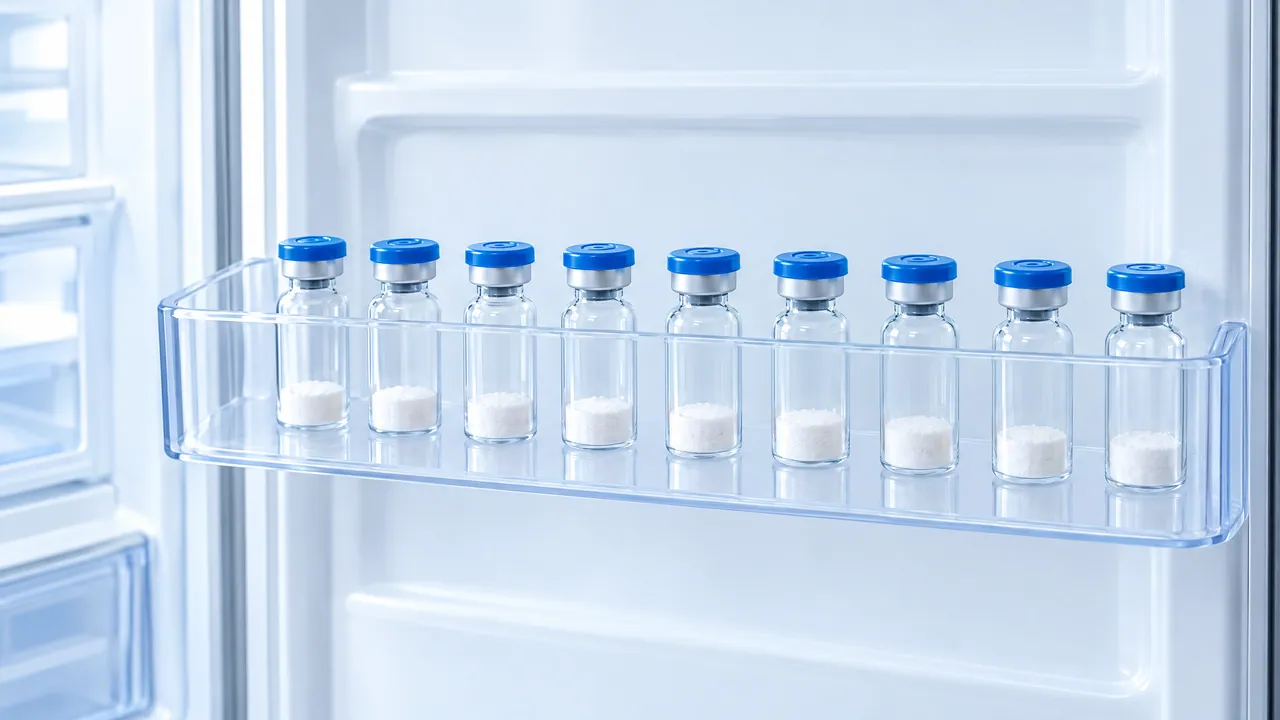
Before mixing the powder is robust, normal room temperature (around 20 to 25 degrees) is fine, ideally kept in the dark. After mixing, keep in the fridge (2 to 8 degrees), do not freeze. It stays good there for at least 4 to 6 months with barely any loss of potency, in practice considerably longer. Swirl or shake to mix, both are fine.
Shelf life
How long it keeps
Robust, no fridge needed. Keeps for several months without trouble.
At least 4 to 6 months with barely any loss of potency. The bacteriostatic water brings a preservative.
- Keep it dark
- Dissolved: 2 to 8 degrees
- Note the mixing date on the vial