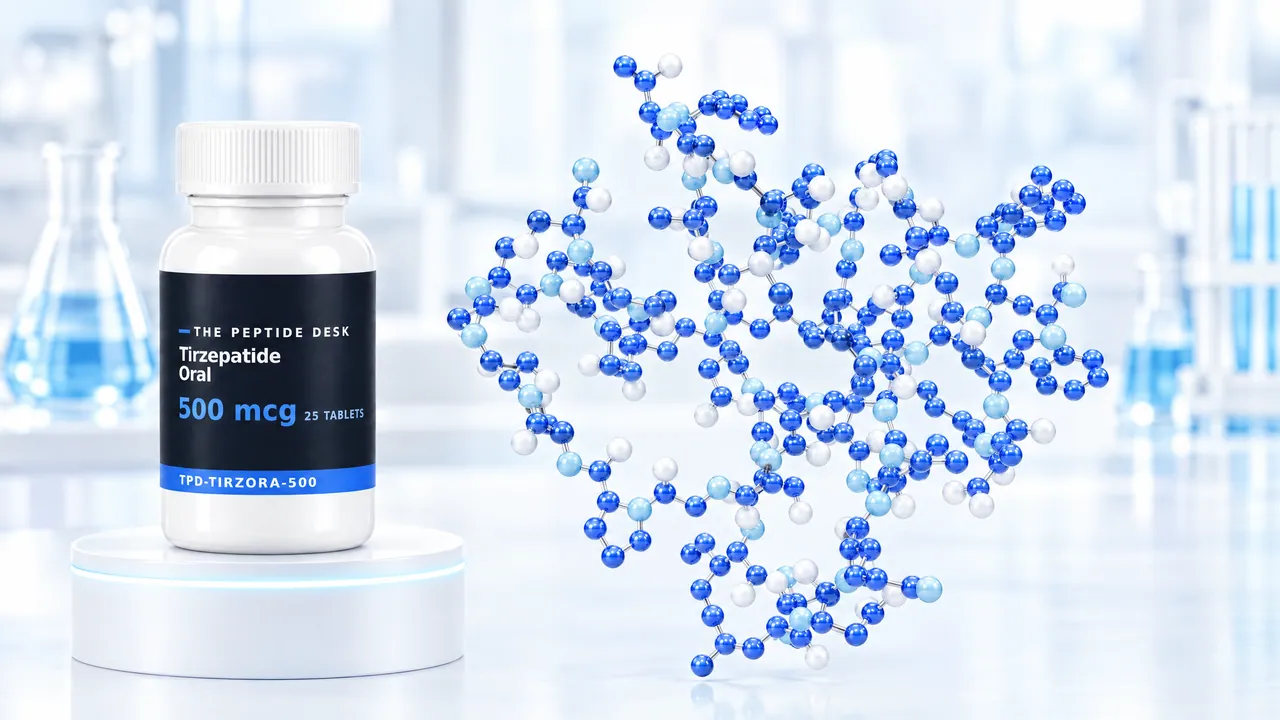
What is Tirzepatide Oral?
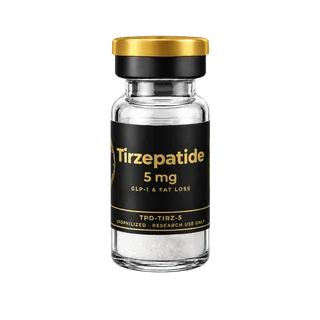
Tirzepatide Oral is the same active compound as injectable tirzepatide, just pressed into a tablet: a dual agonist at the GIP and GLP-1 receptors, here at 500mcg per tablet with 25 tablets per pack. The idea is simple, the same incretin effect without a needle.
The catch is absorption. Tirzepatide is a 39-amino-acid peptide with an attached fatty acid. Peptides are largely digested in the stomach and gut before they reach the blood. The molecule was designed for once-weekly subcutaneous dosing (Coskun, 2018). There is no approved tablet form. No clinical study of oral intake in humans has been published so far. That makes the tablet an experimental product for people who do not want to inject, not the better option.
This information is for research and educational purposes only. No medical advice.
Comparison
Tablet or injection
Same receptors, a different route into the blood. Tap a card to open its entry.
According to ChEMBL: tirzepatide activates the GIP and GLP-1 receptors (approved 2022), semaglutide the GLP-1 receptor (approved 2017). Oral semaglutide is absorbed in the stomach with the enhancer SNAC. 84
How it works
Once in the bloodstream, tirzepatide does what it does from a syringe: it activates the GIP and GLP-1 receptors at the same time. The result is a glucose-dependent boost in insulin release, slower gastric emptying and stronger satiety signalling in the brain. Many describe food noise quieting down and portions shrinking.
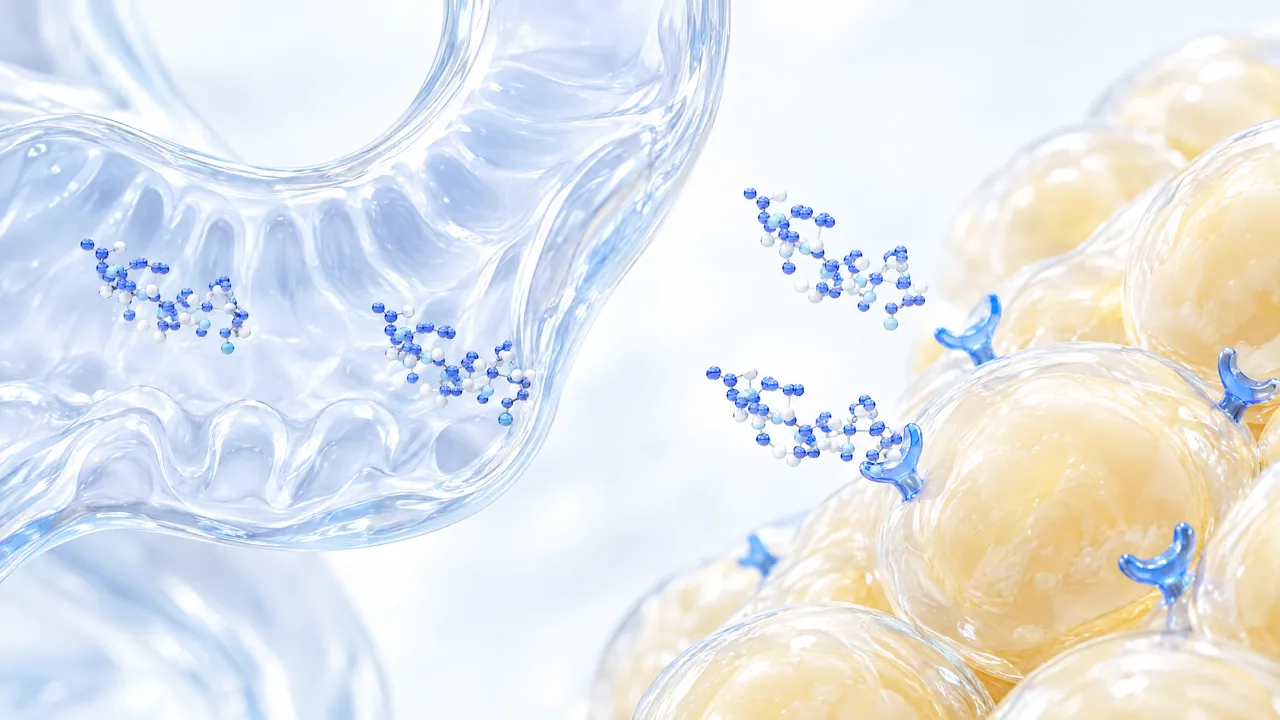
The difference from the injection is the route in. After swallowing, the peptide meets stomach acid and digestive enzymes. Only a tiny fraction crosses the mucosa. Oral peptide tablets therefore rely on absorption enhancers that buffer local pH, slow enzymes and briefly loosen the mucosal barrier. For the only approved oral GLP-1 peptide, oral semaglutide with the enhancer SNAC, uptake happens directly in the stomach (Buckley, 2018). Measured bioavailability is around 0.8 percent (Overgaard, 2021).
For the tirzepatide tablet, nothing is published about whether and which enhancer it contains or how much actually reaches the blood in humans. Studies suggest that tirzepatide can in principle be absorbed orally with sodium caprate as the enhancer, but so far only in a cell model and in rats and dogs (Im, 2026). The half-life of the molecule is about five days. Daily intake is there to even out the low and variable absorption, not to compensate for fast breakdown.
Where it acts
Where tirzepatide and oral peptides acted in studies
Tap a point or a card. Colour = receptor, grey = observed in studies (also injection or semaglutide).
- Stomach
Oral semaglutide is absorbed directly in the stomach and needs the enhancer SNAC4
Observed in trials - Pancreas
Glucose-dependent insulin release via both receptors (mice)2
GIPGLP-1 - Fat tissue
Weight down by up to 20.9 percent after 72 weeks with the injection1
Observed in trials - Blood
Measurable levels after a tablet with sodium caprate in dogs5
Observed in trials
Targets in the ChEMBL database8
Compound CHEMBL4297839: two recorded mechanisms, all Agonist.
- Gene
- GIPR
- UniProt
- P48546
- ChEMBL
- CHEMBL4383
- Action
- Agonist
- Gene
- GLP1R
- UniProt
- P43220
- ChEMBL
- CHEMBL1784
- Action
- Agonist
Use and dosing
Dosing
Dosing, titration and syringe
Loading the dosing information …
- Getting started and stepping up, drawn as a staircase
- Units on the U-100 syringe for every step
- How long one vial lasts
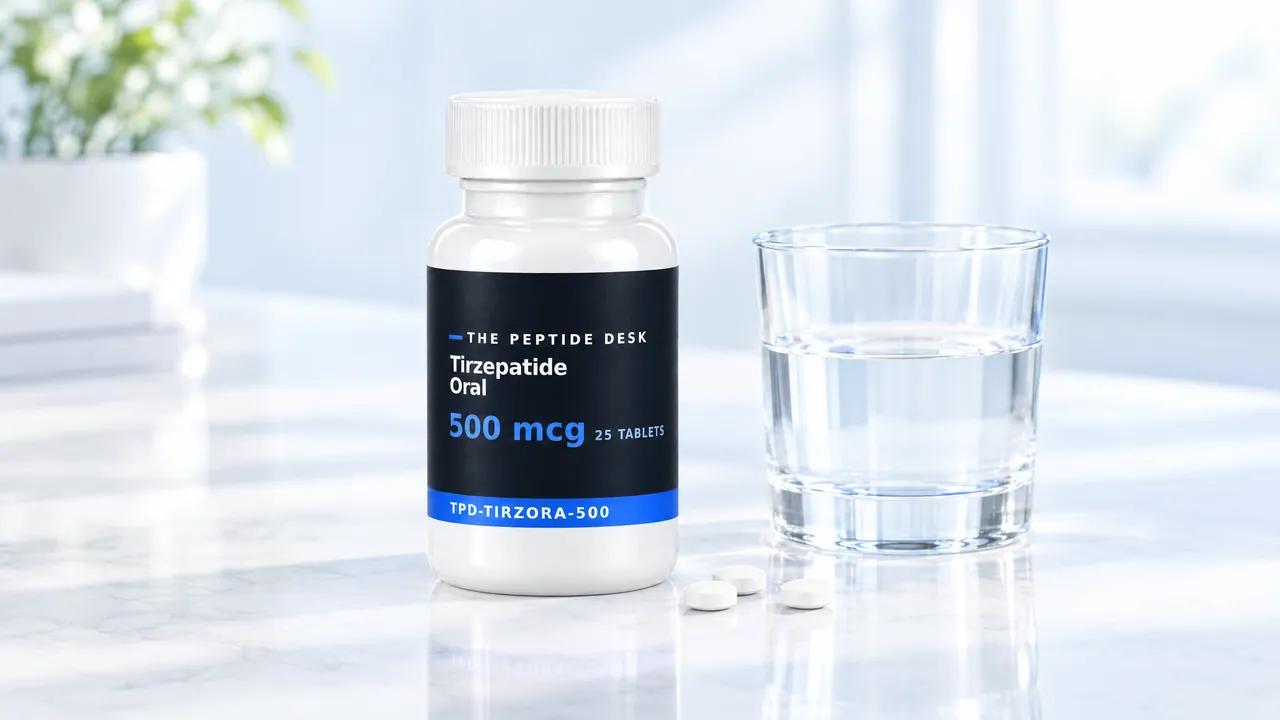
Use when switching from the injection
What the research shows
The evidence splits in two. For the compound itself it is overwhelming: in SURMOUNT-1, participants on once-weekly subcutaneous tirzepatide lost a dose-dependent average of 15 to 20.9 percent of body weight over 72 weeks, versus 3.1 percent on placebo (Jastreboff, 2022). The path from molecule to first human study is described by Coskun (2018): a fatty-acid-modified peptide built for once-weekly subcutaneous dosing.
For the tablet there is none of that in humans. What exists is formulation research: a 2026 paper developed a tirzepatide tablet with sodium caprate as absorption enhancer and showed better permeability in a cell model and measurable blood levels in rats and beagle dogs (Im, 2026). That proves the route works in principle. It does not prove how well it works in humans, let alone how much of a given tablet gets in.
The best reference point is therefore oral semaglutide, the only approved GLP-1 peptide you can swallow: bioavailability around 0.8 percent under the recommended intake conditions, day-to-day variability of 137 percent, which smooths out to about 33 percent at steady state with daily dosing (Overgaard, 2021). Translated: with oral peptides, daily disciplined intake is not a detail, it is the precondition for a stable level to build up at all.
Study results
What the trials measured
Interactive: switch tabs, tap points, show or hide arms. Arms are named relative to each other, no dosing advice.
Body weight after 72 weeks1
SURMOUNT-1, 2,539 adults with obesity, weekly injection, not the tablet
Values from the abstract (treatment-regimen estimand). How much of a tablet reaches the blood has not been measured in humans, the figures cannot be transferred.
Lost at least 5 percent of weight1
Share of participants after 72 weeks, SURMOUNT-1
Values from the abstract. Applies to the weekly injection.
How a GLP-1 peptide from a tablet arrives3
Oral semaglutide with the enhancer SNAC, data from clinical pharmacology trials
Values from the abstract, measured with semaglutide, not tirzepatide. Waiting longer after the tablet raised absorption, more water lowered it.
Research status
Where the research stands
ClinicalTrials.gov lists no trial of tirzepatide as a tablet. Shown are trials of the same compound as an injection, including the first human study, two studies on gastric emptying and the contraceptive pill and SURMOUNT-1. As of 26 Oct 2026. 7
- Preclinical Tablet with sodium caprate: cell model, rats and dogs
- Phase 1 3 trials, 3 completed
- Phase 2 no registered trial
- Phase 3 1 trial, 1 completed
- Approval injection only, since 2022 according to ChEMBL
Show all 1 phase 3 trial on a timelineHide timeline
SURMOUNT-1 · NCT04184622 · 2,539 participants, started Dec 2019, primary endpoint reached Apr 2022.
Registry entry ↗ · Results: Jastreboff et al., New England Journal of Medicine, 2022
Bar: start to primary endpoint (planned for running trials). Green = completed, blue = progress until 26 Oct 2026. Phase 1: 3 trials on safety and pharmacokinetics, not shown as bars.
Side effects
The side-effect profile belongs to the compound, not the tablet: nausea, fullness, belching, diarrhea or constipation, mostly at the start and after each increase. Whether the tablet is harder on the stomach than the injection has not been studied, but here compound and tablet excipients land directly on the gastric lining. The slow entry is exactly what guards against this.
- Appetite and fluids: with little hunger you often drink less too. Keep fluids and protein up, otherwise more muscle is lost along with fat.
- Variable absorption: unlike the injection, the effect can differ from day to day. A strong day is no reason to take less the next. A weak day is no reason to go up either.
- Rare class signals: gallbladder trouble with rapid weight loss, rarely pancreatitis, thyroid C-cell tumors in rats. With persistent severe abdominal pain, stop and get it checked.
- Other tablets: delayed gastric emptying can shift the absorption of other oral compounds, according to the injection label including oral contraceptives (it advises adding a barrier method for four weeks after starting and after each increase). Combined with insulin or sulfonylureas the risk of hypoglycemia rises.
Solid human data on the tolerability of the tablet itself, for example on whether and which absorption enhancer it contains, do not exist. That is the price of an experimental product.
Tolerability
Stopped due to side effects (injection)
Out of 100 participants per group, how many had the event over 72 weeks with the injection.
| Event | Placebo | Lowest level (injection) | Middle level (injection) | Highest level (injection) |
|---|---|---|---|---|
| Stopped due to adverse events1 | 3% | 4% | 7% | 6% |
Values from the abstract. Gastrointestinal effects were most common, mostly mild to moderate and mainly during dose escalation. There are no human data for the tablet.16
Storage
Tablets are low-maintenance: store dry, cool (not above 25 degrees) and protected from light in the tightly closed original container, not in the bathroom or kitchen where humidity and heat swing. A fridge is not needed, what matters is that no moisture gets to the tablets.
Swallow the tablets whole, do not split, crush or chew them: oral peptide tablets are designed to reach the stomach intact. For oral semaglutide this is an explicit part of the intake instructions. Keep out of reach of children and mind the expiry date.