What is Orforglipron?
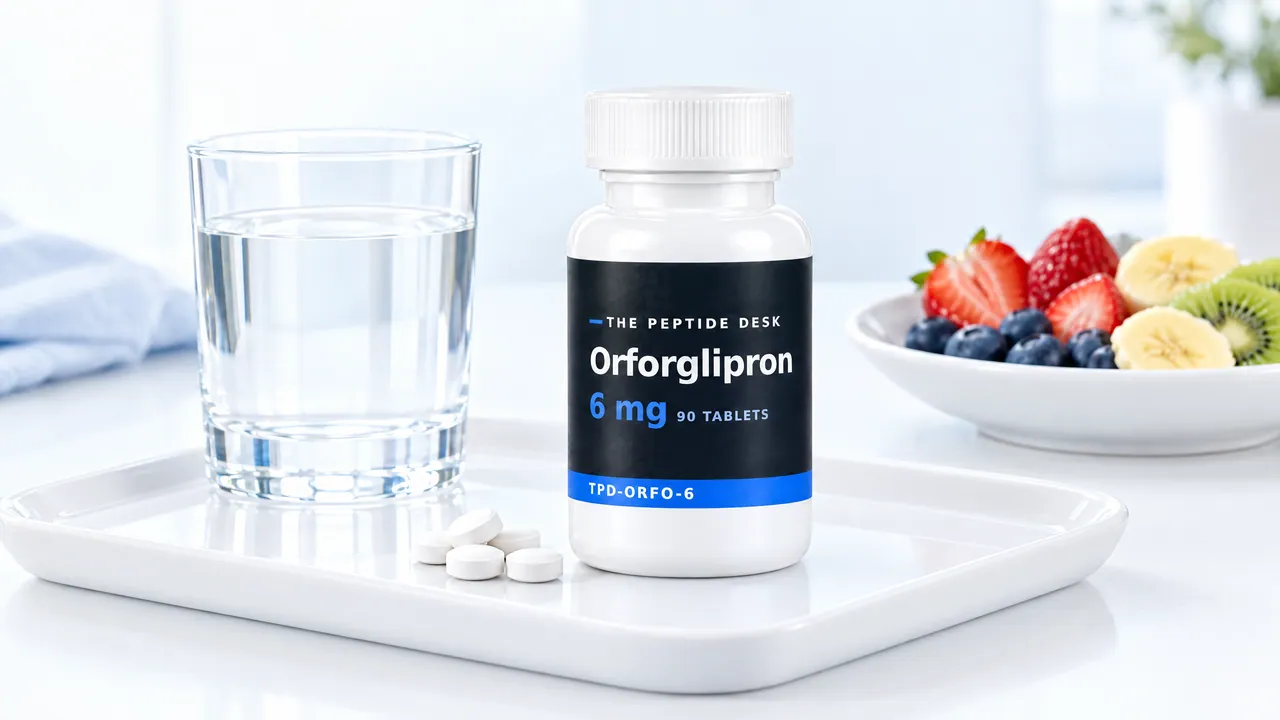
Orforglipron is an oral GLP-1 receptor agonist, but unlike semaglutide not a peptide but a small molecule. That is the key difference: small molecules survive the stomach better and do not need the strict fasting rule like oral semaglutide.
Comparison
One, two or three receptors
Which receptors each compound targets and whether it is a peptide or a small molecule, as stated in the TPD lexicon. Tap a card to open its entry.
Simplified: more receptors does not automatically mean better, each path also brings its own effects. 1014
How it works
Orforglipron activates the same GLP-1 receptor as the GLP-1 peptides: more satiety, dampened appetite, better blood sugar control. Because it is a small molecule, absorption is more robust and intake more practical for everyday use.
Where it acts
One receptor, several organs
Tap a point or a card. Colour = receptor, grey = effect seen in trials.
- Brain
Appetite dampened, binding in appetite centres shown in animal models10
GLP-1 - Stomach
Gastric emptying delayed after 4 weeks8
GLP-1 - Pancreas
Blood sugar lowered, HbA1c clearly lower in trials1
GLP-1 - Body weight
Up to 11.2 percent less in 72 weeks2
Observed in trials - Heart
Pulse rose by up to 4.7 beats per minute on average4
Observed in trials - Liver
Broken down mainly by the enzyme CYP3A412
Observed in trials
Known targets10
Compound CHEMBL4446782: one described target, Agonist, direct binding, little beta-arrestin.
- Gene
- GLP1R
- UniProt
- P43220
- ChEMBL
- CHEMBL1784
- Action
- Agonist, direct binding, little beta-arrestin

How to take it
Oral, once daily. Unlike oral semaglutide, absorption is less sensitive, a strict fasting rule is not needed.
- With some water, with or without food per instructions.
- Once daily is enough given the long duration.
Dosing
Dosing
Dosing, titration and syringe
Loading the dosing information …
- Getting started and stepping up, drawn as a staircase
- Units on the U-100 syringe for every step
- How long one vial lasts
What the research shows
A phase 3 study (NEJM, 2025) tested orforglipron in early type 2 diabetes over 40 weeks: all three doses lowered long-term blood sugar markedly more than placebo. That makes orforglipron one of the most advanced oral GLP-1 agents with solid data.
Study results
What the trials measured
Interactive: switch tabs, tap points, show or hide arms. Arms are named relative to each other, no dosing advice.
Body weight after 72 weeks23
Mean change in percent, two phase 3 trials with three levels each and placebo
Treatment-regimen analysis, so including all participants, also after stopping. With diabetes weight loss was smaller at every level, as with other GLP-1 drugs.
Long-term blood sugar after 40 weeks1
Change in HbA1c in percentage points, early type 2 diabetes without tablets, baseline 8.0%
The lowest level in this trial was below the lowest level of the weight trials. At the end mean HbA1c on Orforglipron was 6.5 to 6.7 percent. There were no severe hypoglycaemias.
HbA1c after 52 weeks head to head4
Type 2 diabetes on metformin, 1,698 participants, open-label phase 3 trial, baseline 8.3%
Both Orforglipron levels were superior to both semaglutide levels. In return Orforglipron caused more gastrointestinal complaints, more discontinuations and a larger rise in pulse.
Share of previous weight loss maintained5
After 72 weeks of injected tirzepatide or semaglutide, then 52 weeks of tablet or placebo (model estimate)
Counted were participants whose weight had reached a plateau on the injection. There was no arm that continued the injection and the trial ran for one year only.

Research status
Where the research stands
Registered trials with status, participants and results. As of 26 Oct 2026. 13
- Preclinical Binding to the human GLP-1 receptor, animal models with an adapted receptor
- Phase 1 22 trials, 21 completed
- Phase 2 3 trials, 2 completed
- Phase 3 26 trials, 10 completed
- Approval in the US since 2026
Show all 29 phase 2 and 3 trials on a timelineHide timeline
NCT05048719 · 383 participants, started Sept 2021, primary endpoint reached Sept 2022. Tests several agents.
Registry entry ↗ · Results: Frias et al., The Lancet, 2023
NCT05051579 · 272 participants, started Sept 2021, primary endpoint reached Aug 2022.
Registry entry ↗ · Results: Wharton et al., New England Journal of Medicine, 2023
NCT07107334 · 20 participants (planned), started Apr 2026, primary endpoint planned Nov 2028. Tests several agents.
ACHIEVE-4 · NCT05803421 · 2,749 participants, started Apr 2023, primary endpoint reached Mar 2026. Tests several agents.
Registry entry ↗ · Results not yet in PubMed
ATTAIN-1 · NCT05869903 · 3,127 participants, started Jun 2023, primary endpoint planned Jul 2025.
Registry entry ↗ · Results: Wharton et al., New England Journal of Medicine, 2025
ATTAIN-2 · NCT05872620 · 1,613 participants, started Jun 2023, primary endpoint reached Aug 2025.
Registry entry ↗ · Results: Horn et al., The Lancet, 2025
ATTAIN-J · NCT05931380 · 238 participants, started Jul 2023, primary endpoint reached Jun 2025.
Registry entry ↗ · Results not yet in PubMed
ACHIEVE-1 · NCT05971940 · 559 participants, started Aug 2023, primary endpoint reached Apr 2025.
Registry entry ↗ · Results: Rosenstock et al., New England Journal of Medicine, 2025
ACHIEVE-3 · NCT06045221 · 1,698 participants, started Sept 2023, primary endpoint reached Aug 2025. Tests several agents.
Registry entry ↗ · Results: Rosenstock et al., The Lancet, 2026
ACHIEVE-J · NCT06010004 · 401 participants, started Sept 2023, primary endpoint reached Jun 2025.
Registry entry ↗ · Results not yet in PubMed
ACHIEVE-5 · NCT06109311 · 546 participants, started Nov 2023, primary endpoint reached Sept 2025.
Registry entry ↗ · Results not yet in PubMed
ACHIEVE-2 · NCT06192108 · 962 participants, started Jan 2024, primary endpoint reached Sept 2025. Tests several agents.
Registry entry ↗ · Results not yet in PubMed
ATTAIN-MAINTAIN · NCT06584916 · 376 participants, started Sept 2024, primary endpoint reached Nov 2025.
Registry entry ↗ · Results: Aronne et al., Nature Medicine, 2026
ATTAIN-OSA · NCT06649045 · 712 participants, started Oct 2024, primary endpoint reached Jul 2026.
Registry entry ↗ · Results not yet in PubMed
NCT06672939 · 150 participants (planned), started Nov 2024, primary endpoint planned Dec 2027.
ADVANCE · NCT06672549 · 125 participants (planned), started Nov 2024, primary endpoint planned Feb 2027.
NCT06948422 · 974 participants (planned), started Apr 2025, primary endpoint planned Sept 2027.
NCT06948435 · 487 participants (planned), started Apr 2025, primary endpoint planned Sept 2027.
NCT06952530 · 487 participants (planned), started Apr 2025, primary endpoint planned Sept 2027.
NCT06972459 · 800 participants (planned), started May 2025, primary endpoint planned Aug 2027.
NCT06993792 · 1,400 participants (planned), started May 2025, primary endpoint planned Aug 2027.
NCT06972472 · 600 participants (planned), started May 2025, primary endpoint planned Aug 2027.
ATTAIN-OA PAIN · NCT07153471 · 800 participants (planned), started Sept 2025, primary endpoint planned Apr 2028.
RESTRAIN-SUI · NCT07202884 · 1,000 participants (planned), started Sept 2025, primary endpoint planned Mar 2028.
ATTAIN-PAD · NCT07223593 · 1,205 participants (planned), started Oct 2025, primary endpoint planned Jun 2028.
NCT07241390 · 7,140 participants (planned), started Dec 2025, primary endpoint planned Aug 2031.
ACHIEVE-PEDS · NCT07668336 · 170 participants (planned), started Jul 2026, primary endpoint planned Mar 2030. Tests several agents.
ACHIEVE-RAM · NCT07613307 · 130 participants (planned), started Jul 2026, primary endpoint planned May 2027.
ATTAIN-NOW · NCT07794579 · 2,001 participants (planned), started Aug 2026, primary endpoint planned Aug 2029.
Bar: start to primary endpoint (planned for running trials). Green = completed, blue = progress until 26 Oct 2026. Phase 1: 22 trials on safety and pharmacokinetics, not shown as bars.
Side effects
- Mainly gastrointestinal: nausea, fullness, constipation or diarrhea, especially when dosing up.
- A slow ease-in keeps this small.
Tolerability
Frequency compared with oral semaglutide
Out of 100 participants per group, how many had the event over 52 weeks. Comparison with oral semaglutide, no placebo.
| Event | Middle level | Highest level | Oral semaglutide, lower level | Oral semaglutide, higher level |
|---|---|---|---|---|
| Gastrointestinal events4 | 59% | 58% | 37% | 45% |
| Stopped due to adverse events4 | 9% | 10% | 4% | 5% |
Values from the abstract, mostly mild to moderate complaints. In the large weight trial 5.3 to 10.3 percent stopped on Orforglipron and 2.7 percent on placebo because of adverse events.42
Storage
Store dry, cool and protected from light, out of reach of children. Keep the original container closed and mind the expiry date.