This information is for research and educational purposes only. No medical recommendations. Products are not approved for human use. For health questions, consult a doctor.

Lexicon

Bacteriostatic Water

The standard diluent used to reconstitute peptides - preserved with benzyl alcohol.

2 min read 7 sources

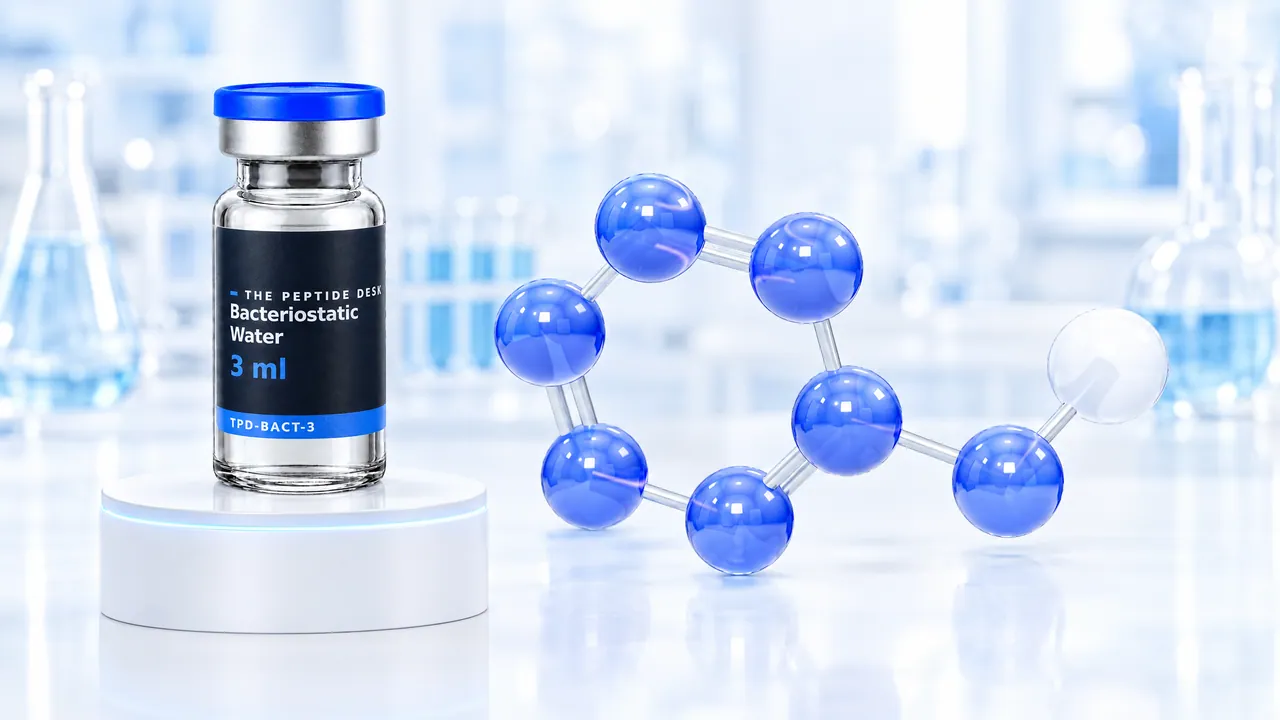
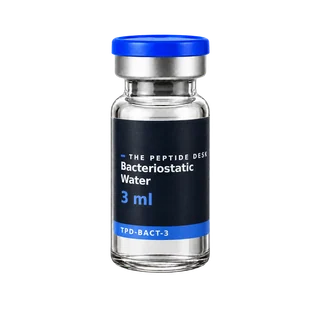
Vial of bacteriostatic water with a blue cap and the black TPD label on a white podium, next to a large blue 3D model of the benzyl alcohol molecule in a bright lab
Approved as a diluent · in the US as a diluent for injectionsLab tested in the shop

Summary

At a glance

Sources checked on 26 Oct 2026

Benzyl alcohol
0.9 %

as a preservative in sterile water for injection, according to the label1

Slightly acidic
5.7 pH

range according to the label 4.5 to 7.01

With pain on injection
38 %

with a pre-flush of saline with benzyl alcohol, without a pre-flush 84 percent2

Published since 1928
62 studies

on saline with benzyl alcohol, according to a review on injections around the eye4

  • Bacteriostatic water is sterile water for injection with 0.9 percent benzyl alcohol. The additive inhibits bacterial growth and allows several withdrawals from the same vial.1
  • According to the label it is meant only for diluting or dissolving medicines that are then given under the skin, into the muscle or into a vein. Plain and without a dissolved substance, injected straight into a vein, it can damage red blood cells.1
  • Benzyl alcohol is off limits for newborns: in them it has been linked to severe poisoning. For them there is sterile water without a preservative.15
  • Benzyl alcohol also has a mild local numbing effect: in one study 38 instead of 84 percent felt pain on injection with a pre-flush of saline with benzyl alcohol.24
  • Bacteriostatic water is approved as a diluent in the US. Everything here is the state of research, not a recommendation.1
Profile

Updated June 2026

Class
Diluent / solvent
Additive
0.9% benzyl alcohol as preservative
Size
3ml vial
Storage
Room temperature

a dark cupboard is enough - no fridge needed

Sizes
3 to 10 ml

2 sizes in the shop

Contents 13 sections
  1. At a glance
  2. What is bacteriostatic water?
  3. How to reconstitute peptides
  4. Dosing on the insulin syringe
  5. Storage and shelf life
  6. Sterile vs bacteriostatic water
  7. Research status
  8. How much bac water you get at TPD
  9. Safety notes
  10. Related compounds
  11. FAQ
  12. Glossary
  13. Sources

What is bacteriostatic water?

Bacteriostatic water is sterile water for injection with 0.9% benzyl alcohol added as preservative. The benzyl alcohol inhibits bacterial growth - hence "bacteriostatic" - and allows multiple withdrawals from the same vial over about 28 days.

It is the standard diluent used to reconstitute lyophilized (freeze-dried) peptides before injection. Without bac water the peptide stays as dry powder and cannot be injected.
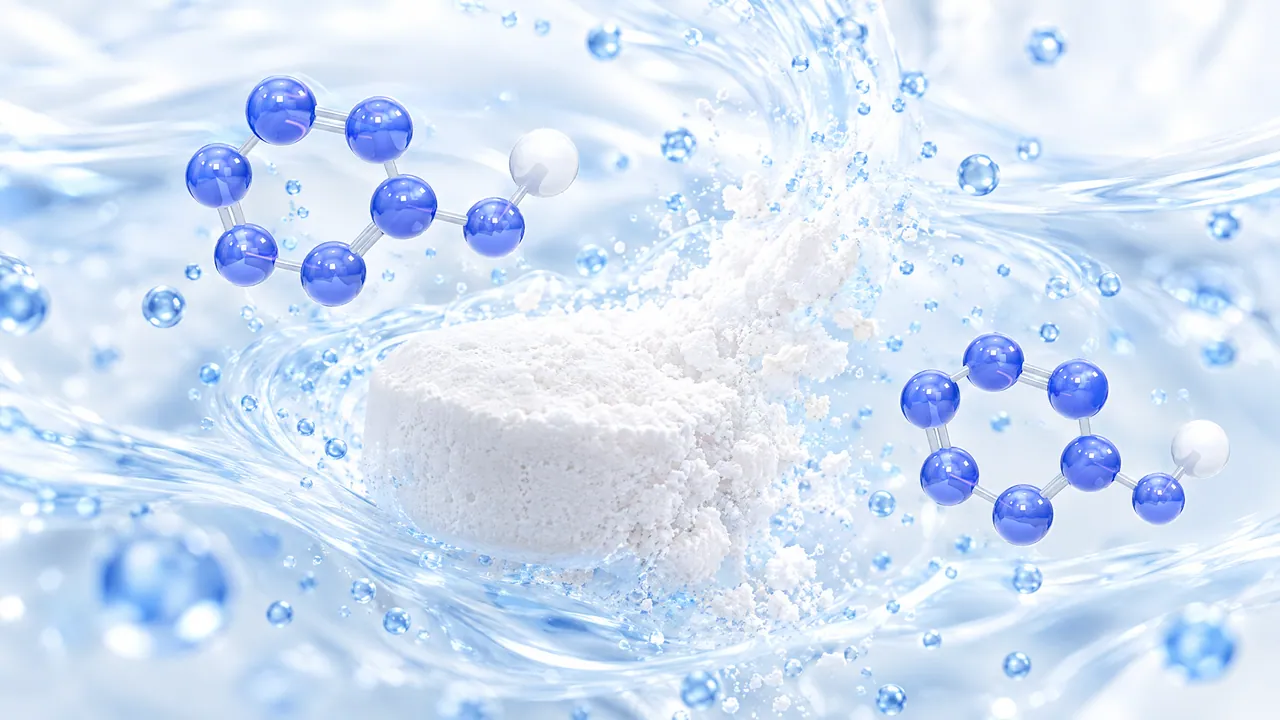
White powder dissolving in a swirl of clear water, next to two blue 3D models of the benzyl alcohol molecule and small bubbles
Powder is dissolved with the water. Symbolic image.

How to reconstitute peptides

The standard process in five steps:

  1. Bring both vials (peptide and bac water) to room temperature.
  2. Draw the desired amount of bac water with a sterile insulin syringe (typically 2-3ml for a 5mg vial).
  3. Insert the needle into the peptide vial and add the bac water - it does not matter if it hits the powder directly, that is a myth.
  4. Swirl or shake the vial until everything dissolves - both are fine, the old no-shaking rule is a myth.
  5. Wait until the solution is fully clear (1-2 minutes).

The amount of bac water determines the concentration. More water = lower concentration per unit on the syringe, less water = higher concentration.

Step by step

Dissolving the powder

Four steps, the same for every vial size.

  1. 1Wipe the cap

    Clean the rubber stopper with an alcohol swab.

  2. 2Add BAC water

    Just add it, it does not matter if it hits the powder directly.

  3. 3Swirl or shake

    Until everything has dissolved, both are fine.

  4. 4Draw up

    With the U-100 insulin syringe.

Less water higher concentration fewer units on the syringe

Dosing on the insulin syringe

Dosing

Dosing, titration and syringe

Loading the dosing information …

  • Getting started and stepping up, drawn as a staircase
  • Units on the U-100 syringe for every step
  • How long one vial lasts

Storage and shelf life

  • Unopened: stable at room temperature until the printed expiry date.
  • Opened (vial punctured): 28 days at room temperature per standard guidance.
  • Reconstituted peptide: refrigerated, stable for at least 4 to 6 months with barely any loss of potency, in practice considerably longer.

Never freeze - it destroys the peptide structure. Keep protected from light.

Sterile vs bacteriostatic water

Two related products often confused:

  • Bacteriostatic water: with 0.9% benzyl alcohol. Multi-use possible. Standard for most peptides.
  • Sterile water for injection: no preservative. Single-use only. Needed for rare applications (e.g. infants or specific clinical procedures).

For standard peptide reconstitution: always bacteriostatic water.

Study results

What the trials measured

Interactive: switch tabs, tap points, show or hide arms. Arms are named relative to each other, no dosing advice.

Who reported pain on injection2

Share in percent, 120 patients before anaesthesia, randomised

Pain on injection2 Anaesthetic propofol into a vein
Without pre-flush (placebo) 84%
Lidocaine (anaesthetic) 52%
Saline with benzyl alcohol 38%

15 of 39 with benzyl alcohol, 22 of 42 with lidocaine, 33 of 39 without. Benzyl alcohol and lidocaine were each better than placebo.

Pain on a scale of 0 to 1003

68 patients, double-blind, mean values

During numbing of the skin3
Lidocaine (anaesthetic) 14.0%
Saline with benzyl alcohol 13.2%
During the joint injection3
Lidocaine (anaesthetic) 15.7%
Saline with benzyl alcohol 20.7%

No significant difference between saline with benzyl alcohol and buffered lidocaine. No adverse events occurred.
Glass display case in a bright lab with a beaker of clear water and an empty petri dish
With and without preservative. Symbolic image.

Research status

Where the research stands

There is no registered trial on bacteriostatic water itself. Shown are trials with saline containing the same additive (0.9 percent benzyl alcohol), mostly as gentle numbing before an injection. As of 26 Oct 2026. 6

  1. Preclinical 62 studies on saline with benzyl alcohol since 1928
  2. Phase 1 no registered trial
  3. Phase 2 no registered trial
  4. Phase 3 no registered trial
  5. Approval in the US as a diluent for injections
Bacteriostatic water for injection is approved in the US as a finished product, only for diluting or dissolving other medicines. ChEMBL lists benzyl alcohol as an approved substance.1
Show all 6 phase 4 trials on a timelineHide timeline 6 completed 0 running 1 with results
Phase 4

Bar: start to primary endpoint (planned for running trials). Green = completed, blue = progress until 26 Oct 2026.

How much bac water you get at TPD

We only ship as much bacteriostatic water as your reconstitution-required vials actually need - calculated at a maximum of 3ml per vial. Bacteriostatic water therefore cannot be bought "in stock". That is exactly why our automated system always adds the right amount to your cart when you order.

The same applies to single vials: 3ml per vial is included. If you order, say, 30ml but only have 5 vials, you receive 15ml - the difference is credited to your account as balance.

Safety notes

  • Use a fresh sterile syringe every time, never reuse.
  • Disinfect the vial septum with an alcohol swab before each withdrawal.
  • Watch for a clear solution - discard if cloudy or discolored.
  • Store out of reach of children.

Where it acts

What matters in the body

Tap a point or a card. Grey = finding from the label and studies.
  1. Skin and injection site

    Benzyl alcohol numbs slightly, injections were less painful in studies4

    Observed in trials
  2. Blood

    Plain without a dissolved substance into a vein it can destroy red blood cells (haemolysis)1

    Observed in trials

Related

Related compounds

A different path: all in the TPD lexicon.

FAQ

Common questions about Bacteriostatic Water

Short answers, each backed by the sources below.

What is in bacteriostatic water?

Sterile, pyrogen-free water for injection with 0.9 percent benzyl alcohol as a preservative. According to the label the pH is 5.7 (range 4.5 to 7.0). It is meant for several withdrawals from the same vial.1

Why not just sterile water?

Sterile water without an additive is meant for a single withdrawal. The benzyl alcohol inhibits bacteria that could get in with repeated punctures. One review reports very low infection rates for injections with preserved saline around the eye.14

Does it sting less on injection?

Benzyl alcohol has a mild local numbing effect. Before a stinging anaesthetic 38 percent felt pain with a pre-flush of saline with benzyl alcohol, 84 percent without. Before a hip injection it numbed as well as buffered lidocaine.23

Who is it not suitable for?

For newborns: in them benzyl alcohol has been linked to severe poisoning, the so-called gasping syndrome. According to the label it also does not belong in spinal or epidural anaesthesia or in larger amounts as fluid replacement.51

Can it be injected on its own?

It is meant only as a diluent. Plain and without a dissolved substance, injected straight into a vein, it can destroy red blood cells because it does not have the same salt concentration as blood. As possible reactions the label lists fever, problems and infections at the injection site as well as vein irritation.1

Are there studies on it?

None registered on bacteriostatic water itself. Saline with the same additive was tested in several phase 4 trials as gentle numbing, one of them for reconstituting botulinum toxin. One review counts 62 studies since 1928.64

Glossary

Terms explained briefly

Dotted words in the text open these explanations directly.

Bacteriostatic
Inhibits the growth of bacteria without reliably killing them.
Benzyl alcohol
A simple aromatic alcohol. In small amounts it inhibits bacteria and numbs slightly.
Gasping syndrome
Severe poisoning in newborns from benzyl alcohol, described in the 1980s.
Haemolysis
Breakdown of red blood cells, for example when they swell in fluid with too little salt.
Isotonic
With the same salt concentration as blood. Plain water is not.
Lyophilisate
Freeze-dried powder. Peptides come like this and are dissolved in water.
Multiple withdrawals
Liquid is drawn from the same vial several times, each time with a fresh needle.
Preservative
An additive that keeps a solution low in germs for longer.
Reconstitution
Dissolving a powder in a liquid so that it can be injected.
U-100 syringe
Insulin syringe with 100 units per 1 ml, one mark equals 0.01 ml.

Evidence

Sources

Show all 7 sourcesHide sources 4 Studies1 Trial registry2 Database checked 26 Oct 2026

Studies

  1. Saline with benzyl alcohol reduces pain from propofol

    Minogue und Sun, Anesthesia & Analgesia, 2005

    Checked 26 Oct 2026 via doi.org, Crossref, PubMed
  2. Saline with benzyl alcohol versus lidocaine before hip injection

    Kruse et al., PM&R, 2021

    Checked 26 Oct 2026 via doi.org, Crossref, PubMed
  3. Review of saline with benzyl alcohol for injections around the eye

    Hunt und Malhotra, Eye, 2022

    Checked 26 Oct 2026 via doi.org, Crossref, PubMed
  4. Gasping syndrome from benzyl alcohol in newborns

    Gershanik et al., New England Journal of Medicine, 1982

    Checked 26 Oct 2026 via doi.org, Crossref, PubMed

Trial registry

  1. Trials with benzyl alcohol on ClinicalTrials.gov

    ClinicalTrials.gov, U.S. National Library of Medicine

    Checked 26 Oct 2026 via ClinicalTrials.gov API v2

Database

  1. Label of Bacteriostatic Water for Injection (US)

    DailyMed, U.S. National Library of Medicine (NDA018802, Fassung Juli 2026)

    Checked 26 Oct 2026 via DailyMed
  2. Benzyl alcohol in ChEMBL (approved)

    ChEMBL, EMBL-EBI (CHEMBL720)

    Checked 26 Oct 2026 via ChEMBL

In the shop

Bacteriostatic Water in the catalog

Sizes, prices and shipping times are on the product page.

To the product