What is Alprostadil?
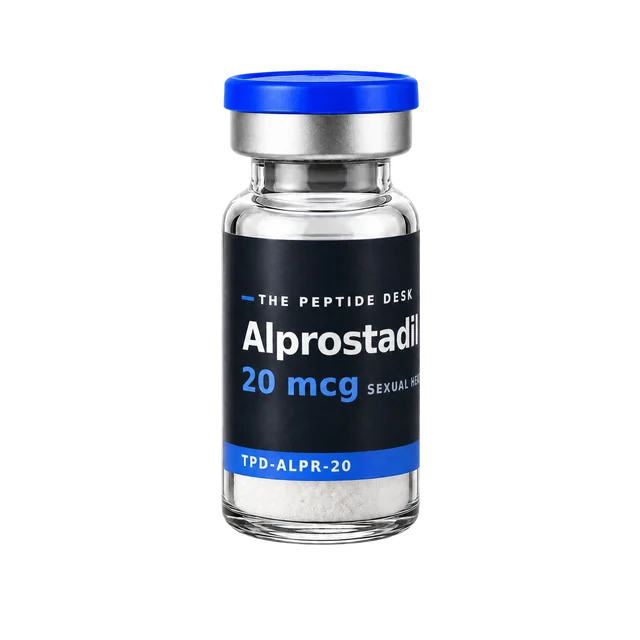
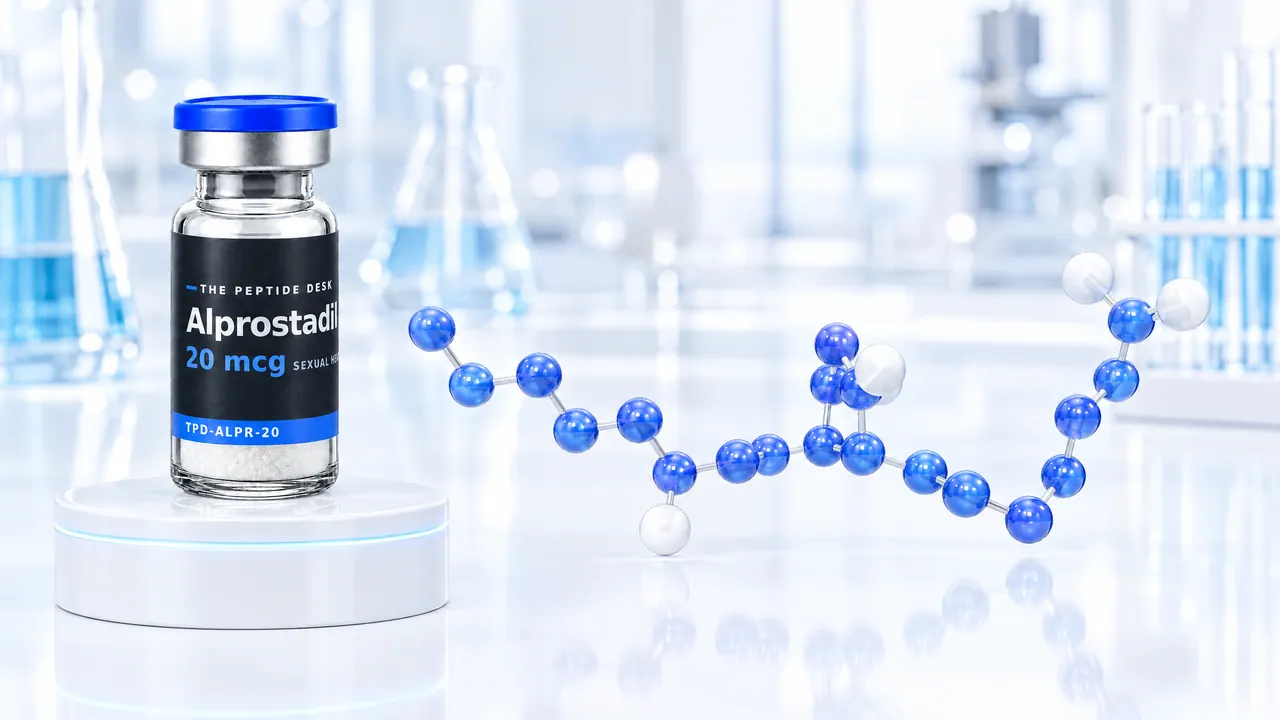
Alprostadil is the medical form of prostaglandin E1 (PGE1), a vessel-widening messenger. It is a clinically established agent for treating erectile dysfunction and is prescribed for that indication. We carry it as 20mcg vials with freeze-dried powder that is dissolved before use (as in the US prescribing information).
Important: alprostadil is a medical agent with sensitive use. The classic application (intracavernosal injection) is a medically guided procedure, not a casual research experiment.
Comparison
Approaches to erectile dysfunction
Compounds from the TPD lexicon, as described there. Tap a card to open its entry.
Simplified from the lexicon entries. Alprostadil acts directly in the erectile tissue, the other compounds act at other points. This page shows no direct comparison. 5
How it works
Alprostadil widens the blood vessels and relaxes the smooth muscle. Applied locally it increases circulation and can so trigger an erection, independent of sexual stimulation. That is exactly what makes it an effective agent for erectile dysfunction when tablets (like sildenafil/tadalafil) are not enough.
Where it acts
Where alprostadil acts
Tap a point or a card. Colour = receptor, grey = approved use.
Targets in the ChEMBL database6
Compound CHEMBL495: two recorded mechanisms, all Agonist according to ChEMBL.
- Gene
- PTGER1
- UniProt
- P34995
- ChEMBL
- CHEMBL1811
- Action
- Agonist according to ChEMBL
- Gene
- PTGER2
- UniProt
- P43116
- ChEMBL
- CHEMBL1881
- Action
- Agonist according to ChEMBL
Use
Dosing
Dosing
Dosing, titration and syringe
Loading the dosing information …
- Getting started and stepping up, drawn as a staircase
- Units on the U-100 syringe for every step
- How long one vial lasts
What the research shows
A clinical study (Linet, NEJM 1996) showed that intracavernosal alprostadil was effective in men with erectile dysfunction with tolerable side effects and a clear dose-response relationship. So alprostadil is a well-evidenced, medically established agent, the sensitive application is the decisive point.
Study results
What the trials measured
Interactive: switch tabs, tap points, show or hide arms. Arms are named relative to each other, no dosing advice.
Successful intercourse at home2
Share of men with intercourse at least once in three months
Values from the abstract. Only men who responded in the clinic continued at home (65.9 percent of 1,511). Given as a small pellet into the urethra, not as an injection. No priapism and no fibrosis in this study.
Self-injection into the erectile tissue1
Share of injections, 683 men over six months
Values from the abstract, open study without placebo. In a second part with 296 men all doses were better than placebo, with a clear dose-response relationship.
Circulatory disorder of the legs, stage IV4
Share of participants in percent, 840 participants, infusion
Values from the abstract. In this other use alprostadil was not superior to placebo, the differences were not significant.

Research status
Where the research stands
Alprostadil has been approved since 1981, the approval studies in erectile dysfunction ran before the registry existed. A search for alprostadil and erectile dysfunction finds 14 entries there, many use the compound only as a tool. Shown are trials with alprostadil as the tested agent, plus a large trial on circulation in the legs. As of 26 Oct 2026. 7
- Preclinical Prostaglandin E1, a messenger made by the body
- Phase 1 1 trial, 1 completed
- Phase 2 3 trials, 1 completed, 1 stopped early
- Phase 3 2 trials, 1 completed, 1 stopped early
- Approval in the USA since 1981
Show all 6 phase 2, 3 and 4 trials on a timelineHide timeline
NCT00080808 · 111 participants, started Aug 2001, primary endpoint reached Jul 2006. Tests several agents.
Registry entry ↗ · Results not yet in PubMed
NCT01810575 · 16 participants, started Feb 2013, stopped early Apr 2013.
NCT07601646 · 83 participants (planned), started May 2026, primary endpoint planned Apr 2027.
NCT00544076 · 110 participants, started Jan 2006, stopped early Apr 2012. Tests several agents.
NCT01008605 · 48 participants, started Feb 2011, primary endpoint reached Feb 2011.
Registry entry ↗ · Results not yet in PubMed
ESPECIAL · NCT00596752 · 840 participants, started Mar 2004, primary endpoint reached May 2013.
Registry entry ↗ · Results: Lawall et al., European Journal of Vascular and Endovascular Surgery, 2017
Bar: start to primary endpoint (planned for running trials). Green = completed, blue = progress until 26 Oct 2026, grey = stopped early. Phase 1: 1 trial on safety and pharmacokinetics, not shown as bars.
Side effects
- Painful prolonged erection (priapism), an emergency that must be treated medically.
- Pain or burning at the application site.
- Dizziness, drop in blood pressure.
Tolerability
Local side effects with injection
Out of 100 men per group, how many had the event in studies of up to 18 months (1,861 with alprostadil, 294 with placebo).
| Event | Placebo | Alprostadil |
|---|---|---|
| Penile pain5 | 2% | 37% |
| Prolonged erection (4 to 6 hours)5 | 0% | 4% |
| Hardening in the penis (fibrosis)5 | 0% | 3% |
| Bruise at the injection site5 | 0% | 3% |
| Dizziness5 | 0% | 1% |
Values from the US prescribing information. With placebo no local or general side effect occurred apart from penile pain. Priapism over 6 hours occurred in 0.4 percent, 3 percent stopped because of pain.5
Practice
-
A delicate, medically applied agent, not a casual self-experiment.
-
With an erection lasting more than a few hours, seek medical help immediately (priapism).
-
For erection problems oral agents (sildenafil/tadalafil) are the first, simpler choice.

Storage
According to the US prescribing information, unopened 20mcg vials are stored at room temperature, meaning 20 to 25 °C. Use the dissolved solution within 24 hours, keep it at or below 25 °C, do not put it in the fridge and do not freeze it. Store out of reach of children, keep the original packaging closed and mind the expiry date.