What is the Cartalax + TB-500 + BPC-157 Blend?
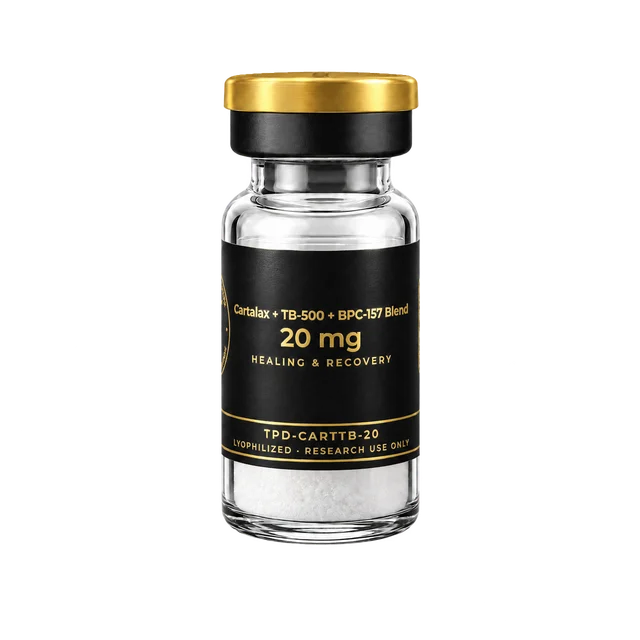
The blend combines three peptides from regeneration research in one vial: Cartalax, a short bioregulator peptide from the Khavinson program focused on cartilage, plus TB-500 and BPC-157, which together form the best-known healing stack. You can find all three on their own in the lexicon.
The 20mg vial holds 10mg Cartalax, 5mg TB-500 and 5mg BPC-157. The 2:1:1 ratio is fixed; the components cannot be adjusted separately.
This information is for research and educational purposes only. No medical advice.
How it works
The three components act at different points. Cartalax is the tripeptide Ala-Glu-Asp (AED); according to the Khavinson group it influences gene expression in cartilage cells, and in cell cultures chondrocytes multiplied more with it.
TB-500 is the synthetic form of thymosin beta-4. It binds the structural protein actin inside the cell and promotes cell migration and new vessel formation in animal models. In studies BPC-157 acts via the nitric oxide axis and promotes outgrowth, survival and migration of tendon cells.
The idea of the blend: Cartalax for cartilage, TB-500 and BPC-157 for tendons, ligaments and soft tissue. Whether they complement each other in combination has not been studied.
What you need
- The blend vial (lyophilized powder, all three compounds).
- Bacteriostatic water, U-100 insulin syringes and alcohol swabs.
- A fridge for the mixed solution.
Reconstitution
Use the peptide calculator. The values refer to the total amount in the vial, meaning all three compounds together. A 20mg vial with 2ml of water gives 10mg per ml: 1mg total is then 10 units on a U-100 syringe, 2mg total 20 units. Simply add the water to the vial and let it dissolve.
Injection
The injection goes subcutaneously, into the fatty tissue under the skin. Typical sites are the belly (leave about two finger widths around the navel), the front and inner thigh or the back of the upper arm.
- Clean the skin with an alcohol swab and let it dry briefly
- Lift a small fold of skin
- Insert the needle: at 90 degrees where there is more fat under the skin, at 45 degrees in lean people with little fat
- Inject slowly, wait a moment, then withdraw the needle
- Put the needle straight into the sharps container
Rotate the injection site each time so the tissue does not get irritated.
Use and dosing
What the research shows
All three components are described mainly in preclinical work. For Cartalax the data come almost only from the Khavinson group in Saint Petersburg (cell culture on chondrocytes, Myakisheva 2023); independent confirmation is missing.
BPC-157 promoted outgrowth and migration of tendon cells (Chang 2011), and thymosin beta-4 sped up wound healing in a rat model (Malinda 1999). In a study on the sutured rat Achilles tendon, BPC-157 and TB-500 each improved tissue structure while the combination brought no additional benefit (Biçer 2026).
To be honest: there is no study on exactly this three-way mix; its benefit is derived from the mechanisms of the single compounds.
Side effects
- Usually well tolerated, mostly local reactions at the injection site such as redness or itching.
- TB-500 and BPC-157 promote new vessel formation in animal models; with existing growths or a history of cancer this is a theoretical concern.
- Robust long-term human data are missing for all three components.
Storage
Before mixing, the powder is robust; normal room temperature (around 20 to 25 degrees) is fine, ideally stored dark. After mixing keep it in the fridge (2 to 8 degrees), do not freeze. There the solution keeps for at least 4 to 6 months with almost no loss of potency, in practice much longer. Swirling or shaking to mix are both fine.