What is Dapoxetine?
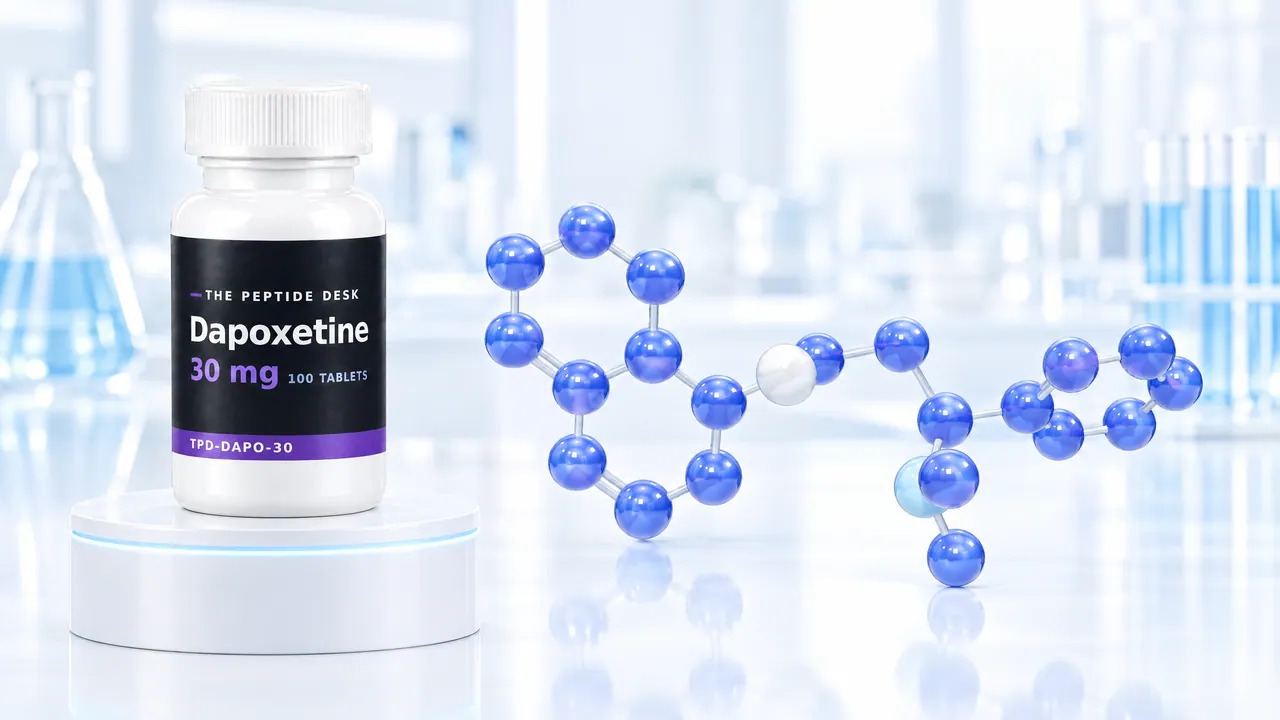
Dapoxetine (known as Priligy) is a selective serotonin reuptake inhibitor (SSRI), but a special one: unlike the classic SSRIs for depression, it is not taken continuously but on demand, one to three hours before sexual activity.
Its target is different from the PDE-5 inhibitors: dapoxetine addresses premature ejaculation, not the erection. The two are sometimes combined because they address different things.
Comparison
Sexual health in the lexicon
What each entry targets, as stated in the TPD lexicon. Tap a card to open its entry.
Simplified. Dapoxetine delays ejaculation, PDE5 inhibitors improve erection, PT-141 acts on desire in the brain. With sildenafil and tadalafil there was no relevant interaction in the blood. 6
How it works
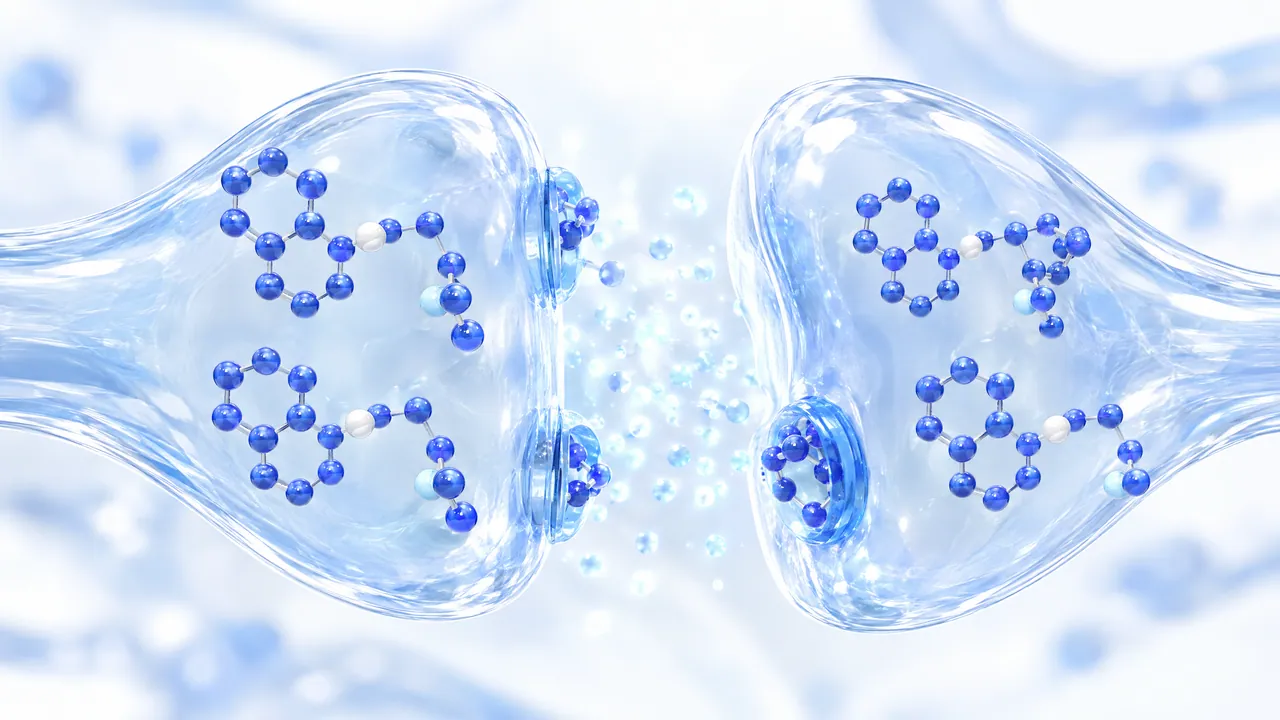
Serotonin is involved in the nervous system's control of the ejaculation reflex; more available serotonin tends to delay it. Dapoxetine briefly raises serotonin availability and so shifts the timing later.
The key is the fast pharmacokinetics: peak after 60 to 90 minutes, half-life only one to two hours. So the effect is fast in and fast out, without the typical chronic SSRI pharmacology.
Where it acts
Where dapoxetine acts
Tap a point or a card. Colour = serotonin transporter, grey = observed.
Targets in the ChEMBL database9
Compound ChEMBL CHEMBL2110900: one recorded mechanism, Inhibitor.
How to take it
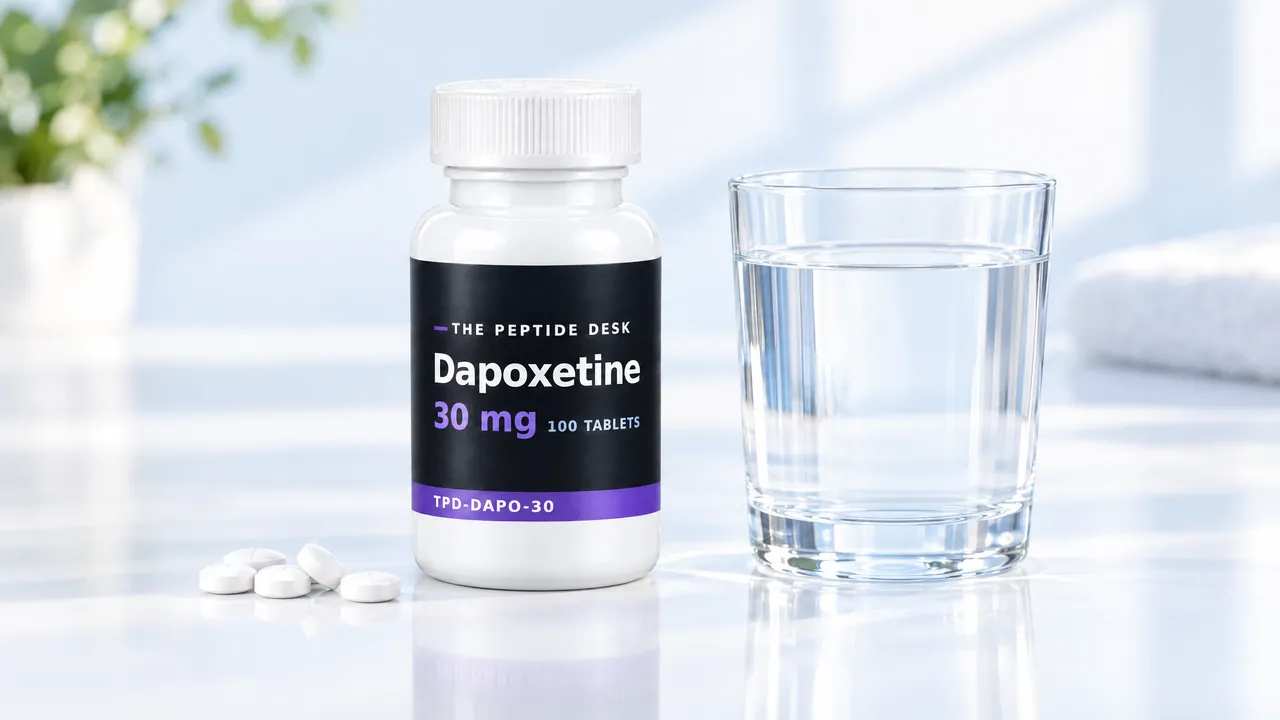
Dapoxetine is taken as a tablet on demand, about one to three hours before activity.
- Common is 30mg, with 60mg if needed and well tolerated.
- At most once a day.
- A glass of water with it helps against possible nausea. Do not combine with alcohol.
What the research shows
Dapoxetine is well studied clinically. An integrated analysis of two large randomised phase 3 trials (Pryor, 2006) showed that on-demand dapoxetine is effective and generally well tolerated in premature ejaculation. On this basis it was introduced as a specific agent for PE.
The study with a link is in the source block below.
Study results
What the trials measured
Interactive: switch tabs, tap points, show or hide arms. Arms are named relative to each other, no dosing advice.
Time to ejaculation1
2,614 men, measured by stopwatch, mean
Placebo: Week 0 +0.9 min, Week 12 +1.8 min. Lower level: Week 0 +0.9 min, Week 12 +2.8 min. Higher level: Week 0 +0.9 min, Week 12 +3.3 min.
Values from the abstract, baseline and study end. Both levels worked from the first dose. Taken on demand 1 to 3 hours beforehand.
Time to ejaculation after 24 weeks2
1,162 men, start at 0.9 minutes in all groups
Values from the abstract. Only 618 men completed the study. Only men in steady relationships were included.
Rise from baseline after 12 weeks3
6,081 men from five phase 3 trials, geometric mean
Values from the abstract. Questionnaires showed no anxiety, restlessness, suicidal thoughts or mood changes. There was no discontinuation syndrome after abrupt stopping.

Research status
Where the research stands
ClinicalTrials.gov lists 33 trials with dapoxetine. Shown here are the manufacturer's trials and interaction studies. For the phase 3 trials up to 2006 the registry only gives the study end, one more has no date at all and is missing. As of 26 Oct 2026. 8
- Preclinical Pharmacokinetics in healthy men
- Phase 1 3 trials, 3 completed
- Phase 2 no registered trial
- Phase 3 6 trials, 6 completed
- Approval in several countries, for example the UK
Show all 6 phase 3 trials on a timelineHide timeline
NCT00211107 · 1,294 participants, started Jun 2003, primary endpoint reached Jun 2004.
Registry entry ↗ · Results: Pryor et al., The Lancet, 2006
NCT00210613 · 199 participants, started Nov 2004, primary endpoint reached Aug 2005.
Registry entry ↗ · Results not yet in PubMed
NCT00229073 · 1,116 participants, started Dec 2004, primary endpoint reached Oct 2006.
Registry entry ↗ · Results not yet in PubMed
NCT00210704 · 1,067 participants, started Mar 2005, primary endpoint reached Jun 2006.
Registry entry ↗ · Results not yet in PubMed
COUPLE · NCT01063855 · 495 participants, started Apr 2010, primary endpoint reached Aug 2011.
Registry entry ↗ · Results not yet in PubMed
NCT01063881 · 285 participants, started May 2010, primary endpoint reached Jun 2011.
Registry entry ↗ · Results not yet in PubMed
Bar: start to primary endpoint (planned for running trials). Green = completed, blue = progress until 26 Oct 2026. Phase 1: 3 trials on safety and pharmacokinetics, not shown as bars.
Side effects
The most common side effect is nausea, clearly dose-dependent. On top come dizziness, headache and occasionally diarrhoea. Because dapoxetine is serotonergic, caution is needed when combining with other serotonin-active substances (other SSRIs, certain migraine or pain medications, MDMA).
Tolerability
Common side effects
Out of 100 participants per group, how many had the event over 12 weeks.
| Event | Lower level | Higher level |
|---|---|---|
| Nausea1 | 9% | 20% |
| Headache1 | 6% | 7% |
| Diarrhoea1 | 4% | 7% |
| Dizziness1 | 3% | 6% |
| Stopped due to side effects2 | 4% | 8% |
The abstract of the 12-week trials gives no placebo values. In a meta-analysis 50.5 percent on dapoxetine and 27.9 percent on placebo had side effects, serious ones were rare.124
Safety and interactions
The most important point is the serotonergic interaction: combining with other serotonin-active compounds can lead to a serotonin excess and should be avoided. Anyone taking antidepressants or other central medications should clear it with a doctor first. Also be careful with circulatory sensitivity (dapoxetine can cause dizziness on standing up).
Storage
Store the tablets dry, at room temperature and protected from light, out of reach of children. Keep the original packaging closed and mind the expiry date.