

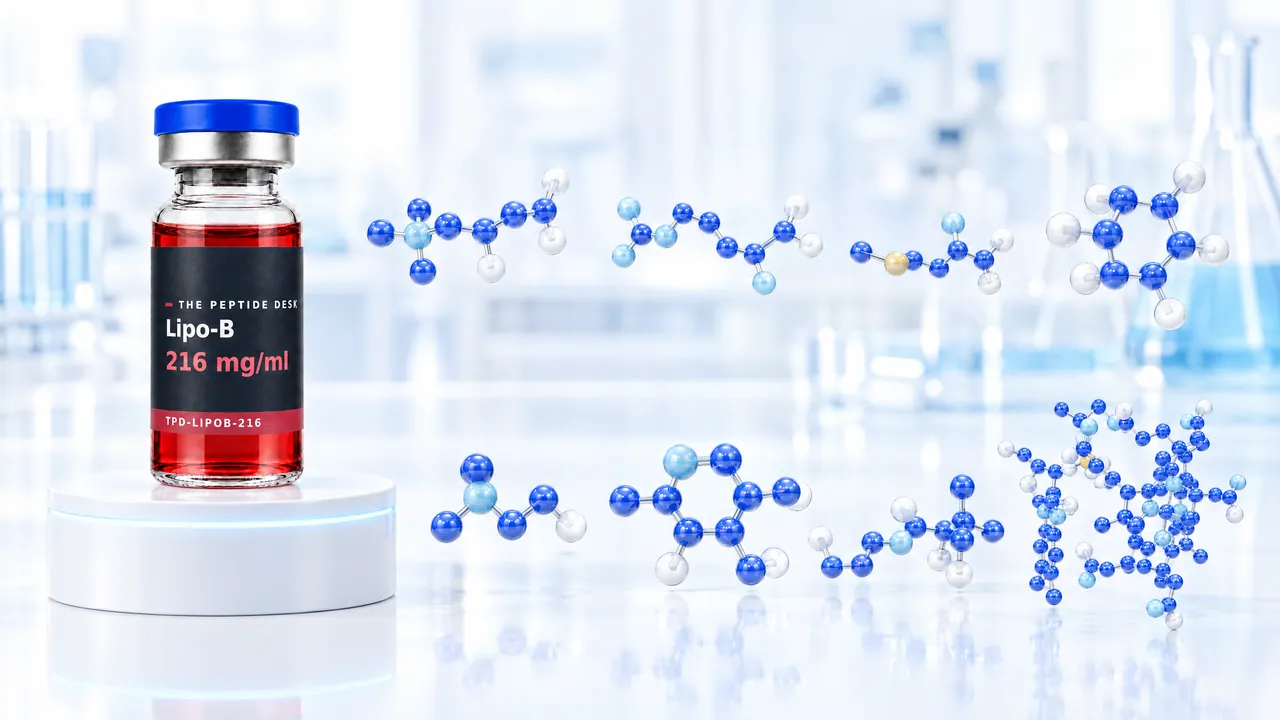
What is Lipo-B?
Lipo-B is an extended variant of the Lipo-C family that, in addition to classical lipotropic components (methionine, inositol, choline), contains an expanded B-vitamin complex. Typical Lipo-B formulations combine alongside B12 also B1 (thiamine), B2 (riboflavin), B3 (niacin), B5 (pantothenic acid) and B6 (pyridoxine).
This expansion addresses energy metabolism more broadly than pure Lipo-C configuration. B vitamins are cofactors in virtually all central metabolic pathways: B1 in pyruvate metabolism, B2 in the respiratory chain, B3 as NAD/NADP precursor, B5 in coenzyme A, B6 in amino acid metabolism, B12 in methylation and homocysteine pathway.
This information is for research and educational purposes only. No medical advice.
Comparison
What is in which blend
Components according to the TPD lexicon. MIC stands for methionine, inositol and choline, B complex for B1, B2, B3, B5 and B6. Tap a card to open its entry.
Simplified: the amounts per component differ. More components do not automatically mean more effect.
How it works
Lipo-B works in parallel through two mechanisms: methylation pool regulation and mitochondrial cofactor supply:
- Methylation axis: Methionine and choline provide methyl groups, B12 supports homocysteine remethylation.
- NAD+ pathway: B3 (niacin) is a precursor to NAD/NADP, central to energy production and redox reactions.
- Cofactor cascade: B1, B2, B5, B6 are cofactors in pyruvate dehydrogenase, respiratory chain and amino acid metabolism.
- Synergistic effect: B-vitamin expansion addresses NAD+ precursors and mitochondrial cofactors, complementary to MOTS-C or NAD+ studies.
Where it acts
Where the components act
Tap a point or a card. Colour = component. All from studies on single components, not on the blend.
- Liver
Without choline in the diet many developed a fatty liver, choline in the infusion reduced the fat5
MIC - Muscle
Choline deficiency caused muscle damage in some people5
MIC - Blood
Vitamin B12 lowered homocysteine in the blood by a further 7 percent, B6 did not7
B12 - Waist
Inositol slightly reduced waist size in a meta-analysis8
MIC
Targets in the ChEMBL database10
Three recorded mechanisms, type of action on each card.
- Gene
- MAT1A
- UniProt
- Q00266
- ChEMBL
- CHEMBL5169142
- Action
- Enzyme, turns methionine into SAM, the main methyl group donor
- Gene
- CHKA
- UniProt
- P35790
- ChEMBL
- CHEMBL3117
- Action
- Enzyme, first step from choline to phosphatidylcholine
- Gene
- MTR
- UniProt
- Q99707
- ChEMBL
- CHEMBL2150844
- Action
- Enzyme, needs vitamin B12 and turns homocysteine back into methionine
Application and dosing
Dosing
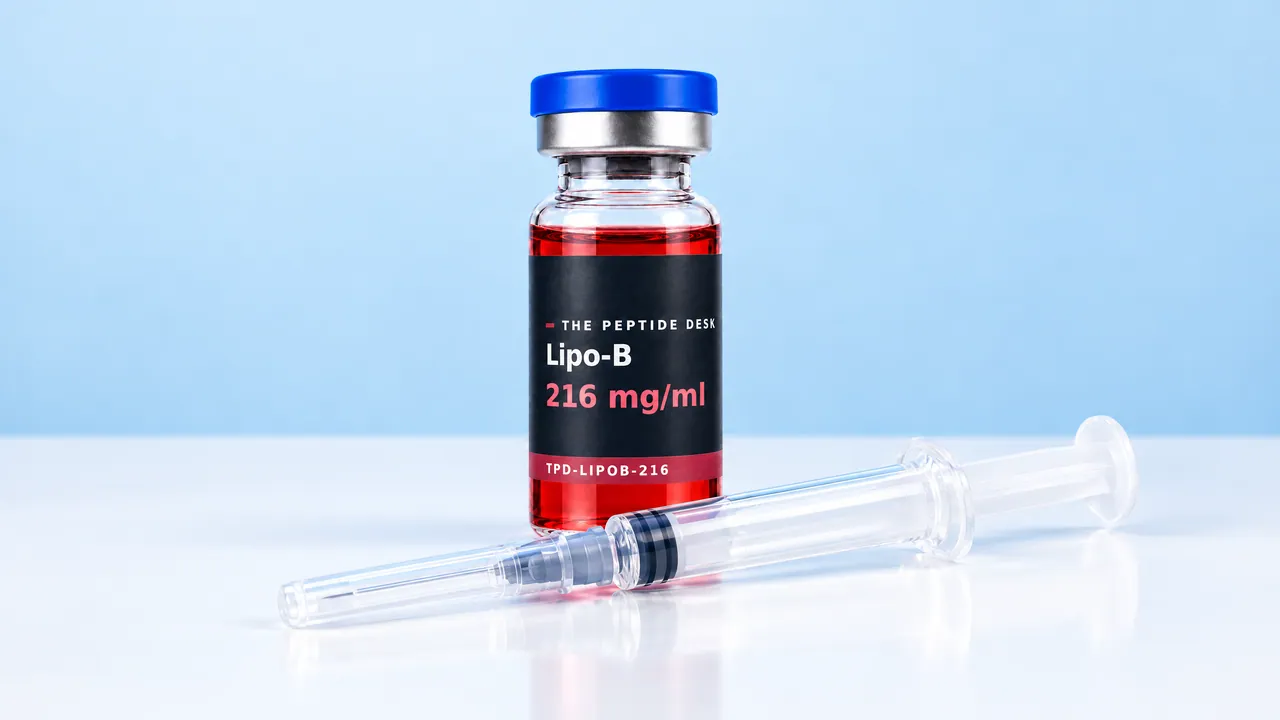
Dosing, titration and syringe
Loading the dosing information …
- Getting started and stepping up, drawn as a staircase
- Units on the U-100 syringe for every step
- How long one vial lasts
What the research shows
Studies document the role of the B-vitamin axis in metabolic regulation:
- NAD+ metabolism: B3 deficiency reduces NAD+ availability, central to sirtuin activity and mitochondrial function.
- Energy production: B1, B2, B5 are essential in pyruvate oxidation and respiratory chain - limiting factors under energy deficit.
- One-carbon pathways: B6, B12 and folate together regulate homocysteine remethylation.
- Practical context: Lipo-B particularly useful in documented B-vitamin deficiency or when broader energy metabolism focus is desired.
Study results
What the trials measured
Interactive: switch tabs, tap points, show or hide arms. Arms are named relative to each other, no dosing advice.
Organ damage without choline5
Share with fatty liver or muscle damage on a low-choline diet, in percent
Controlled diet for up to 42 days. Those who developed organ damage got choline back, after which the values returned to normal. The study shows the need for choline, not the effect of an injection.
Liver density on CT6
Rise in Hounsfield units (HU), higher means less fat in the liver
15 patients fed almost entirely through a vein, 24 weeks. Liver values in the blood fell with choline, 10 weeks after it ended the fat came back. Choline was given in the infusion here, not as an injection under the skin.
Research status
Where the research stands
There is no registered trial of the blend. Studies on single components are shown above under the results. As of 26 Oct 2026. 9
- Preclinical No study of the blend, components known from nutrition research
- Phase 1 no registered trial
- Phase 2 no registered trial
- Phase 3 no registered trial
- Approval not yet
So far there is no registered trial in humans. 9
Side effects
Lipo-B is considered predominantly mild per research reports. The broader B-vitamin portion shapes the documented profile.
- Injection site: Redness, pressure, mild burning or transient irritation are common.
- B-vitamin complex: Due to expanded B-vitamin portion, occasionally a flushing sensation, warmth or mild tingling is reported after application, typical for B3- and B12-containing blends.
- Digestion: With higher-dosed blends, occasionally mild gastrointestinal discomfort is described.
- Data limitations: Direct comparative studies on Lipo-B as a specific formulation are lacking.
Storage
Lipo-B is an oil-based injection concentrate and should be stored at room temperature, protected from light. A refrigerator is not necessary.
Storage:
- Room temperature (18-25°C)
- Protected from light (dark bottle)
- Store dry
- Use within 60 days after opening



