This information is for research and educational purposes only. No medical recommendations. Products are not approved for human use. For health questions, consult a doctor.

Lexicon

Vilon

A Khavinson cytogen dipeptide aimed at the immune system and general regeneration.

3 min read 9 sources

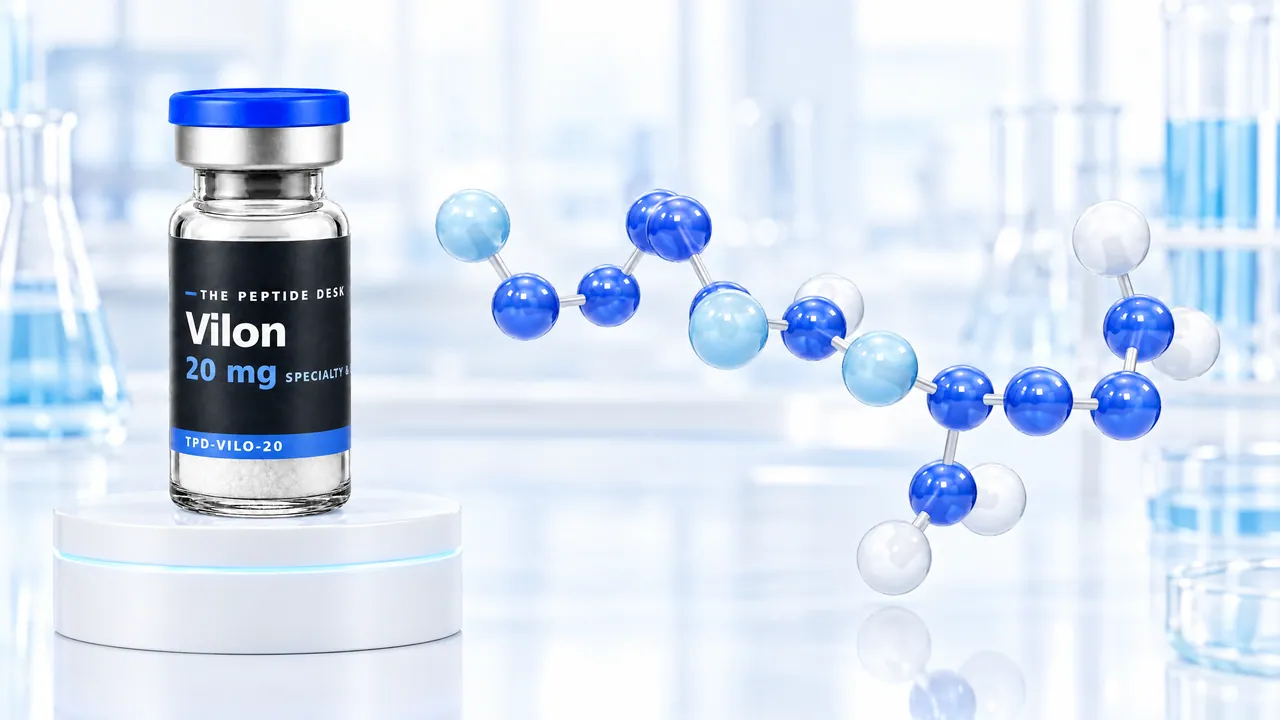
Vilon vial with the black TPD label on a white podium, next to a short molecule chain of blue and white spheres in a bright lab
No registered trial · not approved

Summary

At a glance

Sources checked on 26 Oct 2026

Length
2 amino acids

Lys-Glu (KE), assigned to the immune system in the Khavinson programme2

Rats with bladder tumours
56 %

versus 75.5 percent without Vilon, tumours triggered by a carcinogen5

More SIRT1 gene activity
6 -fold

in young human stem cells, cell culture7

In the registry
0 trials

no trial with Vilon on ClinicalTrials.gov, as of 26 Oct 20269

  • Vilon is the dipeptide Lys-Glu (KE) from the Russian Khavinson programme. There it is assigned to the immune system.21
  • In one mouse study animals given Vilon lived longer and developed spontaneous tumours less often. In a second study by the same group Vilon increased activity and reduced lung adenomas, a longer survival was seen there only with Epitalon.34
  • In rats with induced bladder cancer 56 percent developed a tumour with Vilon, 75.5 percent without it.5
  • In human stem cells KE raised the activity of the SIRT1 gene six-fold. With monocytes in the lab Vilon, like other Khavinson peptides, dampened the inflammatory messengers TNF and IL-6.76
  • There is no registered human trial, only small Russian reports. Everything here is preclinical research, not a recommendation.98
Profile

Updated May 2026

Class
Short bioregulator peptide

Khavinson cytogen

Use
Subcutaneous

in mg

Target tissue
the immune system and general regeneration
Status
Data mostly from the Khavinson program
Sizes
20 mg

1 size in the shop

Contents 15 sections
  1. At a glance
  2. What is Vilon?
  3. How it works
  4. What you need
  5. Reconstitution
  6. Dosing
  7. Injection
  8. What the research shows
  9. Research status
  10. Side effects
  11. Storage
  12. Related compounds
  13. FAQ
  14. Glossary
  15. Sources

What is Vilon?

Vilon is a short peptide from the Russian Khavinson program, which deals with tissue-specific bioregulators. These very short peptides (usually 2 to 4 amino acids) are meant to act specifically on a particular tissue, Vilon is aimed at the immune system and general regeneration.

Up front: most research comes from a single research line and mostly from Russia, large independent studies are missing.

Comparison

Same family, different building blocks

Short peptides from the Khavinson programme with their amino acid sequence according to a review. Tap a card to open its entry.

The assignment to a tissue comes from the Khavinson group itself. It has not been confirmed independently. 2

How it works

The theory behind the Khavinson peptides: they are meant to act at the level of gene regulation and restart age-related declining functions of a tissue. For Vilon a supportive effect on the immune system and general regeneration is described.

How well this concept transfers to humans is little established outside the originating research.

Where it acts

Where Vilon acted in experiments

Tap a point or a card. All from cell and animal studies, there is no confirmed receptor.

  1. Immune cells

    Monocytes in the lab: less TNF and IL-6 after an inflammatory stimulus6

    Observed in trials
  2. Lung

    Mice: spontaneous lung adenomas less often4

    Observed in trials
  3. Urinary bladder

    Rats: 56 versus 75.5 percent with an induced bladder tumour5

    Observed in trials

Known targets2

Compound Dipeptid KE: one described target, Modelled on the computer (docking), binding weaker than the authors' threshold.

Amino acid transporter LAT1
Gene
SLC7A5
UniProt
Q01650
ChEMBL
CHEMBL4459
Action
Modelled on the computer (docking), binding weaker than the authors' threshold
Glass cells with glowing DNA inside, surrounded by tissue fibres, small blue molecule chains moving in
The Khavinson concept assigns Vilon to the immune system. Symbolic image.

What you need

Supplies

2 things, numbered as in the picture

Tick off what you already have. Vial and BAC water are our real shop photos at the same size.
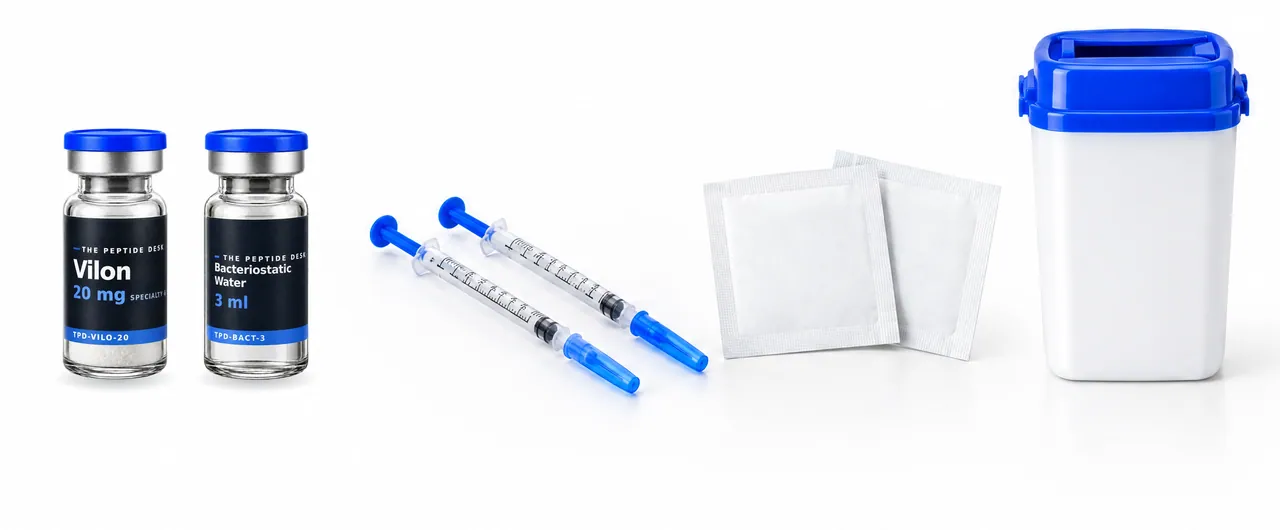
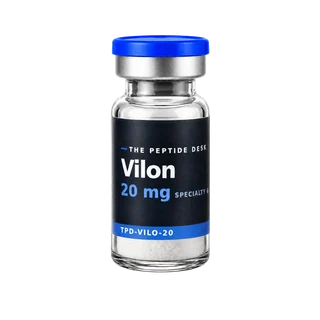
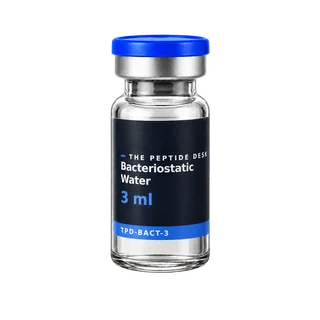
Vilon vial and bacteriostatic water at the same size with the black TPD label, next to two U-100 insulin syringes, two alcohol swabs and a sharps container with a blue lid
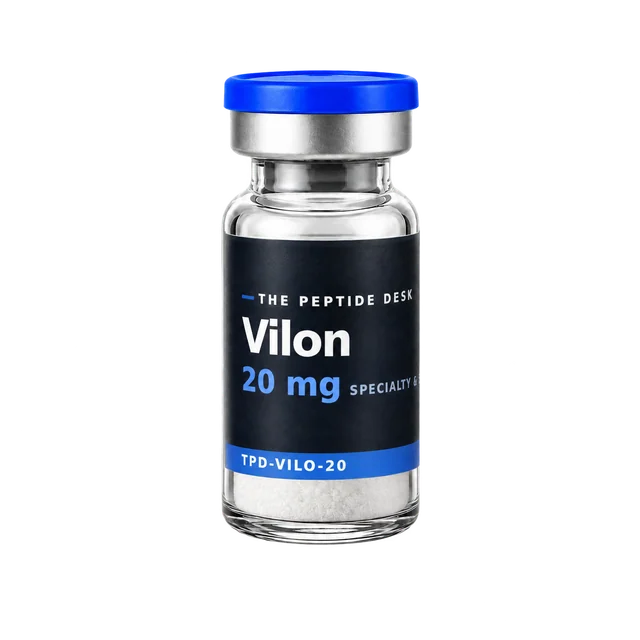
  1. Vilon vial

    The vial (lyophilized powder, usually 20mg).

    In the shop
  2. Water and supplies

    Bacteriostatic water, U-100 insulin syringes, alcohol swabs.

As an Amazon associate we earn from qualifying purchases. Links open Amazon - no extra cost for you.

Reconstitution

Use the peptide calculator. A 20mg vial with 2ml water gives 10mg per ml. Just add the water to the vial and let it dissolve.
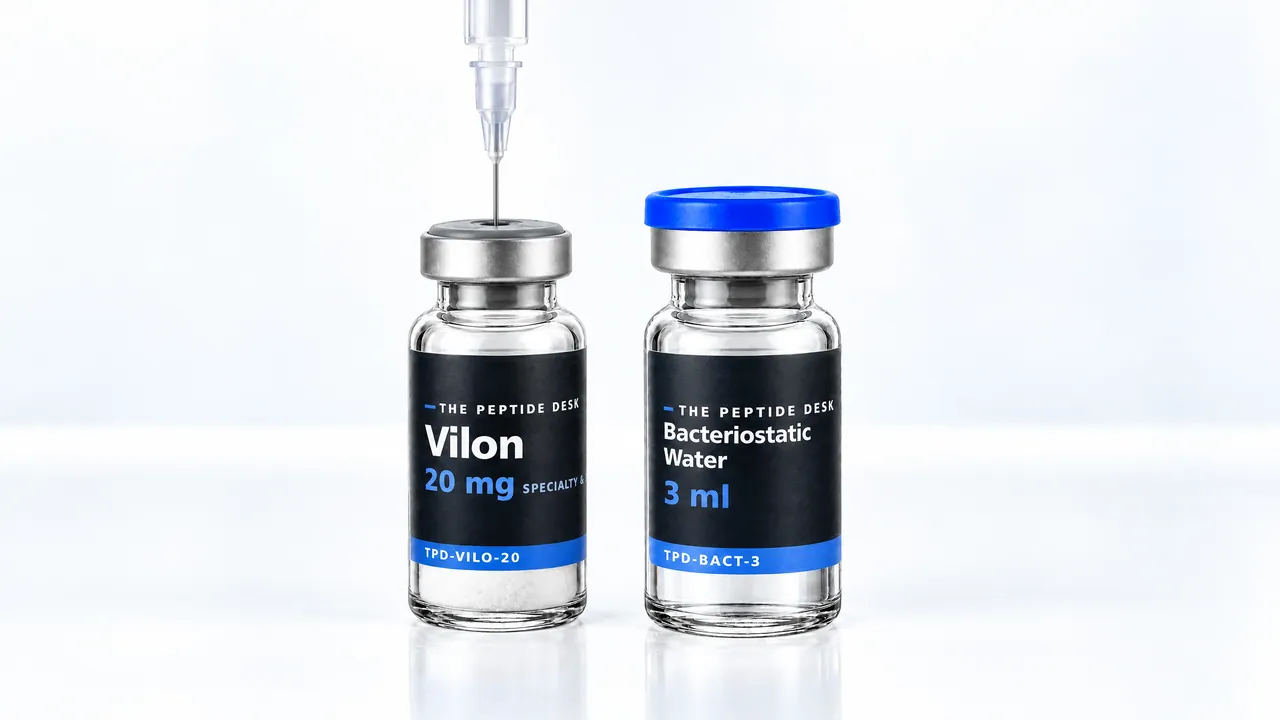
Step by step

Dissolving the powder

Four steps, the same for every vial size.

  1. 1Wipe the cap

    Clean the rubber stopper with an alcohol swab.

  2. 2Add BAC water

    Just add it, it does not matter if it hits the powder directly.

  3. 3Swirl or shake

    Until everything has dissolved, both are fine.

  4. 4Draw up

    With the U-100 insulin syringe.

Less water higher concentration fewer units on the syringe Example: 20 mg + 2 ml = 10 mg/ml

Dosing

Dosing

Dosing, titration and syringe

Loading the dosing information …

  • Getting started and stepping up, drawn as a staircase
  • Units on the U-100 syringe for every step
  • How long one vial lasts

Injection

The injection is subcutaneous, into the fat layer under the skin. Common spots are the abdomen (keep about two finger-widths clear of the navel), the front and the inner side of the thigh, or the back of the upper arm.

The short version:

Injection

Where and at what angle

Pick a spot or switch the angle. Subcutaneous means: into the fat layer, not the muscle.

Rotate the spot each time, never the same one twice in a row.

90°More fat under the skin

Rule of thumb: where there is more fat under the skin, insert straight at 90 degrees. In lean people with little fat, 45 degrees, so the needle stays in the fat layer. Simplified diagram.

  1. Clean the spot with an alcohol swab and let it dry

  2. Pinch up a small fold of skin

  3. Insert the needle: at 90 degrees where there is more fat under the skin, at 45 degrees in lean people with little fat

  4. Inject slowly, wait a moment, then withdraw

  5. Put the needle straight into the sharps container

Rotate the site each time so the tissue does not get irritated. Never the same spot twice in a row.

What the research shows

The Khavinson program has published numerous works on tissue-specific bioregulators over decades (overview: Khavinson, 2002), including effects on organ function and, in animal models, on lifespan. But the read must stay honest: the data come mostly from one research line, large independent studies are missing.

Study results

What the trials measured

Interactive: switch tabs, tap points, show or hide arms. Arms are named relative to each other, no dosing advice.

Rats with a bladder tumour5

Share in percent, tumours triggered by a targeted carcinogen

Urinary bladder tumours5
With Vilon 56.0%
Without Vilon (comparison) 75.5%

Precursors and early tumour changes of the bladder lining occurred half as often with Vilon. An animal model, not tested in humans.

SIRT1 in young human stem cells7

Increase versus untreated cells, cell culture

Gene activity7
With Vilon 6.0-fold
Protein amount7
With Vilon 8.2-fold

SIRT1 is involved in DNA repair and ageing processes. In ageing cells KE instead lowered PARP1 and PARP2. All from one line of research.
Cold-room shelves with stacked petri dishes, a small glass thymus in the middle
The data come from cell and animal studies. Symbolic image.

Research status

Where the research stands

Where the compound stands on the way from lab research to approval. As of 26 Oct 2026. 9

  1. Preclinical Mice, rats and cell cultures, one line of research
  2. Phase 1 no registered trial
  3. Phase 2 no registered trial
  4. Phase 3 no registered trial
  5. Approval not yet
Not approved and no registered human trial.9

So far there is no registered trial in humans. 9

Side effects

  • Well tolerated in the available reports, mainly local reactions.
  • Solid, independent human safety data are limited.

Storage

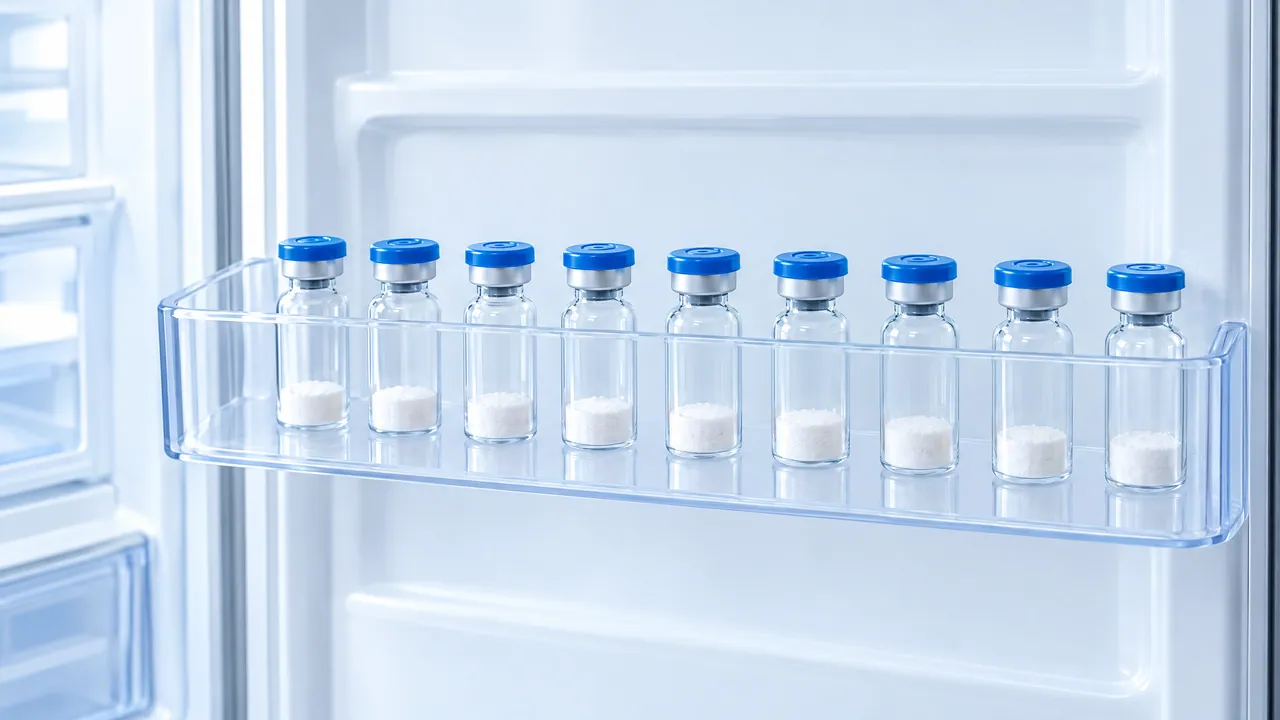
Before mixing the powder is robust, normal room temperature (around 20 to 25 degrees) is fine, ideally kept in the dark. After mixing, keep in the fridge (2 to 8 degrees), do not freeze. It stays good there for at least 4 to 6 months with barely any loss of potency, in practice considerably longer. Swirl or shake to mix, both are fine.

Shelf life

How long it keeps

Undissolved (powder) Room temperature, around 20 to 25 degrees, dark

Robust, no fridge needed. Keeps for several months without trouble.

Dissolved (mixed) Fridge, 2 to 8 degrees, do not freeze

At least 4 to 6 months with barely any loss of potency. The bacteriostatic water brings a preservative.

  • Keep it dark
  • Dissolved: 2 to 8 degrees
  • Note the mixing date on the vial
Nine vials with white powder and blue caps in the door shelf of a bright fridge
Powder dark at room temperature, once dissolved into the fridge (2 to 8 degrees), stable there for at least 4 to 6 months. Symbolic image.

Related

Related compounds

Same common ground or a different path: all in the TPD lexicon.

FAQ

Common questions about Vilon

Short answers, each backed by the sources below.

Is Vilon approved or studied in humans?

Not approved. As of 26 October 2026 ClinicalTrials.gov lists no trial with Vilon. PubMed has small Russian reports in patients, for example with diabetes, without registry entries and without figures in the abstract. The other data come from cell cultures, mice and rats.98

What is Vilon made of?

Of just two amino acids, lysine and glutamic acid, KE for short. According to the Khavinson concept it acts on the immune system. In the computer model KE bound to the transporter LAT1 more weakly than most other short peptides of the group.2

What do the mouse studies on lifespan show?

In a 2000 study mice given Vilon from the sixth month of life lived longer and developed spontaneous tumours less often. In a second study by the same group with Vilon and Epitalon, Vilon increased activity and reduced lung adenomas, while only Epitalon extended survival there.34

What is known about cancer?

In rats in which a carcinogen deliberately triggered bladder cancer, 56 percent with Vilon and 75.5 percent without had a tumour, precursors occurred half as often. This is an animal model. No statements about cancer in humans can be derived from it.5

What happens in cell experiments?

In young human stem cells the activity of the SIRT1 gene rose six-fold and the protein amount 8.2-fold. In monocytes after an inflammatory stimulus Vilon, like four other Khavinson peptides, lowered the messengers TNF and IL-6.76

Which side effects are known?

There are no solid human data because Vilon has never been tested in a registered trial. In mice the group describes no unfavourable effects of long-term use on development, which allows no statement on safety in humans.93

Glossary

Terms explained briefly

Dotted words in the text open these explanations directly.

Adenoma
A benign growth of glandular tissue, common in the lungs of old mice.
Bioregulator
The Khavinson group's term for short peptides meant to regulate tissue functions.
Dipeptide
A chain of exactly two amino acids. For Vilon lysine and glutamic acid.
Inflammatory messengers
Cytokines such as TNF and IL-6 that fuel inflammation.
Khavinson peptides
Short peptides from the St. Petersburg Institute of Bioregulation and Gerontology. Each is meant to target one specific tissue.
Lyophilisate
Freeze-dried powder. Without water a peptide keeps much longer.
Monocytes
White blood cells that develop into scavenger cells.
Preclinical
Studied in cells or animals, not yet in humans.
SIRT1
Sirtuin-1, a protein involved in DNA repair and ageing processes.
Subcutaneous
Into the fat layer just under the skin.

Evidence

Sources

Show all 9 sourcesHide sources 5 Studies1 Trial registry3 Database checked 26 Oct 2026

Studies

  1. Short peptides, their sequences and transport into the cell (review with docking)

    Khavinson et al., International Journal of Molecular Sciences, 2022

    Checked 26 Oct 2026 via doi.org, Crossref, PubMed, PMC
  2. Vilon, biological age and lifespan in mice

    Khavinson et al., Bulletin of Experimental Biology and Medicine, 2000

    Checked 26 Oct 2026 via doi.org, Crossref, PubMed
  3. Thymic and pineal peptide in ageing mice

    Anisimov et al., Mechanisms of Ageing and Development, 2001

    Checked 26 Oct 2026 via doi.org, Crossref, PubMed
  4. Vilon and induced bladder cancer in rats

    Pliss et al., Bulletin of Experimental Biology and Medicine, 2001

    Checked 26 Oct 2026 via doi.org, Crossref, PubMed
  5. Five Khavinson peptides and inflammation in monocytes

    Avolio et al., International Journal of Molecular Sciences, 2022

    Checked 26 Oct 2026 via doi.org, Crossref, PubMed

Trial registry

  1. Search on ClinicalTrials.gov (no trial with Vilon)

    ClinicalTrials.gov, U.S. National Library of Medicine

    Checked 26 Oct 2026 via ClinicalTrials.gov API v2

Database

  1. Review of peptides and ageing (PubMed record, journal without DOI)

    Khavinson, Neuro Endocrinology Letters, 2002

    Checked 26 Oct 2026 via PubMed
  2. KE and SIRT1, PARP1, PARP2 in human stem cells (PubMed record, without DOI)

    Khavinson et al., Advances in Gerontology, 2023

    Checked 26 Oct 2026 via PubMed
  3. Vilon in older people with diabetes (PubMed record, without DOI)

    Kuznik et al., Advances in Gerontology, 2007

    Checked 26 Oct 2026 via PubMed

In the shop

Vilon in the catalog

Sizes, prices and shipping times are on the product page.

To the product