What is DNP?
DNP stands for 2,4-dinitrophenol, a yellow industrial chemical that is also the historical prototype of the mitochondrial uncouplers. During the First World War it was handled in French munitions factories, where workers were poisoned and some died. In 1933 Maurice Tainter at Stanford University reported that taking it caused marked weight loss in humans. Soon afterwards DNP was sold over the counter as a slimming aid (Grundlingh, J Med Toxicol 2011).
The compound did not disappear because it failed to work. It disappeared because of deaths and rapidly developing cataracts. In 1938 the US classified DNP as extremely dangerous and not fit for human consumption. Many countries have banned it for human consumption since (Sousa, Arch Toxicol 2020). In research it remains a standard tool for studying oxidative phosphorylation. That is where it genuinely belongs.
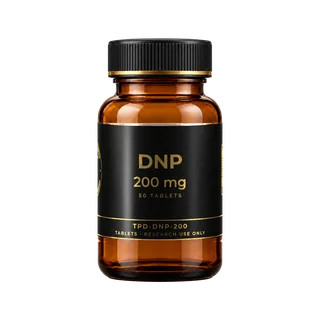
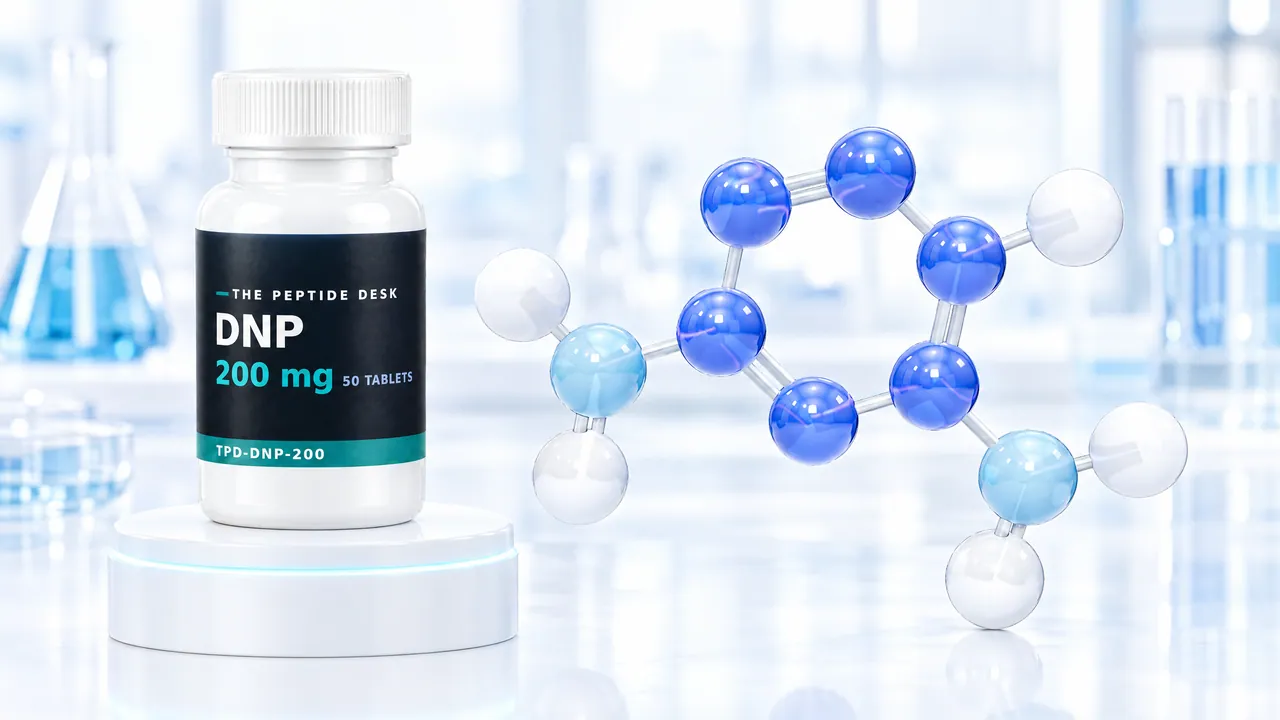
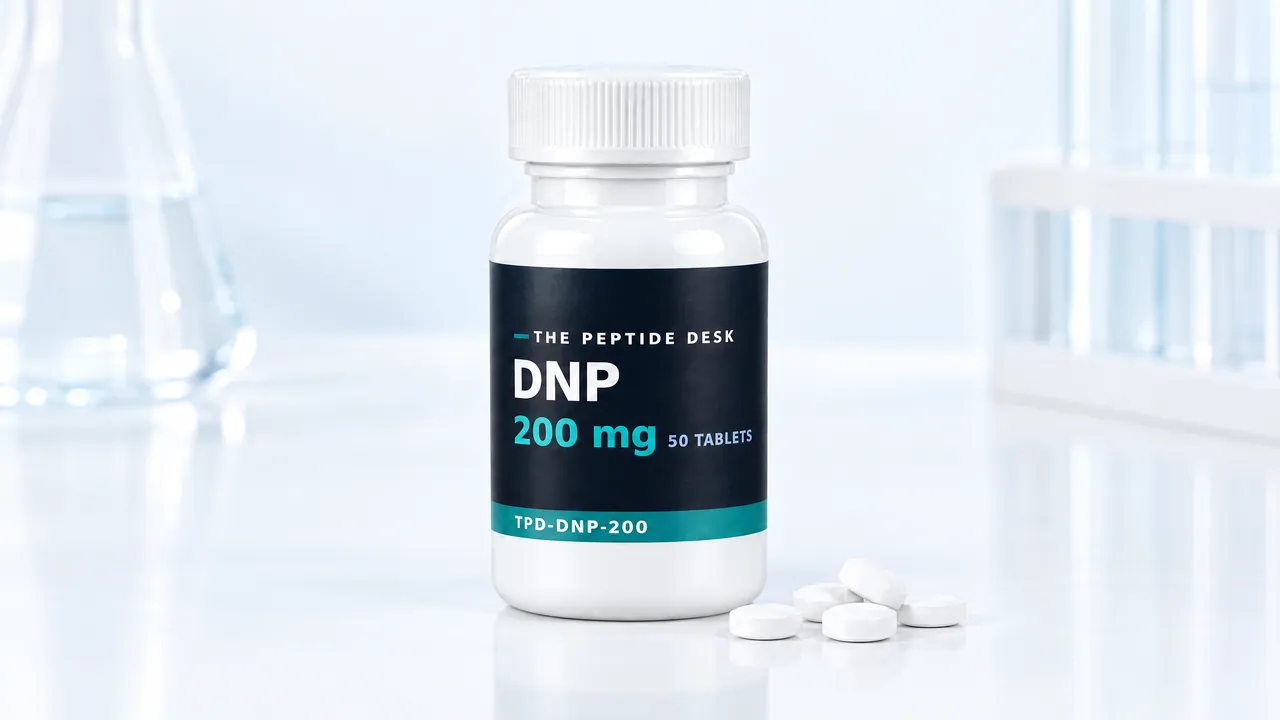
This entry is therefore built differently from the others: it gives no dose. The toxicology literature does not support any range that can be defended in humans. We do not invent one. In the range DNP comes as a tablet containing 200 mg, 50 tablets per tin.
This information is for research and educational purposes only. No medical advice.
Comparison
Uncouplers compared
DNP, BAM15 and the combo with SLU-PP-332, as described in the TPD lexicon. Tap a card to open its entry.
Simplified: all three act on the mitochondria. In its first description BAM15 did not depolarise the outer cell membrane. There is no comparison in humans. 85
How it works
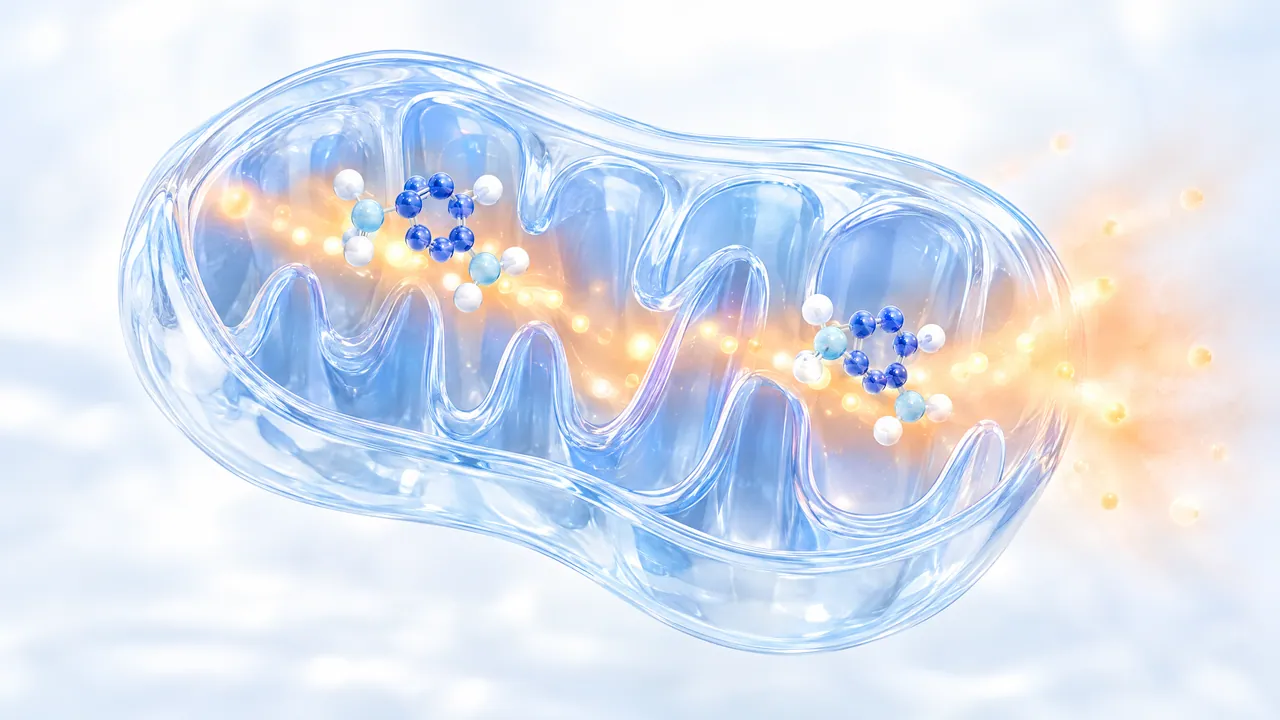
In cellular respiration, mitochondria pump protons out of the matrix and build a gradient across the inner membrane. When those protons flow back through ATP synthase, ATP is made, the energy currency of the cell. In the classic model DNP is a small, lipophilic molecule carrying a dissociable proton: it picks up a proton on the acidic outer side, crosses the membrane and releases it in the matrix.
That bypasses ATP synthase. The energy from oxidising fats and sugars is no longer packaged into ATP but released as heat. The cell registers the shortfall and raises turnover, burning more substrate for the same result. This uncoupling is a real and long established effect. It is why the substance looked so attractive historically.
The effect is neither organ specific nor adjustable. Every cell with mitochondria is affected. There is no receptor and no counterpart through which the body could push back. Recent work shows that transport proteins of the inner mitochondrial membrane, such as the ADP/ATP carrier and the uncoupling proteins, further amplify the protonophoric action. Exactly how uncoupling proceeds at the molecular level is still not fully resolved (Pohl and Jovanović, Eur Biophys J 2026).
Where it acts
What DNP does in the body
Tap a point or a card. Grey = observed in poisonings or trials. There is no receptor, every cell with mitochondria is affected.
- Heart
Racing heart in 43% of reported poisonings4
Observed in trials - Skin
Fever 47%, sweating 37%, discolouration or rash 23%4
Observed in trials - Lungs
Rapid breathing, breathing difficulties in 23%4
Observed in trials - Kidney
Acute kidney failure as part of the poisoning2
Observed in trials - Circulation
Falling blood pressure in poisoning2
Observed in trials - Liver
Converts the precursor HU6 into DNP, liver fat down to -35.6%6
Observed in trials
Why the safety window is so narrow
With most substances there is a buffer between the amount that does something and the amount that does harm. With DNP that buffer was already described as small when doctors prescribed it in the 1930s. Its width cannot be predicted for an individual. Grundlingh and colleagues describe substantial variation in individual response: the same amount can act very differently in two people (J Med Toxicol 2011).
Poisoning runs through exactly the mechanism that produces the effect. When too much heat is released, body temperature rises faster than the body can shed it through sweating and breathing. Past a certain point the process reinforces itself, because metabolic rate climbs further with temperature. There is no way to switch the uncoupling off from outside. There is no specific antidote either (Sousa, Arch Toxicol 2020).
The second point is slow elimination. In case reports it stretched over several days, so repeated doses can add up: an amount that passes without consequence on one day can, together with what is left from previous days, reach the critical range. In the UK series 16 of 30 cases involved repeated intake over days to a few weeks and 12 a single overdose (Kamour, Emerg Med J 2014). Heat, physical exertion, warm surroundings and too little fluid additionally block the very routes by which the body sheds that heat.
Use and dosing
Dosing
Dosing, titration and syringe
Loading the dosing information …
- Getting started and stepping up, drawn as a staircase
- Units on the U-100 syringe for every step
- How long one vial lasts
What the research shows
Grundlingh and colleagues (J Med Toxicol 2011) collected the published cases and counted 62 deaths documented in the medical literature. They describe a consistent picture of hyperthermia, tachycardia, heavy sweating and rapid breathing that can end in death. Even for the medical use of the 1930s, they note that the wanted and the toxic effects lie close together.
Gziut and Thomas (Clin Toxicol 2021) worked with the WHO to contact poisons centres worldwide and received data from 38 countries on 456 exposure cases between January 2010 and September 2020. Annual cases rose from 4 in 2010 to 71 in 2015 and still stood at 53 in 2019. Where the outcome was known, 11.9 percent of cases were fatal, with no significant difference between women and men. The authors describe fatal outcomes as common.
Kamour and colleagues (Emerg Med J 2014) analysed reports to the UK National Poisons Information Service from 2007 to 2013: 30 cases, 22 of them in 2013 alone, 27 of them men, median age 23.5 years. The most common features were fever in 47 percent, tachycardia in 43 percent and sweating in 37 percent, alongside nausea or vomiting, skin discolouration or rash, breathing difficulty and abdominal pain. Five of the 30 cases were fatal, four of them after an acute overdose.
Sousa and colleagues (Arch Toxicol 2020) summarise the current position: hyperthermia, tachycardia, falling blood pressure and acute renal failure as the core picture of poisoning, a 2015 warning from the Interpol anti-doping unit and no specific antidote or treatment available. Pohl and Jovanović (Eur Biophys J 2026) place the mechanism in context and name the open problem: until the molecular detail of uncoupling is properly understood, there is neither a mechanism based antidote nor a safer successor.
Study results
What the trials measured
Interactive: switch tabs, tap points, show or hide arms. Arms are named relative to each other, no dosing advice.
Most common signs in DNP poisonings4
Share of 30 cases in percent, UK National Poisons Information Service 2007 to 2013
Plus abdominal pain in 23 percent, agitation and headache in 13 percent each. 27 of the 30 people were men, median age 23.5 years. These signs are not a sign of effect but the picture of poisoning.
Share of fatal outcomes34
In percent of cases, two analyses of poisons centre data
Internationally the number of cases rose from 4 in 2010 to 71 in 2015 and was still 53 in 2019. In the UK four of the five deaths followed an acute overdose.
Liver fat after 61 days with the precursor HU66
Relative change in percent, 80 adults with fatty liver and overweight, phase 2a
The trial tested HU6, not DNP: a precursor that the liver converts into DNP. No serious adverse events and no deaths occurred in this trial.
HU6 in heart failure with obesity7
Difference from placebo after 19 weeks in kg, 66 participants, phase 2a
Without significant loss of muscle mass. Exercise capacity (oxygen uptake), walking distance and quality of life did not change significantly. Serious events in 4 people on HU6 and 1 on placebo, judged unrelated to treatment by the trial.

Research status
Where the research stands
The registry lists no trial with free DNP. Only the precursor HU6 (phase 1 and 2) is being tested, which the liver converts into DNP. As of 26 Oct 2026. 9
- Preclinical Standard tool of mitochondrial research
- Phase 1 no registered trial
- Phase 2 no registered trial
- Phase 3 no registered trial
- Approval not yet
So far there is no registered trial in humans. 9
Side effects
DNP has the narrowest safety window in the entire range. The framing belongs ahead of any list: the central risk is not a side effect but death from hyperthermia. No antidote exists.
- Fatal hyperthermia. The central danger mechanism. Body temperature rises faster than the body can shed it. The process reinforces itself. In the international poisons centre analysis just under 12 percent of cases with a known outcome were fatal. In the UK analysis it was 5 of 30.
- Heart and circulation. Tachycardia is among the most common signs. Blood pressure falls as poisoning progresses.
- Kidneys. Acute renal failure is described as part of the poisoning picture.
- Common signs. Fever, heavy sweating, rapid breathing or breathlessness, nausea, abdominal pain, agitation and headache, plus yellow discolouration of the skin, the whites of the eyes and the urine. These signs are not the body getting used to it, they can be the start of poisoning.
- From medical use in the 1930s. Rashes as the most common side effect, rapidly developing cataracts usually with permanent loss of vision, prolonged nerve inflammation in the hands and feet, a dangerous drop in white blood cells (agranulocytosis) and in some cases permanent deafness.
- Amplifiers. Sauna, intense training, heat and too little fluid raise the danger markedly, because they impede heat loss. With repeated intake the compound can build up. In the UK case series repeated intake was more common than a single overdose.
As early as 1938 the US classified DNP as extremely dangerous and not fit for human consumption. The current toxicology literature reaches the same conclusion. For questions about metabolism, research offers approaches with a far better studied safety profile. This classification does not replace medical advice.
Emergency. Fever, a feeling of overheating, a racing heart or confusion after taking DNP are an emergency: call emergency services straight away (112 in the EU, the local emergency number elsewhere), cool the body until the ambulance arrives and tell the paramedics explicitly that DNP is involved.
Tolerability
Tolerability of the precursor HU6
There is no trial with free DNP, only poisoning cases. The only controlled frequencies come from the trial with the precursor HU6 over 61 days.
All HU6 levels combined. Three people on HU6 and two on placebo stopped because of side effects. No serious adverse events. These values apply to the controlled-release precursor, not to DNP tablets.6
Storage
Store dry, at room temperature, protected from light and away from heat sources, keep the tin closed and mind the expiry date. Do not keep it in the bathroom, the humidity there degrades tablets.
With this substance storage means more than usual: keep it strictly separate from everything else and unmistakably labelled, never decanted into an unlabelled container. Mix-ups cannot be corrected for a compound that has no antidote.
Keep out of reach of children and pets and do not put it in household waste. Leftovers belong at a hazardous waste collection point.