What is BAM15?
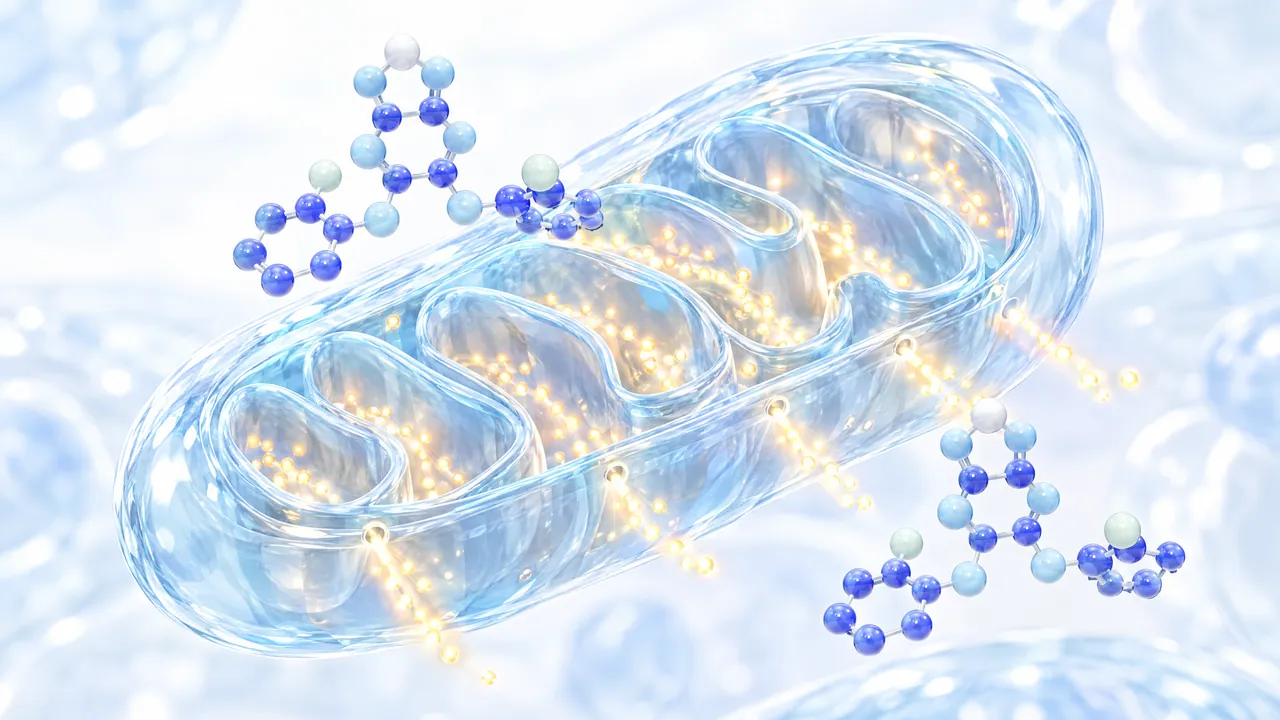
BAM15 is a synthetic mitochondrial uncoupler. It acts as a protonophore: lets protons flow across the inner mitochondrial membrane without ATP being produced. The energy is dissipated as heat instead - metabolism accelerates.
Same principle as DNP (dinitrophenol), with one difference: BAM15 acts on the mitochondrial membrane and, unlike DNP, does not depolarize the cell's plasma membrane (Kenwood 2014). In cell and animal studies BAM15 was well tolerated; it has not been studied in humans.
How it works
In mitochondria a proton gradient is normally built up that ATP synthase then uses to produce ATP. BAM15 opens an alternative path - protons flow back without making ATP.
Consequence: mitochondria have to work harder to maintain the gradient. More substrate is burned, more heat produced, basal metabolic rate rises markedly. Body weight drops - mostly fat mass.
Where it acts
Where BAM15 acted in experiments
Tap a point or a card. Colour = target, grey = observed. All from cell and mouse studies.
- Liver
Main target: more respiration and fat breakdown, liver fat back to normal on a high-fat diet (mice)1
Mitochondria - Fat tissue
Less fat mass and smaller fat depots at the same food intake (mice)1
Observed in trials - Skeletal muscle
More muscle share and grip strength in old obese mice4
Observed in trials - Blood and blood sugar
Lower triglycerides, better insulin action in the clamp test (mice)1
Observed in trials - Kidney
Protection from acute kidney injury after blocked blood flow and in sepsis (mice)5
Observed in trials
BAM15 vs DNP
DNP is the historical uncoupler: known as a slimming agent since the 1930s, with documented deaths from hyperthermia and no antidote. What sets BAM15 apart in the studies:
- Plasma membrane: besides the mitochondria, DNP also depolarizes the cell's plasma membrane; BAM15 does not (Kenwood 2014).
- Concentration range in cells: in mouse liver cells BAM15 raised cellular respiration at a roughly sevenfold lower concentration than DNP and kept it high across a broad range. DNP inhibited respiration above 30 µM (Alexopoulos 2020).
- Body temperature in mice: BAM15 reduced fat mass without changing body temperature (Alexopoulos 2020).
All of these data come from cells and mice. There is no direct comparison in humans. There are no human studies of BAM15 at all. Whether the wider window from the lab holds in humans is an open question.
Comparison
Uncouplers compared
DNP, BAM15 and the combo with SLU-PP-332, as stated in the TPD lexicon. Tap a card to open its entry.
Simplified: all three act on the mitochondria. DNP also acts on the outer cell membrane, BAM15 does not in cell experiments. There is no comparison in humans. 21
How to take it
Oral capsule, once per day.
- 1 capsule with some water.
- Better tolerated with food.
- Ideally in the morning - mildly activating.
Dosing
Dosing
Dosing, titration and syringe
Loading the dosing information …
- Getting started and stepping up, drawn as a staircase
- Units on the U-100 syringe for every step
- How long one vial lasts
What the research shows
BAM15 is a preclinical research tool:
- Kenwood et al. 2014: first characterization as mitochondrial uncoupler, less cytotoxic in cell cultures than the reference uncoupler FCCP.
- Alexopoulos et al. 2020: clear fat reduction in mouse models without hyperthermia, plus improved insulin sensitivity and fatty liver.
Human studies are missing entirely. Everything is research frontier.
Study results
What the trials measured
Interactive: switch tabs, tap points, show or hide arms. Arms are named relative to each other, no dosing advice.
Mice on a high-fat diet1
Change compared with mice on the same diet without BAM15, in percent
Values from the results section of the study (full text). Liver triglycerides with BAM15 were back at the level of mice on normal chow. Body temperature, lean mass and liver enzymes did not change. Mouse model, not tested in humans.
More energy use, more fat burning1
Rise compared with the comparison without BAM15, in percent
The mice did not move more, so the extra energy use does not come from more activity. Muscle and fat tissue showed no clear rise in respiration, BAM15 was distributed mainly to the liver.
Old obese mice, 10 weeks4
Difference from the group without BAM15 at the end, in percent (calculated from the means in the abstract)
Mice aged 80 weeks on a high-fat diet. The abstract gives the means of both groups (for example 54.0 versus 42.3 g body weight), the percentages are calculated from them. Muscle share of the body rose from 52.7 to 59.4 percent.
Research status
Where the research stands
Where the compound stands on the way from lab research to approval. As of 25 Oct 2026. 8
Side effects
- Body temperature: unchanged in mice, not studied in humans. As an uncoupler BAM15 releases energy as heat, so watch for overheating.
- Elevated heart rate: reflects higher basal metabolic rate.
- Sweating: classic uncoupling symptom.
- Thirst: more fluid needed due to higher heat production.
Storage
Store dry and cool, out of reach of children.